

Aiming to Make CO₂ Storage Safer and More Predictable
What happens to CO₂ when it is stored underground, and how do we know it will stay there? Professor Jan Martin Nordbotten from the Department of Mathematics and Martin Fernø from the Department of Physics and Technology have been awarded NOK 40 million by the Research Council of Norway to establish a leading research centre developing new methods to make CO₂ storage safer and more predictable.
By: Ina Hilton
Published:

The new flagship research project DAISy builds on the work of the FluidFlower research team, led by Nordbotten and Fernø. The six-year project will bring together researchers in applied mathematics, reservoir physics, geology, data science and education research at the University of Bergen (UiB). DAISy will also collaborate with research teams across five continents.
Understanding What Happens to CO₂ Over Time
Through laboratory experiments, data science and advanced modelling, the researchers will develop improved methods for understanding and predicting how CO₂ moves and is stored in geological formations.
Nordbotten explains that one of the project's main objectives is to better understand how findings from laboratory experiments can be used to predict what happens underground on a much larger scale.
Our aim is to investigate what we learn in the laboratory and how we can transfer that knowledge to predict what will happen underground on a much larger scale. We hope to gain a better understanding of what happens to CO₂ over long periods of time
The DAISy project will investigate how millions of years of geological processes have shaped the subsurface and how this affects the movement and storage of CO₂. The researchers will also study the conditions under which CO₂ can form hydrates, which could potentially act as an additional barrier against leakage.
From the Laboratory to Real-World Conditions
One of the project's most ambitious goals is to further develop the FluidFlower methodology to enable experiments that more closely replicate the conditions found in underground CO₂ storage sites. The researchers plan to deploy a DeepSea-FluidFlower setup in a Norwegian fjord. At depths of several hundred metres, they will study CO₂ processes under realistic pressure and temperature conditions.
Mathematical models and image analysis will be used to analyse the results, providing a framework for transferring knowledge from laboratory-scale experiments to real-world CO₂ storage sites. The tools and models developed through DAISy will be made available to other research groups so that they can test and further develop the findings.
In the long term, this knowledge could benefit public authorities and companies planning to implement CO₂ storage. It could also make it easier to assess the safety of a technology that plays a role in the energy transition.
If we can develop better tools to identify areas suitable for CO₂ storage more reliably and safely, it will become easier and safer for industry to use the technology
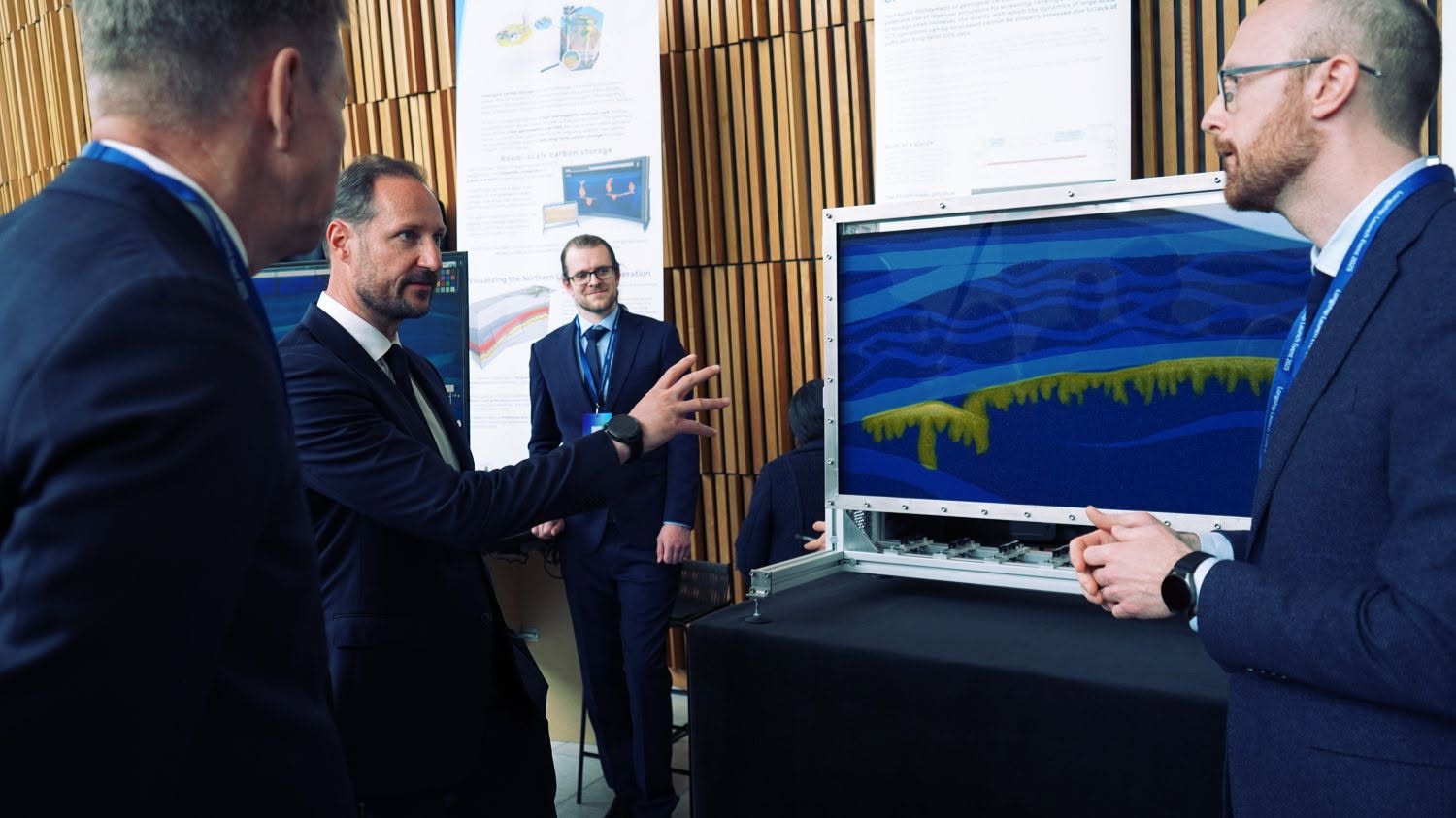
Professor Martin Fernø demonstrates the virtual FluidFlower laboratory to His Royal Highness Crown Prince Haakon in 2025.
Aiming to reach school students
FluidFlower will also be used to explain young people how CO₂ storage works. At the University of Bergen this methodology is already being used in an educational programme developed in collaboration with the University Museum. Around 1,000 students in Bergen take part in the programme each year. Through DAISy, there will be developed a smaller and more portable version, called “mini-flower”. The educational programme will also be expanded and refined, making it easier for more schools, science centres and museums to adopt it.
– We want to make the educational programme available to students in other countries through our international partners across five continents, Fernø tells enthusiastically.
DAISy will not only communicate research to students. The project will also examine how practical experiments influence students’ learning, interest in science and confidence in their own abilities in STEM subjects, science, technology, engineering and mathematics. The effect will be followed up over time.
– We hope students will gain a better understanding of how STEM subjects can be used to develop methods and tools to look at specific research questions. We also hope to spark their interest in science and that they will enjoy doing practical experiments, Fernø says.
The international educational initiative builds on an established collaboration centered around FluidFlower. In 2025, Fernø was invited to join the UNESCO Chair in Green Transition for Carbon Neutrality and Climate Change. The Network brings together institutions from around the world, with education, research collaboration, and knowledge sharing among its key objectives.
Training the next generation of researchers
In addition to funding new experiments, the grant will finance five PhD positions and two postdoctoral positions. The project also aims to involve more than 30 master’s students at UiB. Together, these efforts will help train a new generation of researchers with expertise in geological CO₂ storage, experimental methods and mathematical modelling.
Related content
- Kristian Smeland Ytre-Hauge has been awarded funding to conduct research on proton therapy.
- Professor Martin Fernø Joins UNESCO Chair in Green Transition for Carbon Neutrality and Climate Change
- Will have the opportunity to carry out ambitious research projects on climate change, artificial intelligence, and the future of work at sea.