

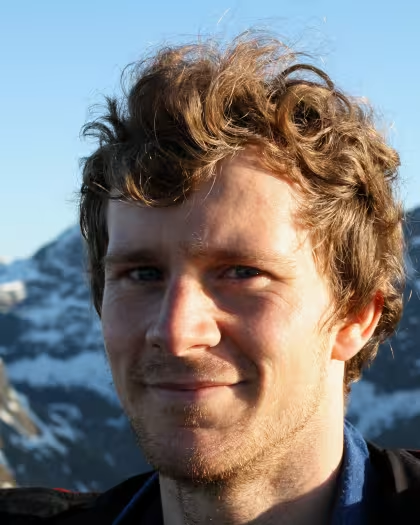
Oliver Müller
Stilling
Forsker, Arktisk marin mikrobiell økologi
Tilhørighet
- E-post
- oliver.muller@uib.no
- Besøksadresse
-
Thormøhlens gate 53 A/B
5006 Bergen - Postadresse
-
Postboks 7803
5020 Bergen
Følg meg
Oliver Müller
Stilling
Forsker, Arktisk marin mikrobiell økologi
Tilhørighet
Formidling
Blogg post/article:
https://blogg.forskning.no/arktis-arven-etter-nansen-havforskning/a-jobbe-med-det-usynlige---eller-hvorfor-fotografen-ikke-tar-bilder-av-arbeidet-vart/1370083
https://www.studvest.no/forskning-pa-verdens-ende/
Undervisning
Undervisningsemner:
- Mikobiell Økologi (BIO217)
- Organismebiologi - Mikrobiologi (BIO101)
- Utvalgte emner i mikrobiologi (BIO315)
Publikasjoner
2025
- Akino, Ryota; Nomura, Daiki; Webb, Alison et al. (2025). Melt Pond Nutrient Dynamics and Their Relationship With Melt Pond Bottom Ice in the Central Arctic Ocean. (ekstern lenke)
- Gawornu, Benjamin Dziedzorm; Yeboah, Justice; Müller, Oliver et al. (2025). Microbial responses to crude oil and cadmium pollution in a tropical coastal environment, Gulf of Guinea. (ekstern lenke)
- Boulton, William; Salamov, Asaf; Grigoriev, Igor V. et al. (2025). Metagenome-assembled-genomes recovered from the Arctic drift expedition MOSAiC. (ekstern lenke)
- Digernes, Maria Guadalupe; Bodur, Yasemin Vicdan; Arumí, Martí Amargant et al. (2025). Contrasting seasonal patterns in particle aggregation and dissolved organic matter transformation in a sub-Arctic fjord. (ekstern lenke)
- Kohlbach, Doreen; Fransson, Agneta; Arumí, Martí Amargant et al. (2025). Nansen and Amundsen basins: Gradients of physico-chemical properties and biota composition with implications for future resource management of the central Arctic Ocean. (ekstern lenke)
- Digernes, Maria Guadalupe; Hawkes, Jeffrey A.; Müller, Oliver et al. (2025). Variation in chemical composition of dissolved organic matter during the winter to spring transition in the northern Barents Sea. (ekstern lenke)
2024
- Granskog, Mats; Müller, Oliver (2024). A peek beneath the surface of Arctic sea ice. (ekstern lenke)
- Hoppe, Clara J. M.; Fuchs, Niels; Notz, Dirk et al. (2024). Photosynthetic light requirement near the theoretical minimum detected in Arctic microalgae. (ekstern lenke)
- Beck, Ivo; Moallemi, Alireza; Heutte, Benjamin et al. (2024). Characteristics and sources of fluorescent aerosols in the central Arctic Ocean. (ekstern lenke)
- Kohler, Stephen Gustav; Heimbürger-Boavida, Lars-Eric; Assmy, Philipp Kurt Wolf et al. (2024). Biotic transformation of methylmercury at the onset of the Arctic spring bloom. (ekstern lenke)
- Müller, Oliver; Gardner, Jessie; Olsen, Lasse et al. (2024). Arctic Sea ice ridges: Complex havens of biodiversity with astonishing community changes from ridge formation to melting and summer consolidation. (ekstern lenke)
- Fransson, Agneta; Bluhm, Bodil Annikki Ulla Barbro; Kohlbach, Doreen et al. (2024). Nansen vs. Amundsen Basin: Constrasting physico-chemical properties and biota composition to inform management. (ekstern lenke)
- Fong, Allison A.; Hoppe, Clara J. M.; Aberle-Malzahn, Nicole et al. (2024). Overview of the MOSAiC expedition: Ecosystem. (ekstern lenke)
- Gawinski, Christine; Daase, Malin Hildegard Elisabeth; Primicerio, Raul et al. (2024). Response of the copepod community to interannual differences in sea-ice cover and water masses in the northern Barents Sea. (ekstern lenke)
2023
- Müller, Oliver (2023). The unexpected roles of sea-ice ridges for Arctic ecosystems in winter and summer. (ekstern lenke)
- Gardner, Jessie; Reigstad, Marit; Gradinger, Rolf Rudolf et al. (2023). Are particle fluxes below pressure ridges greater than below first-year ice in the central Arctic Ocean winter and summer?. (ekstern lenke)
- Salganik, Evgenii; Katlein, Christian; Lange, Benjamin et al. (2023). Temporal evolution of under-ice meltwater layers and false bottoms and their impact on summer Arctic sea ice mass balance. (ekstern lenke)
- Friesen, Lisa W Von; Paulsen, Maria Lund; Müller, Oliver et al. (2023). Glacial meltwater and seasonality influence community composition of diazotrophs in Arctic coastal and open waters. (ekstern lenke)
- Bodur, Yasemin Vicdan; Digernes, Maria Guadalupe; Arumi, Marti Amargant I et al. (2023). Increased DOM lability and depletion of the POM inventory during winter in an Arctic fjord (Ramfjord, Tromsø). (ekstern lenke)
- Thiele, Stefan; Vader, Anna; Thomson, Stuart et al. (2023). Seasonality of the bacterial and archaeal community composition of the Northern Barents Sea. (ekstern lenke)
- Gradinger, Rolf Rudolf; Arumi, Marti Amargant I; Assmy, Philipp Kurt Wolf et al. (2023). Ranges of Annual Production in the Barents Sea along Environmental Gradients. (ekstern lenke)
- Lange, Benjamin Allen; Salganik, Evgenii; Macfarlane, Amy et al. (2023). Snowmelt contribution to Arctic first-year ice ridge mass balance and rapid consolidation during summer melt. (ekstern lenke)
- Gawinski, Christine; Daase, Malin Hildegard Elisabeth; Primicerio, Raul et al. (2023). Are small copepods the winners of an ice free Barents Sea?. (ekstern lenke)
- Arumi, Marti Amargant I; Müller, Oliver; Bodur, Yasemin Vicdan et al. (2023). Interannual differences in sea ice regime in the north-western Barents Sea cause major changes in summer pelagic production and export mechanisms. (ekstern lenke)
- Smith, Madison M.; Angot, Hélène; Chamberlain, Emelia J. et al. (2023). Thin and transient meltwater layers and false bottoms in the Arctic sea ice pack - Recent insights on these historically overlooked features. (ekstern lenke)
- Müller, Oliver (2023). Microbial Communities in the Future Central Arctic Ocean – What Can We Learn From Present Observations and What’s Next?. (ekstern lenke)
- Salganik, Evgenii; Müller, Oliver; Olsen, Lasse Mork et al. (2023). Hidden in Plain Sight – New Insights on Arctic Sea-Ice Ridges from the MOSAiC Expedition – an Overview. (ekstern lenke)
- Arumi, Marti Amargant I; Müller, Oliver; Bodur, Yasemin Vicdan et al. (2023). Lower trophic level carbon fluxes in two summers of contrasting ice conditions. (ekstern lenke)
- Müller, Oliver; Bratbak, Gunnar; Paulsen, Maria Lund (2023). Increased organic matter input. Testing bacterial responses in Arctic fjords vs Barents Sea. (ekstern lenke)
- Kohlbach, Doreen; Goraguer, Lucie; Bodur, Yasemin V. et al. (2023). Earlier sea-ice melt extends the oligotrophic summer period in the Barents Sea with low algal biomass and associated low vertical flux. (ekstern lenke)
- Steinrücken, Pia; Jackson, Steve Sofsrud; Müller, Oliver et al. (2023). A closer look into the microbiome of microalgal cultures. (ekstern lenke)
- Steinrücken, Pia; Müller, Oliver; Böpple, Hanna et al. (2023). Insect frass as a fertilizer for the cultivation of protein-rich Chlorella vulgaris. (ekstern lenke)
- Gawinski, Christine; Daase, Malin Hildegard Elisabeth; Primicerio, Raul et al. (2023). Are small copepods the winners of an ice free Barents Sea?. (ekstern lenke)
- Thiele, Stefan; Vader, Anna; Thomson, Stuart et al. (2023). The summer bacterial and archaeal community composition of the northern Barents Sea. (ekstern lenke)
- Steinrücken, Pia; Müller, Oliver; Böpple, Hanna et al. (2023). Insect frass as a fertilizer for cultivation of protein-rich Chlorella vulgaris. (ekstern lenke)
2022
- Olsen, Lasse Mork; Müller, Oliver; Thingstad, T. Frede et al. (2022). How carbon flow is controlled by microbial predator-prey interactions along a productivity gradient in the Barents Sea. (ekstern lenke)
- Mock, Thomas; Boulton, William; Balmonte, John-Paul et al. (2022). Multiomics in the central Arctic Ocean for benchmarking biodiversity change. (ekstern lenke)
- Jones, Elizabeth Marie; Reigstad, Marit; Espinel, Nadjejda et al. (2022). JC2-1 Joint cruise part 1 2021 : Cruise Report. (ekstern lenke)
- Reigstad, Marit; Gabrielsen, Tove M.; Amargant-Arumi, Marti et al. (2022). Seasonal Cruise Q3: Cruise Report. (ekstern lenke)
- Gerland, Sebastian; Wold, Anette; Al-Habahbeh, Amalia Keck et al. (2022). Seasonal Cruise Q1 2021: Cruise Report. (ekstern lenke)
Se en full oversikt over publikasjoner i Cristin
Articles in peer-reviewed journals:
- Müller O, Wilson B, Paulsen ML, Rumińska A, Armo HR, Bratbak G, Øvreås L (2018). Spatiotemporal dynamics of ammonia-oxidizing Thaumarchaeota in distinct Arctic water masses. Front. Microbiol. 9:24. doi: 10.3389/fmicb.2018.00024
- Müller O, Bang-Andreasen T, White III RA, Elberling B, Taş N, Kneafsey T, Jansson JK, Øvreås L (2018). Disentangling the complexity of permafrost soil by using high resolution profiling of microbial community composition, key functions and respiration rates. Environ. Microbiol. doi:10.1111/1462-2920.14348.
- Müller O, Seuthe L, Bratbak G, Paulsen ML (2018) Bacterial response to permafrost derived organic matter input in an Arctic fjord. Front. Mar. Sci. 5. doi:10.3389/fmars.2018.00263.
- Paulsen ML, Müller O, Larsen A, Møller EF, Sejr MK, Middelboe M, and Stedmon CA (2018). Biological transformation of Arctic dissolved organic matter in a NE Greenland fjord. Limnol. Oceanogr.10.1002/lno.11091
- Wilson B, Müller O, Nordmann EL, Seuthe L, Bratbak G and Øvreås L (2017). Changes in marine prokaryote composition with season and depth over an Arctic polar year. Front. Mar. Sci. 4:95. doi: 10.3389/fmars.2017.00095
- Paulsen ML, Nielsen SEB, Müller O, Møller EF, Stedmon CA, Juul-Pedersen T, Markager S, Sejr MK, Delgado Huertas A, Larsen A, Middelboe M. (2017) Carbon Bioavailability in a High Arctic Fjord Influenced by Glacial Meltwater, NE Greenland. Front. Mar. Sci. 4: 176. doi:10.3389/fmars.2017.00176.
- Paulsen M L, Doré H, Garczarek L, Seuthe L, Müller O, Sandaa RA, Bratbak G, and Larsen A (2016). Synechococcus in the Atlantic Gateway to the Arctic Ocean. Front. Mar. Sci. 3: 191. doi: 10.3389/fmars.2016.00191
- Harig L, Beinecke F, Oltmanns J, Muth J, Müller O, Rüping B, Twyman R, Fischer R, Prüfer D and Noll G (2012). Proteins from the FLOWERING LOCUS T-like subclade of the PEBP family act antagonistically to regulate floral initiation in tobacco. The Plant Journal, Volume 72, Issue 6, pages 908–921, December 2012, doi: 10.1111/j.1365-313X.2012.05125.x.
PhD thesis:
- Müller O (2018) Implications of a changing Arctic on microbial communities: Following the effects of thawing permafrost from land to sea (http://bora.uib.no/handle/1956/18525)
Prosjekter
Arven etter Nansen - The Nansen Legacy (https://arvenetternansen.com)
RF3 - The living Barents Sea
The knowledge of the structure and function of the ecosystem of the northern Barents Sea and adjacent slope to the central basin is strikingly unequal compared to the regular surveyed southern Barents Sea. Yet, the most radical changes in the physical environment are observed in the northern parts of the Barents Sea, where sea ice retreat and increasing water temperatures are reshaping the ecosystem.
Hypothesis: The ecosystems of the northern (Arctic-influenced) Barents Sea and adjacent slope and basin areas function fundamentally differently from the much better understood southern (Atlantic-influenced) region.
The work package The living Barents Sea investigates how organisms in the northern Barents Sea and adjacent slope respond to current and changing environmental conditions on the species and community levels by identifying characteristic communities, by delineating the relevant environmental forcing factors that structure these communities across seasons and habitats. Estimating the production and rate-limiting factors of these organisms, as well as entangling their detailed trophic linkages, is yet another focus of this work package. More concretely, the work package addresses the following tasks:
- Characterize biological communities in sympagic, pelagic and benthic realms in the seasonal ice zone of the northern Barents Sea and adjacent slope of the Arctic Basin in terms of biodiversity, abundance, biomass and distribution patterns in relation to environmental forcing, in particular sea ice
- Investigate the timing of critical biological processes including primary and secondary production, phenology of life cycles, and related processes and test how changing conditions may affect these seasonal patterns across several trophic levels
- Characterize the total annual production from microbes to fish along latitudinal and environmental gradients, identify production hot spots and how condition-specific variability in life history traits affect these
- Characterize lower trophic level food web structure and links to consumers including top predators, carbon cycling, and biological interactions, and investigate selected regulating factors
Ridges - Safe HAVens for ice-associated Flora and Fauna in a Seasonally ice-covered Arctic(HAVOC - https://www.npolar.no/en/projects/havoc/)
HAVOC will study the role sea ice ridges play in the thinner ice pack in the Arctic Ocean. While the ice is getting thinner, the thicker parts of the ice cover are most likely to survive summer melt and provide the last habitat for ice-associated flora and fauna. The project will take part in the MOSAiC expedition.