

CET Lunch: Willing to Pay for the Green Transition? The Role of Social Assistance and Temporary Energy Support
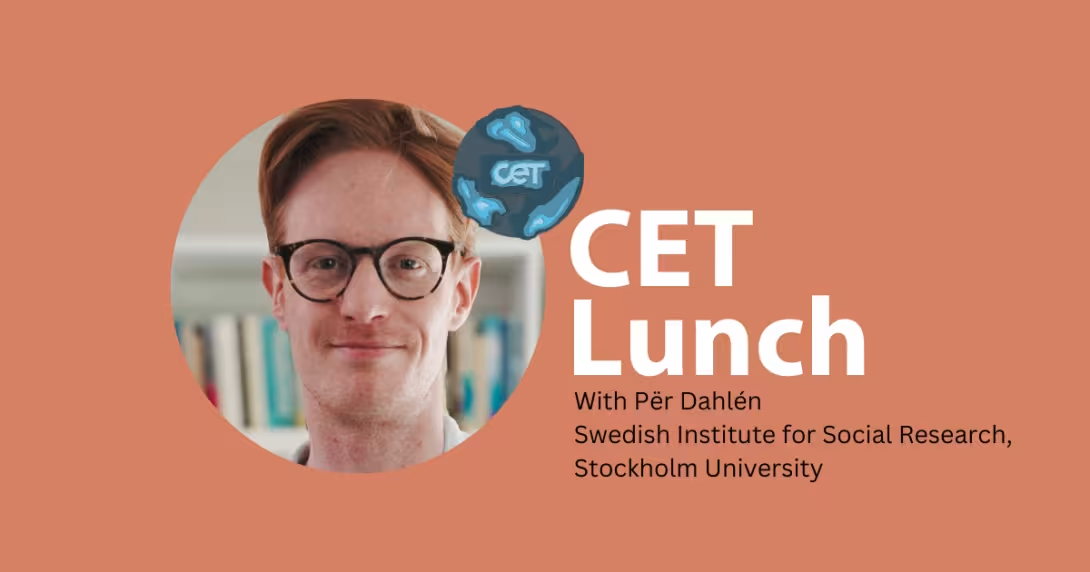
Welcome to this CET Lunch seminar with Për Dahlén, PhD Candidate at the Swedish Institute for Social Research, Stockholm University.
The energy transition has become increasingly contentious in European politics, particularly following the energy crisis beginning in 2021. While citizens often support renewable energy in principle, concerns about affordability reduce their willingness to accept higher energy prices, creating a central policy dilemma for governments. This study examines two welfare state instruments—means-tested social assistance and targeted temporary energy support—that may enable public support for higher energy prices during crisis conditions. Drawing on Eurobarometer 97.4 survey data combined with macro-level indicators from the OECD Energy Price Tracker and the Social Policy Indicators database across 24 countries, the study applies multilevel regression analysis to test these relationships. The theoretical framework builds on welfare state research, suggesting that social assistance alleviates economic hardship by raising the income floor, while temporary energy support cushions households most exposed to price shocks. Preliminary findings indicate that means-tested social assistance increases willingness to support higher energy prices for the energy transition, whereas targeted energy support shows no significant effect. These results highlight the importance of identifying which specific welfare state policies can foster public acceptance of costly but necessary decarbonisation measures.
About the speaker
I am a PhD Candidate at the Swedish Institute for Social Research (SOFI), Stockholm University. My comparative research focuses on how welfare states can mitigate the unequal burdens of climate policy while fostering public support for a green transition.
About CET Lunch seminars
When and where
Wednesdays 12.15 - 13.00.
Meeting room Rio - 4.17, 4th floor, Christies gt 18 (external link)
About the seminars
Enjoy some interdisciplinary knowledge on climate and energy transformation while eating your lunch. Each meeting consists of a 20-minute presentation from a researcher affiliated with CET, a guest researcher visiting the centre, or other interesting people we meet while conducting research. The presentation is followed by 20 minutes of questions and discussion.
CET Lunch seminars are open for anyone interested.
Our seminars are hybrid. We encourage speakers and participants to join us at the CET offices. The seminars will be streamed so participants can join us from near and far.
Lunch will be served on a first-come first-served basis.
If you want to be on our mailing list (or unsubscribe) and receive information including the link to our upcoming seminars, please contact Judith R. Dalsgård.