

Integration for Health
This project has two main aims: First, to study the intertwined development of integration and health in a new home country among forced migrants in a trajectory perspective using both quantitative and qualitative methods. Second, to study the effect of an innovative labour-related intervention on the health and integration of health professionals with refugees with other migrant backgrounds as well as the impact on their families and the institutions opening their doors to this group

About the research project
Integration as a way to reducing health inequalities among forced migrants: A collaborative and knowledge building project
Aims of the study
The project has the ambition to prospectively study measures and services targeting one of the most vulnerable population groups – forced migrants. There is a need to join efforts to better understand the complex interactions between integration and health, including welfare and labour perspectives, to be able to address one of Norway’s main societal challenge: the need to reduce inequalities in health for refugees and their families and to integrate them in a meaningful way in the labour and educational market. This challenge, however, cannot be addressed by research institutions alone. Therefore, this project also builds upon an on-going collaboration of the research team with Caritas Bergen and with the municipality of Bergen, as well as a long-lasting close contact with migrants from Syria establish during the CHART study.
Work Package 1
Interactions between somatic health, mental health and social integration in a trajectory perspective. A cohort study of Syrian refugees plus adolescents.
Continuation of the Health and health care needs among Syrian refugees (external link) project.
Work Package 2
In-depth exploration of interactions between health and participation in training and employment among resettled refugees in Norway. A qualitative perspective.
Work Package 3
Inclusion of migrants with health backgrounds in relevant/meaningful educational activities. An intervention.
Facts about Integration for Health
- What: health, integration and effect of a meaningful health intervention for migrants
- Who does it concern/involve: Syrian refugees and highly educated migrants
- How will we gather data: questionnaire, interview and intervention
- Why are we doing this: To strengthen the knowledge base to be able to develop good practice-based knowledge about the health and integration of migrants in Norway.
- Continuation of Health and health care needs among Syrian refugees.
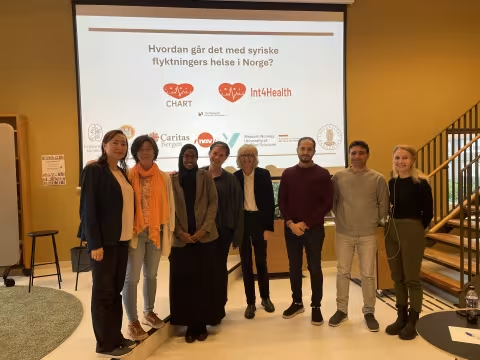
People
Project manager
Esperanza Diaz Steering group leader, (WP1, WP2, WP3)
Project members
Bernadette Kumar Steering group member (WP1, WP3
Lars Thore Fadnes Steering group member (W1, W3)
Arnfinn Andersen Steering group member (WP2)
Per Kristian Hilden Steering group member (WP2)
Melanie Lindsay Straiton Steering group member (WP2)
Wegdan Hasha Steering group member (WP1, WP2, WP3)
Elisabeth Strømme Steering group member (WP1)
Researchers/Post doc/PhD Candidates
Yeneabeba Sima Researcher (WP1)
Ayan Bashir Sheikh-Mohamed PhD Candidate (WP2)
Khadra Yasien Ahmed PhD Candidate (WP3)
Advisory Board
George Deeb User Representative
Sarala Banjara User Representative
Sølve Sætre Bergen municipality
Pål Bjørkjær Kristiansand municipality
Benedicte Hollen IMDI
Pablo Llano Torres CESAL, Spain
Bente Dahle Sylta Western Norway University of Applied Sciences
Marita Moe Sandven Caritas Bergen
Katrine Moland Hansen Arqus Alliance (UiB)
Clair Collins EGPRN Profiles
Elena Ronda Universidad de Alicante
Astrid Ouahyb Sundsbø Western Norway University of Applied Sciences
