

OPTIC-TB - Optimizing Childhood TB Treatment Decision Algorithms in sub-Saharan Africa
Every year, about a million children under 15 years are diagnosed with Tuberculosis (TB) worldwide, and about a quarter die. However, over 60% of children with TB remain undiagnosed, particularly in sub-Saharan Africa, which accounts for about 20% of the global burden of paediatric TB cases. Challenges in specimen collection in young children, which often require trained and experienced staff, difficulty in diagnosis, the perceived low risk of transmission and the lack of laboratory infrastructure contribute to low TB detection in children in this region.
About the research project
Summary of the project
In 2022, the World Health Organization (WHO) issued an interim recommendation to use integrated Treatment-Decision Algorithms (TDAs) to diagnose TB in children under ten years. However, this recommendation was based on very low certainty of evidence. Therefore, our project, which will be conducted in Tanzania, Uganda and DR. Congo aims to address four objectives:
- To compare the effectiveness of TDAs and the Standard of Care in routine clinical settings
- To identify processes and contextual factors that influence the effectiveness and fidelity in the implementation of TDAs
- To compare the costs, cost-effectiveness and the population-level impact of TDA strategies on the burden of TB
- To validate the diagnostic performance (sensitivity, specificity, negative and positive predictive values) of the TDAs in various health system settings and clinical context
Partners and project leaders
University of Bergen (UiB), Norway (coordinator)
National Institute for Medical Research (external link), (NIMR), Tanzania
Universite Catholique De Bukavu (external link) (UCB), Democratic Republic of Congo
Kampala International University Tanzania (external link) (KIUT), Tanzania
Makerere University Lung Institute (external link), (MULI), Uganda
Kampala International University (external link) (KIU), Uganda
Dr. Amani Thomas Mori (UiB) (project coordinator)
Prof. Sayoki Mfinanga (NIMR)
Prof. Patrick de marie Katoto (UCB)
Prof. Bruce Kirenga (MULI)
Prof. Angwara Kiwara (KIUT)
Prof. Andrew Kitua (KIU)
First Annual Scientific Meeting in Kampala, Uganda

There were participants from all the partner institutions. After remarks from all institutions, country updates were given, and status in for the different work packages. There was also time to discuss financial reporting and presentation from PhD scholars.
Kick off meeting
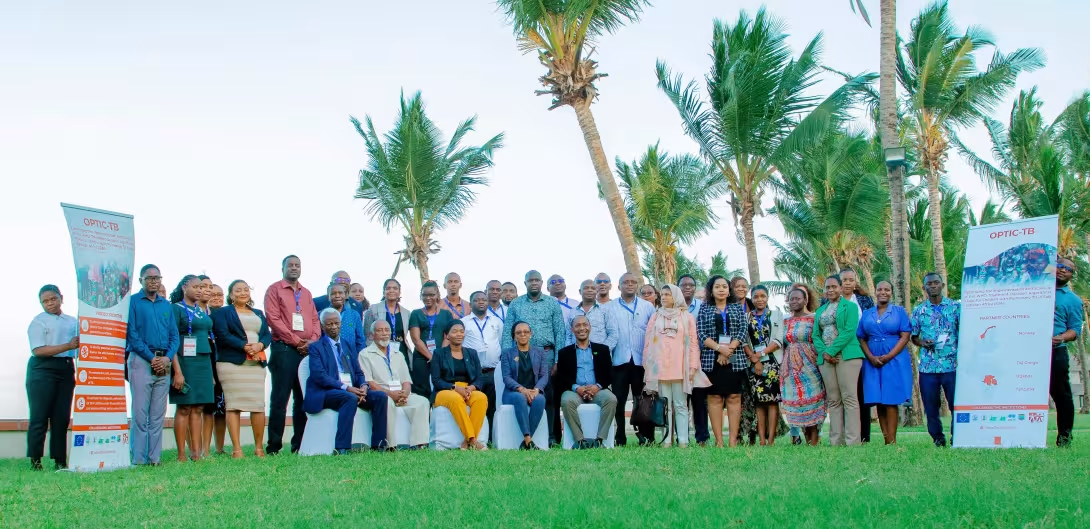
Optic-TB held its Kick Off meeting in Dar es-Salaam in August 2024.
Coordinator Prof Amani Mori, UiB, welcomed all the participants from DR Congo, Uganda, Tanzania and Norway, and gave a brief introduction of the consortium and their roles.
With over 50 participants, the two-day kick-off meeting was organised in Tanzania by the National Institute for Medical Research (NIMR) and Kampala International University in Tanzania (KIUT) to officially launch the project. Here, representatives from all the partner institutions met for the first time together with key stakeholders to discuss the project objective, review work packages, evaluate data collection tools and review prospective PhD-candidate's concept notes.
In addition to introductory remarks from all the beneficiaries, there was also a presentation by EDCPT representative Dr Erika Gaspari. She gave an overview of the development of the EDCTP programme, and the vision of EDCTP3. She also emphasized the importance of following the reporting requirements and system provided.
The rest of day one included scientific presentations about tuberculosis from different viewpoints, status for all 8 work packages and reporting requirements.
At the meeting on day two, there was a presentation and thorough discussion of the Data Collection Tools to be used. There were presentations from potential PhD-candidates, followed by discussion of their proposals. There were also time for a presentation about monitoring and evaluations of project activities, milestones and deliverables.

Project coordinator Amani Mori giving a speech at the meeting.
Design, hypothesis and outcomes, Impact
Design
A four-year pragmatic open-label cluster randomized controlled trial will be conducted in 120 primary health facilities in the three countries. About 60,000 children with presumptive TB visiting the health facilities will be screened and those fulfilling the criteria will be enrolled in the study.
Hypothesis and outcomes
We hypothesize that the WHO-recommended TDA strategy is superior to the standard of care (SOC) in (i) increasing by at least 20%, the proportion of children below 10 years with pulmonary TB detected and initiated on TB treatment and (ii) improve the proportion of children with pulmonary TB with good TB treatment outcome in the intervention facilities compared to the Standard of Care.
Impact
We anticipate that this project will yield results that address the issue of low detection of paediatric TB in sub-Saharan Africa and beyond, build research capacity in conducting implementation research in low- and middle-income countries and foster networking and collaboration between the partner institutions.
Work packages
WP1 Project Management & Coordination - UiB
WP2 Effectiveness assessment, costing/cost effectiveness and impact evaluation - NIMR
WP3 Performance validation, feasibility and accetability studies - MULI
WP4 Dissemination, Communication and networking - UCB
WP5 Data Management, economic and statistical analysis - NIMR
WP6 Mentorship and Capacity Building - KIUT
WP7 Ethics requirements - UiB
WP8 Scientific project leadership - NIMR
People
Project manager
Amani Mori Project coordinator, senior researcher
Funding

The project is supported by the EDCTP3 and its members. Funded by the European Union. Views and opinions expressed are however those of the author(s) only and do not necessarily reflect those of the European Union or Horizon Europe/EDCTP3. Neither the European Union nor the granting authority can be held responsible for them.