From Clouds to Code: Exploring Extreme Weather with AI
Extreme rainfall contributes to some of the most damaging weather disasters in Europe, such as flash floods and landslides. These impacts are likely to increase with climate change. Joshua Oldham-Dorrington studies when and why such events occur.
Published: (Updated: )
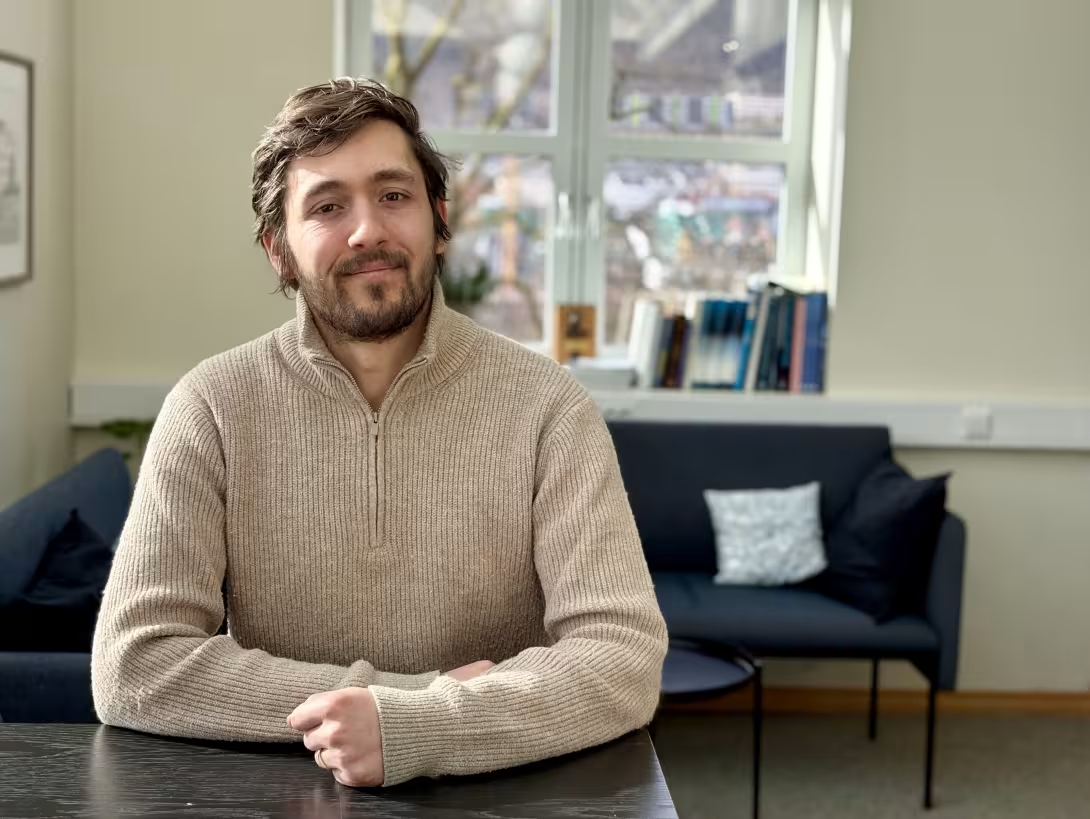
"I am really interested in extreme weather", admits Joshua Oldham-Dorrington, Postdoctoral Fellow at the Geophysical Institute. He is at UiB on a Marie Skłodowska Curie Fellow scholarship, working on understanding extreme rainfall in a changing climate.
Extreme rain contributes to many of the most impactful weather disasters in Europe today. Flash floods and landslides may become even more impactful in the future due to climate change. Oldham-Dorrington wants to know more about when, but also why it happens.
"Understanding exactly why extreme weather occurs today not only helps improve forecasts but also helps us interpret and improve our projections of future climate", he explains.
AI Is Revolutionizing Weather Forecasting
AI is a huge part of the future in climate research and atmospheric physics and dynamics.
Simulating the skies and oceans across the whole globe using supercomputers is the key to both weather and climate prediction. These simulations are becoming ever more accurate and the modelling community is now producing ultra-high-resolution “kilometer-scale” simulations.
"The future of rain is tightly linked to the future of clouds. Now that we are starting to simulate individual clouds we can understand rain in a lot more detail".
"However, he continues, high-resolution simulations also require a lot of computing power, which limits how we can use them".
In the last few years an AI revolution has swept through weather forecasting: data-driven models that know nothing about the laws of physics are now competitive with traditional forecasts and are far cheaper to run. If similar AI approaches can be used for climate modelling, the impact will be ground-breaking.
"But it’s a much harder problem. An AI forecast is trying to predict weather that looks a lot like the data it was trained on, and it can be quickly verified to see if it goes wrong. We've never seen global climate change before, so how can an AI model be trained? And how can we know if its trustworthy?"
Oldham-Dorrington thinks the solutions lie just as much in studying our models in more detail as in running bigger and better ones. By studying the specifics of weather within many kinds of climate models he seeks to gain a more comprehensive understanding of future rainfall.
"There is a lot to learn still even in our current climate models. The datasets get bigger, thousands of terabytes, but the human brain is still the same size: understanding and communicating the possible worlds we simulate is a challenge that's only getting bigger. The same ideas can be used to test AI climate models. We don't tell them anything about the laws of physics, but if they're going to be trustworthy tools, they must have learned some physics for themselves. We can find out if they've done that by diving into the data and trying to work out why they do what they do."
Why do you think these issues became important for you?
"I always had an interest in understanding how the world works. At university I was captivated by chaos theory: the mathematics that explains how tiny changes can have huge consequences. And weather and meteorology are if anything, chaotic! This interest was my way into atmospheric science: why is weather hard to predict? why do some storms cause disasters while others just wetten boots?"

Finding out where it will be worse is a key motivator for Oldham-Dorrington in what he is doing. But, he says, you will also get a bunch of people who will have different views on what is worse where. Someone working offshore will have a different view than a farmer. Weather and climate scientists, therefore, need to understand both the atmosphere and something about the needs of a dozen different industries if they want to communicate the relevant information well.
What about Bergen?
"Bergen has a long pedigree for weather research. With the mountains surrounding us, it is fascinating to see it raining on one side of the city, and at the same time, glimpses of sun on the other. Norway interests me, because the complexity of the mountains, fjords, glaciers and valleys make its climate so rich - and its future uncertain".
At the same time, Norway is one of the few places in Europe where we can say for sure that rain has already increased, he explains. Another thing that intrigues him is that we are at the end of the jet stream. What if it changes? How would that affect us? All in all, he concludes, Bergen is a great place to work on meteorology.
Starting a New Chapter in Norway
Oldham-Dorrington first visited Bergen during Christmas 2022. He moved here in 2024 due to a two-year Marie-Curie grant. He is from Windsor, about an hour by train from London. The historic town with a strong royal connection is quite different from coastal Norway he admits.
"It boosts your stamina to move to a place like Bergen. I have taken up an interest in hiking, he says". He and his wife have decided to make a future here.
"It’s a beautiful place to live!"
Learning Norwegian is also well underway. Currently he is on level three.
"I understand more than I can reply now. A short-term goal is to read the local newspaper from end to end".
Do you enjoy working at the Bjerknes Centre for Climate Research (external link)
"I really like it! It’s a dynamic community, with a sense of pushing bounds to see what we can achieve together. I feel the Bjerknes Center is really punching above its weight in terms of research. Norway is not a big country, but Bjerknes is operating with a wide scope. Constantly interacting with other professional environments. At the same time being a strong pool of expertise".
Climate and the discussions regarding why and what are a typical subject raising tensions in many contents. Oldham-Dorrington has so far never run into any controversies regarding his work. He tries not to fly too often. And, he has no worries about possibly being branded a climate activist.
"If anything, we are not activist enough he says. As scientists, we are more reluctant to give an absolute answer on questions. That being the nature of science".