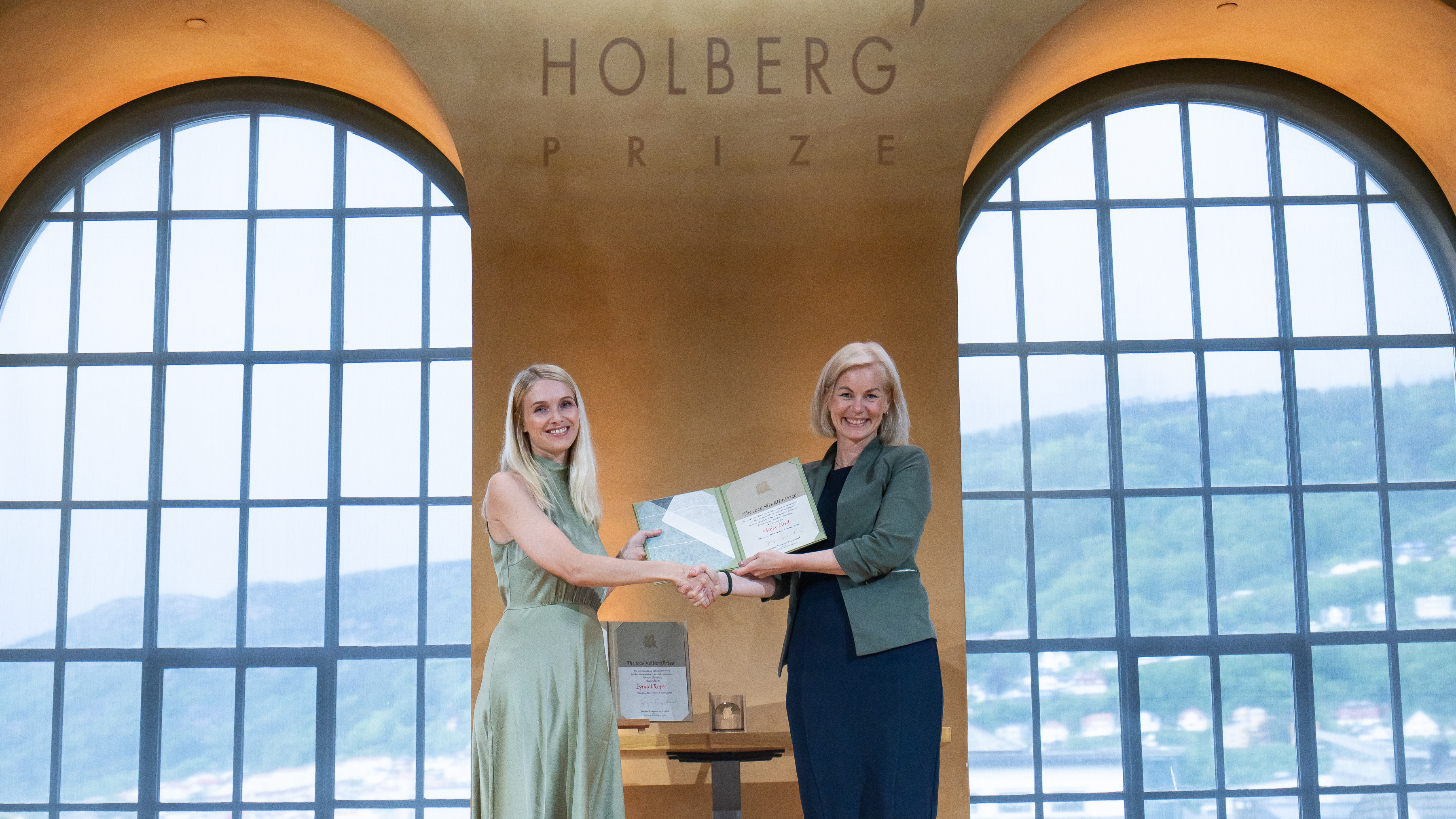
The Holberg Prize conferred upon Professor Lyndal Roper
Today, the Holberg Prize was conferred upon Australian-British Professor Lyndal Roper, by Norway’s Minister of Research and Higher Education Sigrun Aasland.
Published: (Updated: )

At a prestigious award ceremony today in the University Aula in Bergen, Lyndal Roper received the international research award from the Norwegian Minister of Research and Higher Education Sigrun Aasland. The Holberg Prize is worth NOK 6 million (approx. GBP 482,000) and is awarded annually for outstanding contributions to research in the humanities, social sciences, law or theology.
Lyndal Roper is the Regius Chair of History at the University of Oxford emeritus. She is regarded as one of the world’s leading scholars of early modern European history, with particular expertise on the Reformation period. She is widely credited with opening up new ways of understanding both everyday life and political tensions in this period through her research on witch trials, peasant revolts, and the life and thought of Martin Luther.
In her acceptance speech, the Laureate expressed her deep gratitude and highlighted the Holberg Prize as an important recognition—not only of her own work, but of an entire generation of scholars who have expanded the discipline of history and related fields by incorporating new perspectives on gender, the body, emotions, and human experience.
By bringing these aspects of history to the fore, one can achieve a more inclusive and diverse understanding of the past, Roper noted. She emphasized the value of studying history ‘from below,’ placing the experiences of ordinary people at the centre—particularly those of women. ‘I have wanted a history that isn’t just that of great men, Kings, and battles, and that doesn’t use abstractions like “the Reformation”, “imperialism”, “the household” without taking them to bits,’ said the Laureate in her acceptance speech.
Roper also pointed out that history and the humanities more broadly are essential for developing critical thinking, creativity, and a deeper understanding of the human condition. This is crucial in a time characterized by artificial intelligence and rapid, simplified answers: ‘The humanities challenge us to think about societies as a whole and the structures of power in which we live, and to think in the long term, with a sense of context and of the past, not just about what grabs soundbites today,’ she said.
The Holberg Laureate furthermore highlighted Ludvig Holberg as an important source of inspiration, particularly his ability to portray human beings in all their complexity and to take women seriously as historical actors. ‘We need all their voices in the history we write,’ she said.
Finally, Roper underscored that gender equality has yet to be achieved, and that both academia and society more broadly must continue working to create genuine opportunities for all. ‘All of us have a stake in the future, and even in these challenging times, there is so much to hope for and to do,’ the Laureate concluded
The Nils Klim Prize conferred upon Majse Lind
Also today, Norwegian Minister of Research and Higher Education Sigrun Aasland conferred the Nils Klim Prize upon Majse Lind from Denmark. This prize is worth NOK 500,000 and is awarded annually to a young scholar, from or in a Nordic country, who has excelled in one of the research areas covered by the Holberg Prize.
Majse Lind is Associate Professor of Clinical Psychology at the Department of Culture and Communication, Aalborg University. She receives the award for her interdisciplinary research on mental health, with particular focus on disorders among young people and older adults. Her work explores, among other things, how the stories people tell about themselves can be used to identify and treat psychological challenges, such as personality disorders and identity-related difficulties.
In her speech, Lind expressed deep gratitude and emphasized the importance of research on life narratives. A fundamental aspect of being human, she noted, is that we understand ourselves and others through stories that connect past, present, and imagined futures.
Such research provides an important corrective in a time characterized by speed and technological development. ‘We are, by nature, storytellers,’ Lind said, emphasizing the need to slow down, listen, and make space for complex life stories—including those that challenge dominant norms and prevailing ideas of what constitutes a good life. Alternative narratives can open up new possibilities and foster hope, by enabling people to become ‘authors of their own lives’ rather than being constrained by the expectations of others.