

Establishing a Centre for Quantum Technology in Bergen
The University of Bergen (UiB) is establishing UiB Quantum – the Centre for Quantum Technology in Bergen. The centre will be funded by UiB and the Trond Mohn Research Foundation, with a total budget of NOK 80 million over five years. The aim is to build an interdisciplinary centre based on strong academic environments, capable of developing quantum technologies with direct societal impact.
By: Amanda Schei
Published: (Updated: )
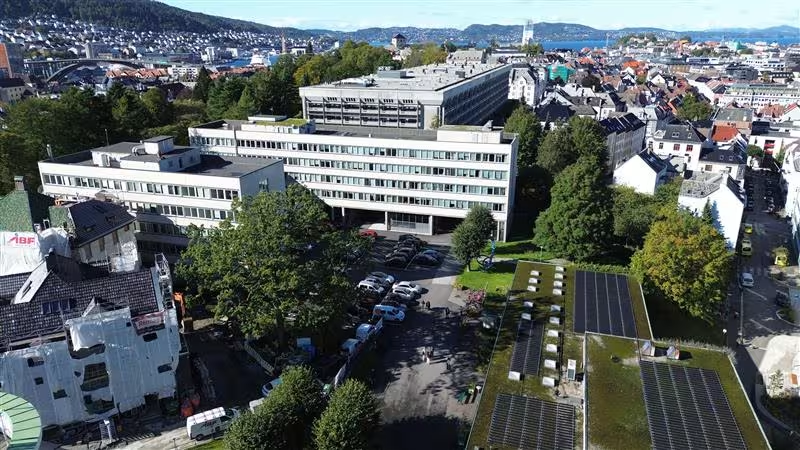
UiB Quantum will be launched in autumn 2026. Professor Pinar Heggernes will lead the centre, which builds on research environments at the Department of Physics and Technology and the Department of Informatics.
Quantum technology involves harnessing the smallest building blocks of nature to solve complex and demanding challenges. It has the potential to enable breakthroughs in fields such as healthcare, navigation, security and energy. In a field characterised by major international investments and strong competition, UiB is now taking a clear strategic position.
The centre will open this autumn, coinciding with the admission of the first students to a new five-year Master’s programme in quantum technology.
“UiB has strong expertise in several areas of quantum technology, particularly in applied research. With UiB Quantum, we are taking an important and clearly defined position in a field that will have major significance in the years ahead. This is also an important contribution to strengthening national capacity in this area,” says UiB Rector Margareth Hagen.
A key contribution from the Trond Mohn Research Foundation
The centre is being realised through close collaboration between UiB and the Trond Mohn Research Foundation (TMF). The funding from TMF also requires substantial co-investment from the university.
“Quantum technology is of strategic importance and has the potential to create long-term impact across many sectors. We are proud to support UiB, both by strengthening existing expertise and by fostering closer collaboration between research fields, with the ambition of positioning Bergen as a visible and competitive player in the national and international quantum landscape,” says Nicholas Knag Nunn, CEO of the Trond Mohn Research Foundation.
Gunn Mangerud, Dean of the Faculty of Science and Technology, welcomes the funding and highlights the strong academic evaluation underpinning the award.
“UiB Quantum will play a key role in advancing quantum research across disciplines. It was particularly encouraging to receive such a strong evaluation from international peer reviewers,” says Mangerud.
Part of a national initiative
The Norwegian government has identified quantum technology as a strategically important area and is investing more than NOK 1 billion over the next five years. A national strategy is expected in 2026.
Minister of Research and Higher Education Sigrunn Aasland is very positive about the establishment of a quantum centre in Bergen by UiB and the Trond Mohn Research Foundation.
“I would like to commend the University of Bergen for investing in emerging technologies and for establishing both a study programme and a research centre in quantum technology. The government aims to increase private funding of research in Norway, and it is very encouraging to see the Trond Mohn Research Foundation once again demonstrating what can be achieved through private funding,” says Aasland.
Interdisciplinary collaboration
The centre will facilitate extensive collaboration. At UiB, researchers from physics, informatics, mathematics, chemistry, geoscience and medicine will work together. The centre will also draw on expertise from clinical environments at Haukeland University Hospital, as well as partners in defence and security, Norwegian industry and business, and leading international research environments.
One key objective is to contribute to earlier detection of cancer through quantum sensing. UiB researchers are developing quantum-based sensors capable of detecting extremely small amounts of biomolecules in blood, enabling cancer to be identified long before symptoms appear.
Another focus area is secure navigation without reliance on GPS. As GPS signals can be disrupted or disabled, quantum-based navigation can improve solutions for aviation, maritime transport and underwater operations – particularly important for a maritime nation like Norway.
The centre will also work on improved planning and optimisation in shipping, transport and energy systems. Digital security is central to all these applications, and the centre will place significant emphasis on post-quantum cryptography and quantum communication.
Education and capacity building
UiB Quantum will begin operations on 1 August 2026. The official opening will take place on 15 September, combined with an industry seminar on the opportunities within quantum technology.
The new Master’s programme in quantum technology is now open for applications.
UiB will also develop continuing and further education programmes, including short courses for professionals. The goal is to make quantum technology more accessible and easier to understand for a wider audience.
With UiB Quantum – the Centre for Quantum Technology in Bergen, UiB is taking a leading role in the development of technologies that will shape society in the decades to come. The centre is an important addition to UiB’s strategic initiative in science and technology, UiB Realfaghøyden.