

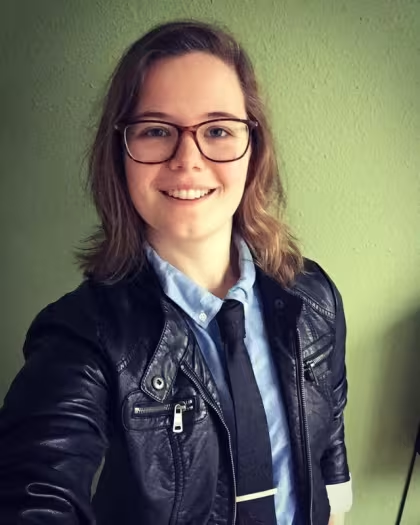
Mayke Nieuwkerk
Position
PhD candidate, in Paleoecology/Experimental Ecology at the Terrestrial Ecology research group
Affiliation
- mayke.nieuwkerk@uib.no
- Visitor address
-
Thormøhlens gate 53 A/B
5006 Bergen - Postal address
-
P.O. Box 7803NO-5020 BergenNorway
Follow me
Mayke Nieuwkerk
Position
PhD candidate, in Paleoecology/Experimental Ecology at the Terrestrial Ecology research group
Affiliation
Research groups
Short info
Pollen chemistry
THM-GC/MS
FTIR
Work
(Palaeo)-ecologist, studying ecological responses to environmental change.
I am interested in the fields of Palaeoecology, Terrestrial Ecology, Environmental Biology and Climate Change Research.
2019-2025 PhD in Palaeoecology, Experimental Ecology and Photobiology at the University of Bergen.
"Using UV-B-absorbing compounds in sporopollenin as a proxy for plant-received UV-B: a greenhouse- and field-experimental approach"
2018 Master thesis (II) at the University of Bergen and Utrecht University
"Do pollen grains get a suntan: An investigation into the drivers of variation in UV-B-absorbing compounds in pollen grains to develop a proxy for solar radiation"
2016-2017 Master thesis (I) at Utrecht University
"Towards climate tolerant crops: The effect of beneficial microbes on thermomorphogenesis in A. thaliana"
2016 Bachelor thesis at the University of Amsterdam
"Calibrating modern phytolith assemblages with vegetation composition in tropical forests"
Publications
Seddon, A.W.R., Festi, D., Nieuwkerk, M., Gya, R., Hamre, B., Krüger, L.C., Östman, S.A.H. and Robson, T.M. (2021), Pollen-chemistry variations along elevation gradients and their implications for a proxy for UV-B radiation in the plant-fossil record. Journal of Ecology. Accepted Author Manuscript. https://doi.org/10.1111/1365-2745.13720
Projects
I am currently working on my PhD at the Terrestrial Ecology research group at the University of Bergen titled "Using UV-B-absorbing compounds in sporopollenin as a proxy for plant-received UV-B: a greenhouse- and field-experimental approach".
During my PhD I will research several key challenges of using pollen chemistry as a proxy for plant-received UV-B.
1. What are the problems surrounding the quantification of UV-B absorbing compounds and how do we solve them?
2. What is the importance of phenotypic plasticity compared to local adaptation on the UV-B-absorbing compounds signal?
3. Are the measurements of the UV-B absorbing compound signal under greenhouse conditions robust and comparable to this signal under natural/field conditions?
My main supervisor during my PhD is Alistair Seddon and Matthew Robson and Daniela Festi are my co-supervisors.
I am also a part of the chemical paleoecology subgroup of Terrestrial Ecology, PalaeoChem. Together we discuss our findings and methods regarding pollen chemistry, as well as discuss recent papers on pollen chemistry (including papers focused on the laboratory methods THM-GC/MS, FTIR and Raman analysis).