

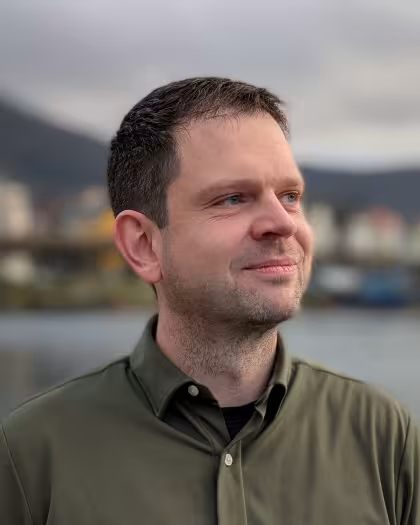
Andreas Borchel
Position
Researcher, molecular salmon louse biology
Affiliation
- andreas.borchel@uib.no
- Phone number
- +47 55584560
- Visitor address
-
Thormøhlens gate 53 A/B
5006 Bergen - Postal address
-
P.O. Box 7803NO-5020 BergenNorway
Follow me
Andreas Borchel
Position
Researcher, molecular salmon louse biology
Affiliation
Research groups
Short info
Research
My work is connected to the Sea Lice Research Group at UiB.
I have a lot of experience with molecular biology and genetics of salmon lice, identifying new gene functions (1, 2), and identifying the reaction of lice to their environment, like heat or reduced salinity. I have employed RNA-Sequencing to analyse gene expression of salmon lice and their salmon hosts.
Teaching
Publications
2025
- Andreas Borchel; Frank Nilsen (2025). Transcriptomic insights into the low-salinity tolerance of the sea louse Caligus elongatus. (external link)
- Aina-Cathrine Øvergård; Andreas Borchel; Christiane Eichner et al. (2025). The generalist Caligus elongatus is better at dampening the Atlantic salmon immune response than the salmonid specialist Lepeophtheirus salmonis. (external link)
- Andreas Borchel; Frank Nilsen (2025). A Review of the Salmon Louse (Lepeophtheirus salmonis) Hyposalinity Responses and the Efficacy of Freshwater Delousing. (external link)
2024
- Helena Marie Doherty Midtbø; Christiane Eichner; Lars Are Hamre et al. (2024). Salmon louse labial gland enzymes: implications for host settlement and immune modulation. (external link)
- Helena Marie Doherty Midtbø; Andreas Borchel; Hugh Craig Morton et al. (2024). Cell death induced by Lepeophtheirus salmonis labial gland protein 3 in salmonid fish leukocytes: A mechanism for disabling host immune responses. (external link)
2023
- Andreas Borchel; Christiane Eichner; Aina-Cathrine Øvergård (2023). Mining Lepeophtheirus salmonis RNA-Seq data for qPCR reference genes and their application in Caligus elongatus. (external link)
- Aina-Cathrine Øvergård; Christiane Eichner; Noelia Nuñez-Ortiz et al. (2023). Transcriptomic and targeted immune transcript analyses confirm localized skin immune responses in Atlantic salmon towards the salmon louse. (external link)
- Andreas Borchel; Erna Irene Heggland; Frank Nilsen (2023). Without a pinch of salt: effect of low salinity on eggs and nauplii of the salmon louse (Lepeophtheirus salmonis). (external link)
2019
- Andreas Borchel; Marieke Verleih; Carsten Kühn et al. (2019). Evolutionary expression differences of creatine synthesis-related genes: Implications for skeletal muscle metabolism in fish. (external link)
- Andreas Borchel; Heidi Kongshaug; Frank Nilsen (2019). Identification and Description of the Key Molecular Components of the Egg Strings of the Salmon Louse (Lepeophtheirus salmonis). (external link)
- Marieke Verleih; Andreas Borchel; Alexander Rebl et al. (2019). A molecular survey of programmed cell death in rainbow trout: Structural and functional specifications of apoptotic key molecules. (external link)
2017
- Andreas Borchel; Anna Zofia Komisarczuk; Alexander Rebl et al. (2017). Systematic identification and characterization of stress-inducible heat shock proteins (HSPs) in the salmon louse (Lepeophtheirus salmonis). (external link)
- Andreas Borchel; Marieke Verleih; Alexander Rebl et al. (2017). Identification of genes involved in cold-shock response in rainbow trout (Oncorhynchus mykiss). (external link)
- Alexander Rebl; Manuela Zebunke; Andreas Borchel et al. (2017). Microarray-predicted marker genes and molecular pathways indicating crowding stress in rainbow trout (Oncorhynchus mykiss). (external link)
Projects
I am currently leading the project "CRISPRLus" ("Deciphering Nutrient Uptake Mechanisms in Salmon Louse Oocytes for Gene Editing and Treatment Development"), financed by the Norwegian Research Council via the FRIPRO-scheme for groundbreaking research. Here, we are going to develop gene editing methods for salmon lice.
I tillegg jobber jeg med de FHF-finansierte prosjektet SaliFilaVax, som er oppfølgeren til Salivax. I dette prosjektet forsøker vi å utvikle og optimalisere en DNA-vaksine som retter seg mot proteinene som lakselusen skiller ut på fisken. Også NanoLice finansiert fra Forsknigsrådet jobber med DNA-vaksiner.
Additionally, I am working on the FHF-funded project SaliFilaVax the successor of, Salivax, in which we try to develop and optimise a DNA vaccine targeting the proteins secreted from the salmon louse onto the fish. Also naNoLice, financed by the Research Council works with DNA vaccines.
Nanolus is led by the Institute of Marine Research and is analysing the suitability of ion-modified water as an anti-louse treatment. I'm the project responsible at UiB and will perform transcriptomic studies on lice treated with this water.
I was also involved in the Microboost project, which was funded by the EEA and Norway Grants and was a cooperation with several portuguese partners. In this project we tried to use microalgae as functional food ingredient to improve the immune system of fish and prevent lice infestation.
Previously I have worked on the projects Freshnet and Freshnet 2 where we looked at the osmoregulation of salmon lice. Additionally I was involved in the project ModuLus which analysed the interaction of salmon lice and their hosts.