

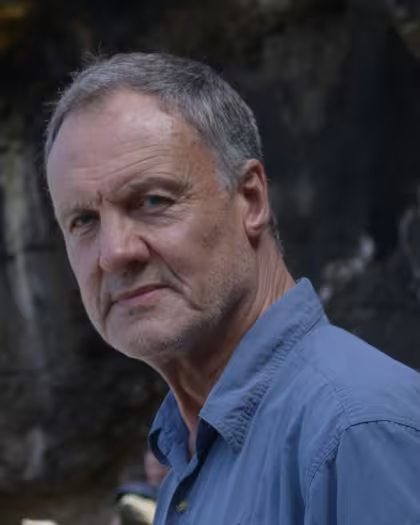
Christopher Stuart Henshilwood
Position
Emeriti, Director - SFF Centre for Early Sapiens Behaviour (SapienCE)
Affiliation
- christopher.henshilwood@uib.no
- Phone number
- +47 55589099
- +4741595771
- Visitor address
-
Centre for Early Sapiens Behaviour (SapienCE) Sydnesplassen 12/13, 4th Floor
5007 Bergen - Room: 414
- Postal address
-
P.O. Box 7805NO-5020 BergenNorway
Christopher Stuart Henshilwood
Position
Emeriti, Director - SFF Centre for Early Sapiens Behaviour (SapienCE)
Affiliation
Research groups
Short info
https://scholargps.com/scholars/567
Research
Centre for Early Sapiens Behaviour (SapienCE)
Abstract
Homo sapiens was anatomically modern by c. 200,000 years ago in Africa, but there is no archaeological evidence to demonstrate that behaviour was modern at the time. Attributes of modern behaviour, inspired by changes in the human brain, are only recognisable after 100,000 years ago. Before we can study the process, we must critically define the criteria for the term 'modern behaviour' and then find a means to recognise such behaviour in the record. This seemingly simple research statement involves complex exploration by a team of specialists. In this highly competitive research field, our centre is rising rise to the challenge by combining the skills of cutting-edge scientists in archaeology, climate reconstruction and modelling, and the cognitive and social sciences. Currently we are synthesising approaches from different disciplines to contribute to a sophisticated understanding of early human behaviour. Our highly ambitious research programme focuses on rare, well-preserved archaeological sites occupied between 100,000 and 50,000 years ago, as these contain the 'keys' for unlocking the past. A major competitive edge is the SapienCE Director’s 30 years of archaeological experience and his long-term exclusive access, with permits, to a number of the best-preserved sites in the southern Cape, South Africa - a region regarded as a major locus for vital evidence that could inform on the behaviour of early humans. Our planned excavations at existing and new sites and our ground-breaking interdisciplinary approaches, including climate and cognitive research, to understanding the processes that shaped human cultures is consolidating Norway’s position as a world leader in early human origins research.
Primary and Secondary Tasks
Primarily, SapienCE is directly addressing unanswered, first-order questions about Homo sapiens: a) what defines the switch to 'modern behaviour', exactly how should this term be defined and then, when, why and how did the 'switch' occur; b) were there changes in the human brain at that time that accelerated behavioural variability and how can these be measured now? Secondary linked tasks address the social organisation of these early humans: was social cohesion enhanced by symbolic material culture or vice-versa and did it lead to innovation; what cognitive skills had to be in place in order for other skills to develop; how adaptable were humans to environmental change and did climate act as a driver for technological innovation, social change and subsistence adaptations?
Introduction
The study of the origins of human behavioural development began in Europe and focused on the Upper Palaeolithic that started at 45 ka (thousand years ago). For many decades it was accepted that these developments originated in Europe. These studies set the standard against which the behaviour of earlier non-European humans was compared. Over the past 25 years, archaeological evidence from the Middle Stone Age (MSA) in Africa, especially after 100 ka, has rapidly changed perceptions of the behavioural variability and adaptive strategies of these early humans. Research led by the SapienCE Director in the southern Cape since 1991, including his ERC-funded Tracsymbols Project (2010-2015), uncovered unprecedented new evidence at Blombos Cave (BBC) and Klipdrift Shelter (KDS), the latter located in De Hoop Nature Reserve, for the behavioural evolution of early H. sapiens in southern Africa. Major discoveries, highly cited, relate to advanced technology and include the earliest evidence for the making of a pigmented compound and the use of containers (100 ka) and the first known use of pressure flaking to create finely crafted stone tools (75 ka). Items of symbolic material, directly linked to cognitive advances, include the earliest geometric engravings on ochre (100-75 ka), personal ornaments made from marine shell (75 ka), and among the earliest engraved ostrich eggshell (66 ka). This research laid the foundation for the need to establish a centre of excellence in human origins research.
Through integrating the unique breadth of competence available at UiB with top international collaborators, we are delivering transformative results. This is being achieved by adopting a holistic approach (integrating Science and Humanities) that focuses on early Homo sapiens in more depth than previously possible and that extends beyond previously limiting intradisciplinary boundaries. To achieve this goal, we have attracted leading scientists from top research groups, including the Bjerknes Centre for Climate Research, UiB Psychosocial Sciences, U. Tubingen, CNRS Bordeaux, the Max Planck Institute and Royal Holloway. Thus, in SapienCE we are able to co-ordinate and integrate expertise and the analytical and computational facilities available to our team of archaeologists, zooarchaeologists, micromorphologists, palaeoclimatologists, climate dynamicists, dating experts, cognitive and neuroscientists as well as geneticists. We believe this is providing the competitive edge that for our highly innovative CoE.
Vision and Strategic Intent
SapienCE continues to be firmly embedded among the top three humanities-oriented palaeo-science institutes globally. The focus of SapienCE is on key fields related to early Homo sapiens that are of international importance and interest. In this regard, SapienCE is uniquely positioned as our research area in the southern Cape lays the basis for groundbreaking excavations followed by globally significant interdisciplinary research we are carrying out at UiB, in South Africa and with our partners. We believe this is allowing for an ideal, yet rare, marriage of the humanities and sciences. To ensure that SapienCE continues to have top research status, visionary, determined and practical leadership is needed. Hence we have just appointed Dr Karen van Niekerk (UiB/Wits) as Deputy Director and Prof. Simon Armitage (Royal Holloway) as Deputy Director. SapienCE will continue to embark on bold strategies that will:
- Fully exploit its competitive advantages by continuing to build on existing strengths and by nurturing new avenues for intense engagement where it can produce top quality research results
- Sustain and increase research output in high impact journals
- Continue to pursue ambitious internationalisation to embed SapienCE as a world-class centre of intellectual engagement and a preferred destination for top-class international scholars and students
- Encourage our ECRs to continue with or initiate groundbreaking research that will lead to publications in top journals.
- Continue to provide a high-quality support environment and top-class infrastructure for our core functions
- Build on our recognition among academics globally that SapienCE offers a gateway to human origins research and to knowledge and understanding of early H. sapiens evolution in southern Africa
Outreach
Centre for Early Sapiens Behaviour
SapienCE
2017 - 2026
SapienCE is communicating the results of its research in numerous ways: scientific publication in prestigious journals and at conferences; use of media outlets to make the research accessible to the general public; develop a SapienCE website, email newsletters and short videos which present recent research results and also publish and disseminate via social media; running of regular focused workshops and forums for specialists and the general public; use of outreach programmes in Norway via the Univ. Museum of Bergen and through Wits University. The SapienCE outreach programme is benefitting thousands of economically disadvantaged school children in South Africa and has been extended, via the Univ. Museum of Bergen, to Norwegian school children(e.g. through the existing collaboration agreements between UiB and several region secondary schools to involve school children in current research topics). Widespread popular appeal of visual representations of heritage objects (e.g. 3D renderings of material culture) means that the media will be a key element of information brokerage, and contact with national and international journalists will be actively sought. All PIs will engage in events aimed at communicating scientific results to team members and the broader public.
Exhibitions
- The SapienCE ‘Early Human Behaviour’ Exhibition: University Museum of Bergen
This exhibition, developed in collaboration with the University Museum of Bergen, has been on display since May 2023. It offers insights into scientific processes, showcasing rare artefacts, interactive displays, and multimedia installations. Visitors explore the evolution of Homo sapiens from over 200,000 years ago to the present, examining cultural, social, and technological developments. The museum has received approximately 22,500 visitors since the opening of the "Early Human Behaviour" exhibition in May. There have been dedicated tours focusing on Early Human Behaviour and tours covering all exhibitions. Particularly significant are the school educational programmes centred on the SapienCE exhibition that were developed by UMB and that have been the ones most sought after by Bergen schools (see below). https://www.uib.no/en/sapience/162829/showcasing-fascinating-discoveries-about-early-modern-human-behaviour
- ‘Origins of Early Southern Sapiens Behaviour’ Exhibition: SANParks Cape Point Nature Reserve, Cape Town
The Wits/SapienCE exhibition that was on display at the Origins Centre at Wits University in 2021/2022 opened at the South Africa National Parks (SAN Parks) Table Mountain National Park’s Buffelsfontein visitor centre in the spring of 2023. The exhibition, based on Wits/SapienCE research, has been expanded with environmental content from the Sea Change Project and is curated by Craig Foster and Petro Keene. The exhibition has been popular with the more than 1 million people who visit Cape Point Nature Reserve annually. Our exhibition will be on display until 2026.
https://www.uib.no/en/sapience/163121/lives-our-early-ancestors-display-cape-point
On January 18, 2024, a third SapienCE-related exhibition opened at De Hoop Collection Nature Reserve in South Africa. The exhibition, based on SapienCE and pre-SapienCE research by Professor Christopher Henshilwood, Dr Karen van Niekerk, Professor Sarah Wurz and their team, and expanded with content from the Sea Change Project, is curated by Craig Foster and Petro Keene. The exhibition was officially inaugurated by Premier Alan Winde of Western Cape in the presence of the Ambassador of Norway to South Africa H.E. Mr Gjermund Sæther. Multiple national and international educational programmes will be centred on this exhibition in the future. https://www.dehoopcollection.com/origins-of-early-southern-sapiens-behaviour-exhibition/
Origins of Modern Human Behaviour Exhibition- De Hoop Nature Reserve, Overberg Region, South Africa,
opened 18th January 2024 by Premier Alan Winde of Western Cape in the presence of the Ambassador of Norway to South Africa H.E. Mr Gjermund Sæther
Other Outreach
University Museum of Bergen Educational Programme based on “Early Human Behaviour” Exhibition
An educational programme based on Early Human Behaviour (EHB) was launched at the University Museum in Bergen in Q3 of 2023. The programme was developed by the Museum’s pedagogical team in consultation with SapienCE Project Manager Žarko Tankosić. Its aim is to give school students in Years 5-7 in the Norwegian school system practical and theoretical insight into research matters focused on within the SapienCE project. Classes are split into two groups alternating between two exercises. The first comprises performing a simulated excavation in dig boxes. In the second, students engage in drama pedagogical exercises designed to encourage and stimulate reflections on our shared human past, human behaviour, and cognitive development. At the end, the class reunites, and they collectively share their observations and experiences.
The custom dig boxes used in the archaeological activity were developed specifically for this educational programme. Each box simulates an ideal archaeological scenario that reflects various relevant findings in either the African MSA or the Nordic Stone Age. These scenarios are carefully excavated by the students, who plot, register, and clean each object. Subsequently, they analyse and discuss their findings, viewing each object and their placement relationally. The practical, tangible excavation is designed to connect with the more introspective drama pedagogical exercises to form a greater context. This is aimed to reflect the project’s interdisciplinary and holistic approach. It is especially fruitful to see how conclusions vary between groups who start with the drama pedagogical activities and groups who start with the practical excavation.
Link to our latest dissemination programme
https://www.youtube.com/watch?v=G5_JctzoxXA&feature=em‐upload_owner
DOCUMENTARIES 2008 -2018 (selected sample)
2018 - The Time Machine- Origins of Innovation (Produced and diected by Craig & Damon Foster) https://www.youtube.com/watch?v=G5_JctzoxXA
2015 – The Great Human Odyssey, directed by Niobe Thompson, Canadian Broadcasting Coropration http://www.cbc.ca/greathumanodyssey/episodes/episode-1-rise-of-a-species
2013 - CNN's Inside Africa documentary on Blombos Cave: http://edition.cnn.com/AFRICA/
2013 - Clearwater Documentary involving Blombos Cave: http://clearwaterdoc.ca/about/
2012 - NHK Japanese Television Special Human Series. Presenter: Tatsuya Fujiwara narration (narrator): Seiko Nakajo
2009 - TV film made with Henshilwood at Blombos Cave for the Swedish Broadcasting Society Directed by Martin Widman and presented by Lasse Berg
2010 - Film made at Cape Point Nature Reserve with Henshilwood on the ‘Origins of H. sapiens’ for Foster Brother Film Productions, South Africa.
2008 - Film made at Blombos Cave with Henshilwood in March, 2008 for display in the ‘Anne & Bernard Spitzer Hall of Human Origins’, American Museum of Natural History, New York.
POPULAR ARTICLES (selected)
· Henshilwood, Christopher; Van Niekerk, Karen Loise. 2016. What excavated beads tell us about the when and where of human evolution. The Conversation. https://theconversation.com/profiles/christopher-henshilwood-222991
· National Geographic Magazine 2015 http://ngm.nationalgeographic.com/2015/01/first-artists/walter-text
· Dybas, C.L. 2013. Ripple marks—The story behind the story. Oceanography 26(3):10–13, http://dx.doi.org/10.5670/oceanog.2013.69
· Dybas, C.L. 2013. Article on Blombos Cave in Oceanography . http://www.tos.org/oceanography/archive/26-3_dybas.html#abstract
· Henshilwood, C. & van Niekerk, K. 2012. Middle Stone Age Chemists: A 100,000 Year Old Pigment Processing Workshop at Blombos Cave, South Africa. The Digging Stick.
· Jeff Tollefson, 2012. Human evolution: Cultural roots. Nature 482, 290–292 (16 February 2012) doi:10.1038/482290a http://www.nature.com/news/human-evolution-cultural-roots-1.10025
20 POPULAR LINKS TO OUR RESEARCH: September, 2014 – July, 2015 (selected sample)
1. http://www.cbc.ca/player/Shows/Shows/The+Nature+of+Things/ID/2440373757/
2. http://ngm.nationalgeographic.com/2015/01/first-artists/walter-text
3. http://www.cbc.ca/greathumanodyssey/episodes/episode-1-rise-of-a-species
4. https://vimeo.com/117470487
5. https://www.youtube.com/watch?v=G5_JctzoxXA&feature=em-upload_owner
7. http://www.wits.ac.za/newsroom/newsitems/201507/26853/news_item_26853.html
8. http://www.uib.no/aktuelt/84984/uib-arkeolog-i-national-geographic
9. http://www.wits.ac.za/newsroom/newsitems/201501/25466/news_item_25466.html
10. http://www.uib.no/en/ahkr/90323/diachronic-change-within-still-bay-blombos-cave-south-africa
11. http://www.wits.ac.za/newsroom/newsitems/201501/25535/news_item_25535.html
12. https://www.facebook.com/groups/SouthernSapiens/
13. http://highlycited.com/#henshilwood
14. https://uib.academia.edu/ChrisHenshilwood
15. http://www.wits.ac.za/newsroom/newsitems/201503/25965/news_item_25965.html
16. http://whc.unesco.org/en/tentativelists/6050
17. http://www.uib.no/ahkr/82096/feltforsking-p%C3%A5-film
18. https://vimeo.com/108896344
20. http://www.journals.elsevier.com/journal-of-archaeological-science/most-downloaded-articles/
Teaching
Our team leaders for Early Career Researchers (ECR's) ie PhDs and Postdoctoral fellows are Dr Karen van Niekerk, Deputy Director with responsibility for Archaeology and Psychology/Cognition and Prof Simon Armitage, Royal Holloway University of London, Deputy Director with responsibility for our early career researchers and leading our GEO and NORCE climate sections. Dr Zarko Tankosic, project (admin) manager, is a key member of our team.
In 2024 our SapienCE team included 19 active researchers (3 retired), of whom 10 form the Leader Group. Additionally, we have 6 PhDs, 11 Postdocs, and 13 administrative staff. We have several new Postdocs who staeted in 2024: Katrina Nilsson-Kerr (GEO), Kurt Wogau (GEO/SEAS), Ella Walsh (AHKR), Marzena Cendrowska (AHKR), Jeremy Beller (AHKR/SEAS), Samuel Pereira (GEO), Dr Ellie Pryor (GEO).
Publications
2026
- Jeremy Alexander Beller; Elizabeth Catherine Velliky; Karen Loise van Niekerk et al. (2026). The lithoscape of Blombos Cave, South Africa: A foundation for lithic procurement and forager mobility during the Middle Stone Age. (external link)
- Antoine Muller; Marzena Cendrowska; Karen Loise van Niekerk et al. (2026). Beyond breaking point: Reconstructing ‘finished’ artefact form in the Still Bay of Blombos Cave. (external link)
- Antoine Muller; Marzena Cendrowska; Simon Armitage et al. (2026). Tracking diachronic changes in lithic technological strategies through the Blombos Cave sequence with computational 3D methods. (external link)
- Marzena Cendrowska; Karen Loise van Niekerk; Christopher Stuart Henshilwood (2026). Understanding trace formation on quartz, quartzite and silcrete and its application in use-wear studies of Middle Stone Age lithics from Blombos cave. (external link)
- Elizabeth Catherine Velliky; Brandi L. MacDonald; Magnus Mathisen Haaland et al. (2026). Ochre and manganese pigments from the Middle Stone Age layers at Klipdrift Shelter. (external link)
2025
- Jeremy Alexander Beller; Karen Loise van Niekerk; Simon Armitage et al. (2025). Hunter-gatherer mobility and lithic procurement in the southern Cape: Results of artefact provenance from MSA Blombos Cave, South Africa. (external link)
- Jeremy Alexander Beller; Karen Loise van Niekerk; Simon Armitage et al. (2025). Forager mobility during the Middle Stone Age at Blombos Cave, South Africa. (external link)
- Neemias Santos da Rosa; Francesco d'Errico; M. Maguregui et al. (2025). Modelling the taphonomic effects of wind erosion and marine aerosol degradation on paintedages through accelerated ageing experiments: implications for the origins of rock art and the evolution of human symbolic behaviour. (external link)
- Marzena Cendrowska; Francesco d'Errico; Karen Loise van Niekerk et al. (2025). Knapping Ochre: Experimental Insights into MSA Ochre Use and Lithic Techniques. (external link)
- Ella Victoria Walsh; Simon Armitage; Christopher Miller et al. (2025). Palaeolandscape evolution during the period of Middle Stone Age occupation of Blombos Cave, South Africa.. (external link)
- Elizabeth Catherine Velliky; Francesco d'Errico; Karen Loise van Niekerk et al. (2025). Unveiling the multifunctional use of ochre in the Middle Stone Age: Specialized ochre retouchers from Blombos Cave. (external link)
2024
- Zahra Haghighi; Meaghan Mackie; Anne Apalnes Ørnhøi et al. (2024). An insight to take away: palaeoproteomics reveals the original binder and modern contaminations in distemper paints from Uvdal Stave Church, Norway. (external link)
- Jeremy Beller; Karen Loise van Niekerk; Pieter-Jan Grabe et al. (2024). Raw material distribution in the southern Cape region and its significance for lithic procurement during the MSA at Blombos Cave, South Africa. (external link)
- Kokeli Peter Ryano; Karen Loise van Niekerk; Christopher Stuart Henshilwood et al. (2024). Shellfish gathering during MIS 5c-d at Klasies River main site and Blombos Cave, southern Cape, South Africa: An inter-assemblage comparison. (external link)
- Zahra Haghighi; Meaghan Mackie; Anne Apalnes Ørnhøi et al. (2024). Palaeoproteomic identification of the original binder and modern contaminants in distemper paints from Uvdal stave church, Norway. (external link)
- Christopher Stuart Henshilwood; Karen Loise van Niekerk (2024). Origins of Early Southern Sapiens Behaviour Exhibition. Archaeological results from Blombos Cave, Klipdrift Shelter and Klasies River. (external link)
- Christopher Stuart Henshilwood (2024). Origins of Early Southern Sapiens Behaviour: Evidence from Blombos Cave, Klipdrift Shelter, Klasies River.. (external link)
- Christopher Stuart Henshilwood (2024). Reviewing the Archaeological Evidence from Blombos Cave, Klipdrift Shelter, Klasies River.. (external link)
- Margit Hildegard Simon; Willem Godert Maria van der Bilt; Pål Tore Morkved et al. (2024). Investigation of biomarkers from Blombos Cave, South Africa and from Rabat-Temara Caves in Morocco: Insights into Middle Stone Age sites. (external link)
- Ella Victoria Walsh; Simon James Armitage; Christopher Miller et al. (2024). Palaeolandscape evolution during the period of Middle Stone Age occupation of Blombos Cave, South Africa. (external link)
- Christopher Miller; Magnus Mathisen Haaland; Simon James Armitage et al. (2024). Geoarchaeological investigations of Klipdrift Shelter, de Hoop Nature Reserve, South Africa. (external link)
- Ole Fredrik Unhammer; Magnus Mathisen Haaland; Simon James Armitage et al. (2024). Reconcilable differences: Using retrospective photogrammetry to bridge the divide between analogue and digital site data collected during long-term excavation projects. (external link)
- Margit Hildegard Simon; Ozan mert Göktürk; Willem Godert Maria van der Bilt et al. (2024). Investigation of biomarkers from Blombos Cave, South Africa and from Rabat-Temara Caves in Morocco: Insights into Middle Stone Age sites Palaeoclimate.. (external link)
- Antoine Muller; Simon James Armitage; francesco d'Errico et al. (2024). Many ways to get to the point: Experimental insights into the behavioural complexity involved in Middle Stone Age point-making. (external link)
- Neemias Santos da Rosa; Francesco d'Errico; Maite Maguregui et al. (2024). TaphArt: an experimental approach to the impact of wind erosion and marine aerosol on coastal rock art sites. (external link)
- Shaw Badenhorst; Joel Ezeimo; L.T. Lebatla et al. (2024). Variability in Hunting Behaviour during the Middle Stone Age in the Eastern and Western Cape of South Africa. (external link)
- Kurt Heinrich Wogau Chong; Margit Hildegard Simon; Karen Loise van Niekerk et al. (2024). From sea to Little Karoo: tracking the paleo-landscape inhabited by the first modern humans. (external link)
- Shaw Badenhorst; Joel Ezeimo; Karen Loise van Niekerk et al. (2024). Differential Accumulation of Large Mammal Remains by Carnivores and Humans during the Middle Stone Age in the Eastern and Western Cape, South Africa. (external link)
2023
- Francesco d'Errico; Karen Loise van Niekerk; Lila Geis et al. (2023). New Blombos Cave evidence supports a multi-step evolutionary scenario for the culturalization of the human body. (external link)
- Kurt Heinrich Wogau Chong; Eystein Jansen; Margit Hildegard Simon et al. (2023). rom Sea to Little Karoo: Tracking the paleo-landscape inhabited by the first modern humans. (external link)
- Christopher Stuart Henshilwood; Karen Van niekerk (2023). Origins of Early Southern Sapiens Behaviour Exhibition, De Hoop Collection. Archaeological results from Blombos Cave, Klipdrift Shelter and Klasies River. (external link)
- Christopher Stuart Henshilwood (2023). Origins of Early Southern Sapiens Behaviour Exhibition. (external link)
- Ozan mert Göktürk; Margit Hildegard Simon; Stefan Pieter Sobolowski et al. (2023). Behaviourally modern humans in coastal southern Africa experienced an increasingly continental climate during the transition from Marine Isotope Stage 5 to 4. (external link)
- Turid Hillestad Nel; Carli Peters; Kristine K. Richter et al. (2023). Peptide mass fingerprinting as a tool to assess micromammal biodiversity in Pleistocene South Africa: The case of Klipdrift Shelter. (external link)
2022
- Kokeli Peter Ryano; Karen Loise van Niekerk; Sarah Jacoba Deborah Wurz et al. (2022). Shellfish remains as proxy for human behaviour and past environments during MSA II lower at Klasies River main site and Blombos Cave, southern Cape, South Africa. (external link)
- Diyendo Massilani; Mike W. Morley; Susan M. Mentzer et al. (2022). Microstratigraphic preservation of ancient faunal and hominin DNA in Pleistocene cave sediments. (external link)
- Shaw Badenhorst; Nomaswazi Mthombothi; Karen Loise van Niekerk et al. (2022). An initial assessment of zooarchaeological assemblage sizes from South Africa. (external link)
- Elizabeth Catherine Velliky; Magnus Mathisen Haaland; Susan M. Mentzer et al. (2022). New insights into ochre features and their associated behaviours from the Howieson’s Poort layers at Klipdrift Shelter. (external link)
- Shaw Badenhorst; Joel Ezeimo; L.T. Lebatla et al. (2022). Variability in hunting behaviour during the Middle Stone Age in the Eastern and Western Cape of South Africa. (external link)
2021
- Shaw Badenhorst; Joel Ezeimo; Karen Loise Van Niekerk et al. (2021). Differential accumulation of large mammal remains by carnivores and humans during the Middle Stone Age in the Eastern and Western Cape, South Africa. (external link)
- Alexandra Coutinho; Helena Malmström; Hanna Edlund et al. (2021). Later Stone Age human hair from Vaalkrans Shelter, Cape Floristic Region of South Africa, reveals genetic affinity to Khoe groups. (external link)
- Turid Hillestad Nel; Christopher Stuart Henshilwood (2021). The 100,000–77,000‑Year Old Middle Stone Age Micromammal Sequence from Blombos Cave, South Africa: Local Climatic Stability or a Tale of Predator Bias?. (external link)
- Shaw Badenhorst; Rialivhuwa Ratshinanga; Francesca Parrini et al. (2021). Rhinoceros from the Middle Stone Age in the Eastern and Western Cape of South Africa. (external link)
- Magnus Mathisen Haaland; Susan M Mentzer; Elizabeth Catherine Velliky et al. (2021). Characterizing microscopic ochre fragments at Middle Stone Age sites: implications for evaluating prehistoric ochre use and deposition. (external link)
2020
- Warren Sharp; Elizabeth Niespolo; Christian A Tryon et al. (2020). 230Th/U Burial Dating of Ostrich Eggshell: A New Geochronometer for Pleistocene Archaeological Sites. (external link)
- Magnus Mathisen Haaland; Christopher Miller; Ole Fredrik Unhammer et al. (2020). Geoarchaeological investigation of occupation deposits in Blombos Cave in South Africa indicate changes in site use and settlement dynamics in the southern Cape during MIS 5b-4. (external link)
- Magnus Mathisen Haaland; André M. Strauss; Elizabeth Velliky et al. (2020). Hidden in plain sight: A microanalytical study of a Middle Stone Age ochre piece trapped inside a micromorphological block sample. (external link)
- Christopher Henshilwood (2020). The First Real People. (external link)
- Christopher Henshilwood; Karen Loise Van Niekerk (2020). The Origins of Early Sapiens Behaviour 'Mother Africa - Welcome Home'. (external link)
- Emmanuel Discamps; Christopher Henshilwood; Karen Loise Van Niekerk (2020). Large mammal exploitation during the c. 14-11 ka Oakhurst techno-complex at Klipdrift Cave, South Africa.. (external link)
2019
- Elizabeth Niespolo; Warren Sharp; Christian A Tryon et al. (2019). Evaluating the temporal range of 230Th/U burial dating of ostrich eggshell, a new chronometer for Pleistocene terrestrial strata. (external link)
- Elizabeth Niespolo; Warren Sharp; Robert Glass et al. (2019). Patterns of U uptake and implications for diagenesis and trace element records in biomineral eggshell. (external link)
- Emmanuel Mellet; Ivan Colagè; Andrea Bender et al. (2019). What processes sparked off symbolic representations? A reply to Hodgson and an alternative perspective. (external link)
- Christopher Henshilwood (2019). Mother Africa - Welcome Home. (external link)
- Craig Foster; Christopher Henshilwood; Jarl Giske (2019). A 100 000 year aquatic journey with our southern African ancestors. (external link)
- Zenobia Jacobs; Brian G. Jones; Hayley C. Cawthra et al. (2019). The chronological, sedimentary and environmental context for the archaeological deposits at Blombos Cave, South Africa.. (external link)
- Christopher Henshilwood (2019). Mother Africa – Welcome Home: The behavioural origins of Homo sapiens in southern Africa between 120 000 – 5 000 years ago.. (external link)
- Christopher Henshilwood (2019). We all come from Africa: Origins of Modern Human Behaviour. (external link)
- Christopher Henshilwood (2019). The Origins of Modern Human Behaviour.. (external link)
- Christopher Henshilwood; Karen Loise Van Niekerk; Craig Foster et al. (2019). Origins of Early Sapiens Behaviour. (external link)
- Kokeli Peter Ryano; Karen Loise Van Niekerk; Sarah Jacoba Deborah Wurz et al. (2019). Shellfish exploitation during the Oakhurst at Klipdrift Cave, southern Cape, South Africa. (external link)
- Magnus Mathisen Haaland; Christopher E. Miller; Ole Fredrik Unhammer et al. (2019). What's in that black layer? A report on a 85 000 year old dark sedimentary feature in Blombos Cave, South Africa. (external link)
- Simon James Armitage; Karen Loise Van Niekerk; Christopher Henshilwood (2019). A reassessment of the luminescence chronology for Blombos Cave, South Africa. (external link)
- Christopher Henshilwood (2019). ‘Mother Africa – Welcome Home’. The behavioural origins of Homo sapiens in southern Africa 120 000 – 50 000 years. (external link)
- Christopher Henshilwood; John Maytham (2019). The Blombos Cave discovery and the origins of symbolism. (external link)
- Christopher Henshilwood; Karen Loise Van Niekerk; Petro Keene et al. (2019). 'Origins of Early Sapiens Behaviour - Mother Africa - Welcome Home'. (external link)
- Christopher Henshilwood (2019). The Origins of Modern Humans - Blombos Cave, Klipdrift Shelter and Klasies River. (external link)
- Christopher Henshilwood (2019). Origins of Early Sapiens Behaviour: Exhibition opening. (external link)
- Christopher Henshilwood; Refilwe Moloto (2019). Cradle of Human Culture Route to be launched in Western Cape. (external link)
- Turid Hillestad Nel; Karen Loise Van Niekerk; Christopher Henshilwood (2019). Local environmental context of the Howiesons Poort sequence at Klipdrift Shelter, South Africa. (external link)
2018
- Magnus Mathisen Haaland; Christopher E. Miller; Christopher Henshilwood (2018). Doing site-oriented depositional experiments? This is why you should consider taking a micromorphological block sample!. (external link)
- Magnus Mathisen Haaland; Christopher Henshilwood; Christopher E. Miller (2018). Geoarchaeological and micro-contextual investigations of Middle Stone Age occupation deposits at Blombos Cave, South Africa. (external link)
- Turid Hillestad Nel; Christopher Henshilwood (2018). Environmental context of the lower Middle Stone Age sequence at Blombos Cave, South Africa. (external link)
- Katja Douze; Anne Delagnes; Sarah Jacoba Deborah Wurz et al. (2018). The Howiesons Poort lithic sequence of Klipdrift Shelter, southern Cape, South Africa. (external link)
- Christopher Henshilwood (2018). Podcast: The oldest drawing and the energy of data. (external link)
- Christopher Henshilwood; Karen Loise Van Niekerk (2018). South Africa’s Blombos cave is home to the earliest drawing by a human. (external link)
- Jerome Reynard; Christopher Henshilwood (2018). Environment versus behaviour: Zooarchaeological and taphonomic analyses of fauna from the Still Bay layers at Blombos Cave, South Africa. (external link)
- Kokeli Peter Ryano; Karen Loise Van Niekerk; Christopher Henshilwood et al. (2018). Shellfishing at Klipdrift Cave during the Oakhurst, ca. 12–10 ka, in the southern Cape coast, South Africa: human predation pressure, dietary and climatic implications. (external link)
- Christopher Henshilwood; Karen Loise Van Niekerk; Petro Keene et al. (2018). Centre for Early Sapiens Behaviour exhibition. (external link)
- Jerome P. Reynard; Christopher Henshilwood (2018). Using trampling modification to infer occupational intensity during the Still Bay at Blombos Cave, southern Cape, South Africa. (external link)
- Francesco d'Errico; Christopher Henshilwood; Karen Loise Van Niekerk (2018). Les premières utilisations du rouge en Afrique. (external link)
- Turid Hillestad Nel; Sarah Jacoba Deborah Wurz; Christopher Henshilwood (2018). Small mammals from Marine Isotope Stage 5 at Klasies River, South Africa - Reconstructing the local palaeoenvironment. (external link)
- Magnus Mathisen Haaland; André Strauss; Christopher E. Miller et al. (2018). The 3D-reconstruction of a modified ochre fragment trapped inside a micromorphological block sample from the Middle Stone Age levels of Blombos Cave, South Africa. (external link)
- Magnus Mathisen Haaland; Christopher E. Miller; Ole Fredrik Unhammer et al. (2018). Investigation of Middle Stone Age occupation deposits in Blombos Cave, South Africa: evidence for changes in site-use and settlement dynamics in the Southern Cape during the MIS 5b-4 (94 – 72 ka). (external link)
- Christopher Henshilwood; Francesco d'Errico; Karen Loise Van Niekerk et al. (2018). An abstract drawing from the 73,000-year-old levels at Blombos Cave, South Africa. (external link)
- Ole Fredrik Unhammer; Stein-Erik Lauritzen; Christopher Henshilwood (2018). Photogrammetric mapping of complex cave chambers at Bloukrans Cave, South Africa: Structural, Morphological and Speleogenetic Information. (external link)
2017
- Stefan Pieter Sobolowski; Christopher Henshilwood; Eystein Jansen (2017). The Centre for Early Human Behaviour (EHB) at the University of Bergen: A transdisciplinary exploration into the evolution of homo sapiens behaviour. (external link)
- Elizabeth Niespolo; Warren Sharp; Nicholas Fylstra et al. (2017). U-TH BURIAL DATING OF OSTRICH EGGSHELLS: A NOVEL APPROACH TO DATING AFRICAN ARCHAEOLOGICAL SEQUENCES BEYOND THE 14C LIMIT. (external link)
- Kokeli Peter Ryano; Sarah Jacoba Deborah Wurz; Karen Loise Van Niekerk et al. (2017). The Technology of the Early Oakhurst Lithic Techno-Complex from Klipdrift Cave, Southern Cape, South Africa. (external link)
- Kokeli Peter Ryano; Karen Loise Van Niekerk; Christopher Henshilwood et al. (2017). Shellfish and tortoise exploitation during the Oakhurst at Klipdrift Cave, southern Cape, South Africa: human predation pressure and climatic implications. (external link)
- Christopher Henshilwood (2017). The philosophy of archaeology. (external link)
- Jerome P. Reynard; Christopher Henshilwood (2017). Subsistence strategies during the Late Pleistocene in the southern Cape of South Africa: Comparing the Still Bay of Blombos Cave with the Howiesons Poort of Klipdrift Shelter. (external link)
- Christopher Henshilwood (2017). Did climate affect the early behavioural evolution of Homo sapiens in Africa?.. (external link)
- Magnus Mathisen Haaland; Christopher Miller; Ole Unhammer et al. (2017). Middle Stone Age ochre contexts in Blombos Cave, South-Africa: a macro- and micro-contextual background. (external link)
- Francesco d'Errico; William E. Banks; Dan L. Warren et al. (2017). Identifying early modern human ecological niche expansions and associated cultural dynamics in the South African Middle Stone Age. (external link)
- Magnus Mathisen Haaland; David Friesem; Christopher Miller et al. (2017). Heat-induced alteration of glauconitic minerals in the Middle Stone Age levels of Blombos Cave, South Africa: Implications for evaluating site structure and burning events. (external link)
- Matthias Czechowski; Magnus Mathisen Haaland; Susan Mentzer et al. (2017). Distribution and spatial analysis of heat in thin-sections. (external link)
- Magnus Mathisen Haaland; Christopher Miller; Christopher Henshilwood (2017). Investigating site formation processes in Blombos Cave, South-Africa – a geo-archaeological and micro-contextual approach. (external link)
- Magnus Mathisen Haaland; Christopher Miller; Karen Loise Van Niekerk et al. (2017). Evaluating the nature and behavioral implications of laterally extensive occupation deposits in the Middle Stone Age levels of Blombos Cave, South Africa. (external link)
- Magnus Mathisen Haaland; Christopher Stuart Henshilwood (2017). Blombos cave. (external link)
- Magnus Mathisen Haaland; David Friesem; Christopher Miller et al. (2017). Investigating burnt deposits in Blombos Cave, South-Africa: a multi-proxy and multi-scale approach. (external link)
2016
- Patrick Roberts; Christopher Henshilwood; Karen Loise Van Niekerk et al. (2016). Climate, environment and early human innovation: Stable isotope and faunal proxy evidence from archaeological sites (98-59ka) in the southern Cape, South Africa. (external link)
- Stanley Moyo; Dikeledi Mphuti; Ewa Cukrowska et al. (2016). Blombos Cave: Middle Stone Age ochre differentiation through FTIR, ICP OES, ED XRF and XRD. (external link)
- Christopher Henshilwood; Karen Loise Van Niekerk; Peter C Kjærgaard (2016). Blombos. (external link)
- Jerome Reynard; Emmanuel Discamps; Shaw Badenhorst et al. (2016). Subsistence strategies in the southern Cape during the Howiesons Poort: Taphonomic and zooarchaeological analyses of Klipdrift Shelter, South Africa. (external link)
- Riaan Rifkin; Prinsloo Linda C.; Dayet Laure et al. (2016). Characterising pigments on 30 000 year-old mobiliary art form Apollo 11 Cave, Karas Region, southern Namibia.. (external link)
- Anne Delagnes; Patrick Schmidt; Katja Douze et al. (2016). Early evidence for the extensive heat treatment of silcrete in the Howiesons Poort at Klipdrift Shelter (layer PBD, 65 ka), South Africa. (external link)
- Shaw Badenhorst; Karen Loise Van Niekerk; Christopher Henshilwood (2016). Large mammal remains from the 100 ka Middle Stone Age layers of Blombos Cave, South Africa. (external link)
- Christopher Henshilwood (2016). The behavioural origins of early Homo sapiens in southern Africa. (external link)
- Christopher Henshilwood; Karen Loise Van Niekerk; Peter Kjaergaard (2016). Homo sapiens: Blombos Cave. (external link)
- Christopher Henshilwood (2016). Tracing further the behavioural evolution of Homo sapiens in southern Africa. (external link)
- Anne Delagnes; Katja Douze; Sarah Jacoba Deborah Wurz et al. (2016). The habitual heat treatment of silcrete by the Howiesons Poort groups from southern Africa. (external link)
- Jerome Reynard; Emmanuel Discamps; Sarah Jacoba Deborah Wurz et al. (2016). Occupational intensity and environmental changes during the Howiesons Poort at Klipdrift Shelter, southern Cape, South Africa. (external link)
- Turid Hillestad Nel; Christopher Henshilwood (2016). The Small Mammal Sequence from the c. 76 – 72 ka Still Bay Levels at Blombos Cave, South Africa – Taphonomic and Palaeoecological Implications for Human Behaviour. (external link)
- Christopher Henshilwood; Karen Loise Van Niekerk (2016). What excavated beads tell us about the when and where of human evolution. (external link)
See a complete overview of publications in NVA.
RESEARCHER ID’S
- Thomson Reuters Web of Science: http://www.researcherid.com/rid/K-3806-2014
- ORCID ID:Link http://orcid.org/0000-0002-2818-293X
- Research Gate: https://www.researchgate.net/profile/Christopher_Henshilwood?ev=hdr_xprf
- Academia.edu: https://uib.academia.edu/ChrisHenshilwood
- Google Scholar: https://scholar.google.com/citations?user=cHpPROcAAAAJ
PUBLICATION CITATIONS
Book Chapters: 20; Books 2: Peer reviewed papers 81
Peer Reviewed papers
- Scopus ISI: h-index 41; 12,136 citations (March 2023): 74 publications; 130 co-authors: Top 10 articles cited 3924 times.
- Google Scholar: 129 articles; h-index 46; 12 600 citations (March 2023), Since 2018 - 4512 citations. Top 10 articles cited 7500 times; 92% of citations attributed to Wits/University of Bergen.
- Thompson Reuters Lifetime Research Award in 2014 (2002-2012) and Thompson Reuters Research Award for being in the top 1% most cited in the ‘Social Sciences and General’ Category for 2013, 2014, 2016. http://highlycited.com/#henshilwood
Projects
Centre for Early Sapiens Behaviour (SapienCE)
Abstract
Homo sapiens was anatomically modern by c. 200,000 years ago in Africa, but there is no archaeological evidence to demonstrate that behaviour was modern at the time. Attributes of modern behaviour, inspired by changes in the human brain, are only recognisable after 100,000 years ago. Before we can study the process, we must critically define the criteria for the term 'modern behaviour' and then find a means to recognise such behaviour in the record. This seemingly simple research statement involves complex exploration by a team of specialists. In this highly competitive research field, our centre is rising rise to the challenge by combining the skills of cutting-edge scientists in archaeology, climate reconstruction and modelling, and the cognitive and social sciences. Currently we are synthesising approaches from different disciplines to contribute to a sophisticated understanding of early human behaviour. Our highly ambitious research programme focuses on rare, well-preserved archaeological sites occupied between 100,000 and 50,000 years ago, as these contain the 'keys' for unlocking the past. A major competitive edge is the SapienCE Director’s 30 years of archaeological experience and his long-term exclusive access, with permits, to a number of the best-preserved sites in the southern Cape, South Africa - a region regarded as a major locus for vital evidence that could inform on the behaviour of early humans. Our planned excavations at existing and new sites and our ground-breaking interdisciplinary approaches, including climate and cognitive research, to understanding the processes that shaped human cultures is consolidating Norway’s position as a world leader in early human origins research.
Primary and Secondary Tasks
Primarily, SapienCE is directly addressing unanswered, first-order questions about Homo sapiens: a) what defines the switch to 'modern behaviour', exactly how should this term be defined and then, when, why and how did the 'switch' occur; b) were there changes in the human brain at that time that accelerated behavioural variability and how can these be measured now? Secondary linked tasks address the social organisation of these early humans: was social cohesion enhanced by symbolic material culture or vice-versa and did it lead to innovation; what cognitive skills had to be in place in order for other skills to develop; how adaptable were humans to environmental change and did climate act as a driver for technological innovation, social change and subsistence adaptations?
Introduction
The study of the origins of human behavioural development began in Europe and focused on the Upper Palaeolithic that started at 45 ka (thousand years ago). For many decades it was accepted that these developments originated in Europe. These studies set the standard against which the behaviour of earlier non-European humans was compared. Over the past 25 years, archaeological evidence from the Middle Stone Age (MSA) in Africa, especially after 100 ka, has rapidly changed perceptions of the behavioural variability and adaptive strategies of these early humans. Research led by the SapienCE Director in the southern Cape since 1991, including his ERC-funded Tracsymbols Project (2010-2015), uncovered unprecedented new evidence at Blombos Cave (BBC) and Klipdrift Shelter (KDS), the latter located in De Hoop Nature Reserve, for the behavioural evolution of early H. sapiens in southern Africa. Major discoveries, highly cited, relate to advanced technology and include the earliest evidence for the making of a pigmented compound and the use of containers (100 ka) and the first known use of pressure flaking to create finely crafted stone tools (75 ka). Items of symbolic material, directly linked to cognitive advances, include the earliest geometric engravings on ochre (100-75 ka), personal ornaments made from marine shell (75 ka), and among the earliest engraved ostrich eggshell (66 ka). This research laid the foundation for the need to establish a centre of excellence in human origins research.
Through integrating the unique breadth of competence available at UiB with top international collaborators, we are delivering transformative results. This is being achieved by adopting a holistic approach (integrating Science and Humanities) that focuses on early Homo sapiens in more depth than previously possible and that extends beyond previously limiting intradisciplinary boundaries. To achieve this goal, we have attracted leading scientists from top research groups, including the Bjerknes Centre for Climate Research, UiB Psychosocial Sciences, U. Tubingen, CNRS Bordeaux, the Max Planck Institute and Royal Holloway. Thus, in SapienCE we are able to co-ordinate and integrate expertise and the analytical and computational facilities available to our team of archaeologists, zooarchaeologists, micromorphologists, palaeoclimatologists, climate dynamicists, dating experts, cognitive and neuroscientists as well as geneticists. We believe this is providing the competitive edge that for our highly innovative CoE.
Vision and Strategic Intent
SapienCE continues to be firmly embedded among the top three humanities-oriented palaeo-science institutes globally. The focus of SapienCE is on key fields related to early Homo sapiens that are of international importance and interest. In this regard, SapienCE is uniquely positioned as our research area in the southern Cape lays the basis for groundbreaking excavations followed by globally significant interdisciplinary research we are carrying out at UiB, in South Africa and with our partners. We believe this is allowing for an ideal, yet rare, marriage of the humanities and sciences. To ensure that SapienCE continues to have top research status, visionary, determined and practical leadership is needed. Hence we have just appointed Dr Karen van Niekerk (UiB/Wits) as Deputy Director and Prof. Simon Armitage (Royal Holloway) as Deputy Director. SapienCE will continue to embark on bold strategies that will:
- Fully exploit its competitive advantages by continuing to build on existing strengths and by nurturing new avenues for intense engagement where it can produce top quality research results
- Sustain and increase research output in high impact journals
- Continue to pursue ambitious internationalisation to embed SapienCE as a world-class centre of intellectual engagement and a preferred destination for top-class international scholars and students
- Encourage our ECRs to continue with or initiate groundbreaking research that will lead to publications in top journals.
- Continue to provide a high-quality support environment and top-class infrastructure for our core functions
- Build on our recognition among academics globally that SapienCE offers a gateway to human origins research and to knowledge and understanding of early H. sapiens evolution in southern Africa
Kompetanse, Grader og Utmerkelser
CURRENT POSITIONS
- Director: Research Council of Norway Centre of Excellence in Early Human Behaviour, University of Bergen
- Professor of African Prehistory – Institutt for arkeologi, historie, kulturvitenskap og religionsvitenskap, University of Bergen, Norway
- Distinguished Professor and SARChI Chair in Origins of Modern Human Behaviour – Evolutionary Studies Institute, University of the Witwatersrand, Johannesburg, South Africa
- Executive Committee Member, NRF Centre of Excellence in Palaeosciences, University of the Witwatersrand
- Executive Committee Member, Evolutionary Studies Institute, University of the Witwatersrand
Researcher ID
- Thomson Reuters Web of Science ResearcherID: K-3806-2014. Link http://www.researcherid.com/rid/K-3806-2014 (external link)
- ORCID ID:Link http://orcid.org/0000-0002-2818-293X (external link)
- Research Gate: Christopher Henshilwood: Link https://www.researchgate.net/profile/Christopher_Henshilwood?ev=hdr_xprf (external link)
- Academia.edu: Christopher Henshilwood: Link https://uib.academia.edu/ChrisHenshilwood (external link)
- Scholar GPS: https://scholargps.com/scholars/56750983260571/christopher-s-henshilwood (external link)
DEGREES
B.A. (Distinction in Archaeology), University of Cape Town, 1989
B.A. Hons. (with Distinction), University of Cape Town, 1990
Ph. D. (Archaeology), University of Cambridge, U.K. 1995
CURRENT AND PREVIOUS RESEARCH GRANTS (2004 – 2017)
- Research Council of Norway Centre of Excellence in Early Human Behaviour 2017-2026
- South African Research Council Chair Initiative: Chair in ‘Origins of modern human behaviour’ at University of the Witwatersrand funded by National Research Foundation/ Department of Science and Technology, South Africa (2008-2017; renewable)
- Principal Investigator for European Research Council, FP7 Advanced Grant - TRACSYMBOLS Project Grant 2010 - 2015
- Franco/South Africa (National Research Foundation grant (2008 – 2010).
- Leakey Foundation, (1997, 1998, 1999, 2008)
- Norwegian Research Council /National Research Foundation – South Africa (2007-2010)
- Wenner Gren (1998,1999, 2007/2008)
- National Geographic Research and Exploration Grants (2006-2007, 2012-2014)
- University of Bergen Research Grant (2008-2015)
- National Science Foundation Grant, Stony Brook University, USA (1997-2000)
CREDITS & AWARDS
National (South Africa)
·
- Dr. Nelson Mandela: accepts patronage of the Blombos Cave Project, 2000.
- President Thabo Mbeki: Honourable mention in the ‘The State of the Nation’ address to the joint sitting of the Houses of Parliament, Cape Town, South Africa, February 8, 2002 and presentation by PI of Blombos Cave artefacts to Members of the Houses of Parliament.
- Academy of Science of South Africa – admitted in 2009
- The 75 000 year old engraved ochre and beads from Blombos Cave officially recognised as ‘Symbols of South Africa Culture’. In honour of this recognition a set of stamps featuring these artefacts was issued by the South Africa Post Office in 2013.
- A-rated Scientist by National Research Foundation, South Africa, 2015-2020.
- Vice-Chancellors Research Award, 2015. University of the Witwatersrand. Listed as the pinnacle of recognition in the realm of research achievement at the University.
- Ranked in Top 10 of South Africa’s most influential scientific minds for 2002–2012. Award published in 2014, South African Journal of Science http://dx.doi.org/10.17159/sajs.2015/a0121 (external link)
International
- Chevalier dans l’Ordre des Palmes Académiques medal and order awarded by the French Prime Minister in 2004 for distinguished contributions to French education and culture; conferred, June, 2005.
- Colenso Invited Visiting Fellow, St. John’s College, Cambridge, 2013
- Academia Europaea - Elected Member in 2013.
- Thompson Reuters Lifetime Research Award in 2014 for being among the top 1% most cited for their subject field and year of publication for the period 2002 - 2012.
- Thompson Reuters Research Award for being in the top 1% most cited in the ‘Social Sciences and General’ Category for 2013 and 2014.
- Thompson Reuters Award for inclusion in ‘The World’s Most Influential Scientific Minds’ in 2014
- Thompson Reuters Research Award for being in the top 1% most cited in the ‘Social Sciences and General’ Category for 2016.