

Gabriele de Seta
Position
Project Leader, Center for Digital narrative
Affiliation
- gabriele.seta@uib.no
- Visitor address
-
Langes Gate 1-3
5007 Bergen - Postal address
-
P.O. Box 7805NO-5020 BergenNorway
Gabriele de Seta
Position
Project Leader, Center for Digital narrative
Affiliation
Short info
Research
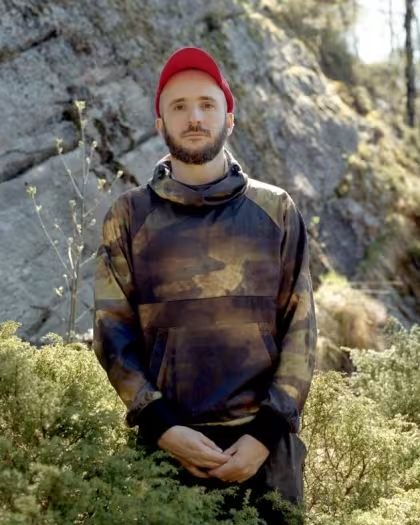
Gabriele de Seta is, technically, a sociologist. He is a Researcher at the University of Bergen, where he leads the ALGOFOLK project (“Algorithmic folklore: The mutual shaping of vernacular creativity and automation”) funded by a Trond Mohn Foundation Starting Grant (2024-2028). Gabriele holds a PhD from the Hong Kong Polytechnic University and was a Postdoctoral Researcher at the Institute of Ethnology, Academia Sinica and at the University of Bergen, where he was part of the ERC-funded project “Machine Vision in Everyday Life”. His research work, grounded on qualitative and ethnographic methods, focuses on digital media practices, sociotechnical infrastructures and vernacular creativity in the Chinese-speaking world. He is also interested in experimental, creative and collaborative approaches to knowledge-production.
Outreach
I regularly share research updates on the Algorithmic Folklore blog and my website, I host a podcast interviewing researchers and artists, and I'm happy to talk about my research on any platform - just get in touch!
Teaching
I have designed the "Machine Vision" module for the Digital Culture BA course Critical Approaches to Technology and Society (Fall 2020), and taught the MA course Key Theories in Digital Culture (fall 2021). I regularly give guest lectures and lead workshops at international institutions. I am currently supervising PhD candidates Hanna Lauvli and Yagmur Vik.
Publications
2026
- Gabriele de Seta (2026). Four theses on algorithmic folklore. (external link)
- Gabriele de Seta; Marianne Gunderson; Hanna Hellesø Lauvli et al. (2026). Algorithmic folklore. (external link)
- Gabriele de Seta; Marianne Gunderson; Hanna Hellesø Lauvli et al. (2026). Algorithmic folklore lexicon. (external link)
- Gabriele de Seta (2026). Algorithmic folklore. (external link)
- Gabriele de Seta (2026). “Hi everyone, I am Yilong Ma”: Synthetic impersonators and despicable celebrities in global media circuits. (external link)
- Gabriele de Seta (2026). Ball-ache, dick hair and serial cunt words: The role of vulgarity in Chinese internet language. (external link)
- Gabriele de Seta (2026). Digital ethnography in, on, and through China: A methodological history. (external link)
2025
- Daniel Vogler; Adrian Rauchfleisch; Gabriele de Seta (2025). Support for deepfake regulation: The role of third-person perception, trust, and risk. (external link)
- Luigi Monteanni; Gabriele de Seta (2025). Spectral hauntings, ancestral tunings: Two unnaturalist modes of listening. (external link)
- Daniel Vogler; Adrian Rauchfleisch; Gabriele de Seta (2025). The short-term impact of an on-site literacy intervention on discerning deepfake videos based on visual features. (external link)
- Gabriele de Seta (2025). Technologies of clairvoyance: Chinese lineages and mythologies of machine vision. (external link)
- Adrian Rauchfleisch; Daniel Vogler; Gabriele de Seta (2025). Deepfakes or synthetic media? The effect of euphemisms for labeling technology on risk and benefit perceptions. (external link)
- Gabriele de Seta; Idil Galip; Lucie Chateau et al. (2025). Groundhog Day: Memes Are New. (external link)
2024
- Murat Karaboga; Nula Frei; Manuel Puppis et al. (2024). Deepfakes und manipulierte Realitäten: Technologiefolgenabschätzung und Handlungsempfehlungen für die Schweiz. (external link)
- Gabriele de Seta (2024). An algorithmic folklore: Vernacular creativity in times of everyday automation. (external link)
- Jill Walker Rettberg; Marianne Gunderson; Linda Maria Jessica Kronman et al. (2024). Machine vision in everyday life: Final report. (external link)
- Gabriele de Seta; Matti Pohjonen; Aleksi Knuutila (2024). Synthetic ethnography: Field devices for the qualitative study of generative models. (external link)
- Gabriele de Seta (2024). Synthetic Probes: A Qualitative Experiment in Latent Space Exploration. (external link)
- Gabriele de Seta (2024). Ethnographic approaches to digital folklore. (external link)
- Gabriele de Seta (2024). From ASCII lanterns to synthetic livestreams: Three decades of Chinese digital folklore. (external link)
2023
- Gabriele de Seta; Anya Shchetvina (2023). Imagining machine vision: Four visual registers from the Chinese AI industry. (external link)
- Gabriele de Seta (2023). QR code: The global making of an infrastructural gateway. (external link)
- Gabriele de Seta (2023). Digital Depth: A Volumetric Speculation. (external link)
- Gabriele de Seta (2023). Let a hundred sinofuturisms bloom. (external link)
- Marianne Gunderson; Ragnhild Solberg; Linda Maria Jessica Kronman et al. (2023). Machine vision situations: Tracing distributed agency. (external link)
2021
- Gabriele de Seta (2021). A “no-venue underground”: Making experimental music around Hong Kong’s lack of performance spaces. (external link)
- Gabriele de Seta (2021). Gateways, sieves and domes: On the infrastructural topology of the Chinese stack. (external link)
- Virginia L. Conn; Gabriele de Seta (2021). Sinofuturism(s). (external link)
- Gabriele de Seta (2021). Huanlian, or changing faces: Deepfakes on Chinese digital media platforms. (external link)
- Gabriele de Seta (2021). Scaling the scene: Experimental music in Taiwan. (external link)
- Ge Zhang; Gabriele de Seta (2021). Introduction: ASIA.LIVE: Inaugurating livestream studies in Asia. (external link)
- Gabriele de Seta (2021). Tres mentiras de la etnografía digital. (external link)
- Gabriele de Seta (2021). The politics of muhei: Ethnic humor and Islamophobia on Chinese social media. (external link)
- Gabriele de Seta (2021). The Bloomsbury handbook of the anthropology of sound. (external link)
2020
- Gabriele de Seta (2020). Sociality, circulation, transaction: WeChat's infrastructural affordances. (external link)
- Quentin Stevens; Gabriele de Seta (2020). Must Zhongzheng fall? Varied responses to memorial statues of Taiwan’s former dictator. (external link)
- Gabriele de Seta (2020). Three lies of digital ethnography. (external link)
- Crystal Abidin; Gabriele de Seta (2020). Private messages from the field: Confessions on digital ethnography and its discomforts. (external link)
See a complete overview of publications in NVA.
My publications are also listed on Google Scholar, and most of them are accessible through links on my website.
Since my PhD degree, I have done research about the internet in China: my main interest in this topic is internet use in everyday life, which includes digital media practices of linguistic creativity, fandom, self-presentation, socialization, citizenship, remembrance and vulgarity. I have focused on trolling and other problematic practices, analyzing how they relate to broader ideas about civility and to urgent issues like islamophobia. I have also written about memes, including messaging app stickers and Pepe the Frog, arguing that they are a form of creativity which is both new and old. This has led me to explore the history of vernacular creativity and to engage with the concept of digital folklore, which I have tracked over three decades of Chinese internet development.
On the technical side of things, I have argued that apps are becoming infrastructure as they change how things circulate; my interest in China’s digital infrastructure ranges from the global geopolitics of computation to minute infrastructural gateways like QR codes. With some colleagues, I explored the implications of these changes for internet celebrity, identifying livestreaming as a new infrastructure of popularity. With others, I speculated that computational infrastructures can be conceptualized as megadungeons, in which digital depth becomes a key dimension. Following the global hype around artificial intelligence, I have charted the development of the Chinese AI industry, with a particular focus on machine vision, its historical genealogies, and how tech companies imagine it, while also examining how it leads to new genres of content like deepfakes or synthetic media, which require new media literacies and regulation.
On the more speculative side, I have argued that tropes about China and the future reproduce colonial temporal logics, and ignore the diversity and richness of sinofuturist imaginaries. Since my MA degree, I have also occasionally written about underground music, including experimental music in China, performance spaces in Hong Kong, extreme metal in Taiwan, the complex dynamics of noise music scenes, the history of listening models and post-naturalist ways of listening. While researching all of this, I also enjoy thinking about methods, particularly ethnographic ones: I have thought about the dilemmas of digital ethnography, and the lies ethnographers often tell; I reflected on the history of doing digital ethnography in China; and I have articulated some strategies to study digital folklore ethnographically, expanding this toolbox to include the analysis of synthetic media and the functioning of generative AI models.
More recently, I have developed the concept of algorithmic folklore, which brings together three key threads woven throughout my research career: automated systems, computational infrastructures, and vernacular creativity.