

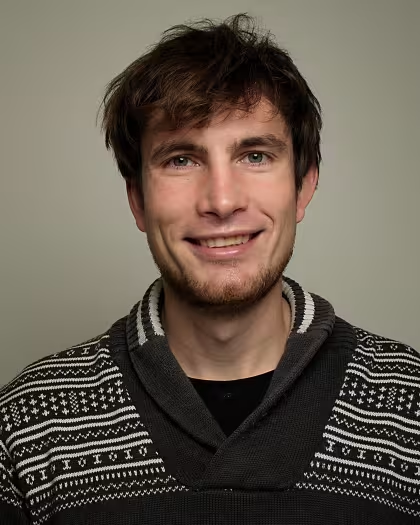
Julius Christopher Havsteen
Affiliation
- julius.havsteen@uib.no
- Visitor address
-
Allégaten 41
5007 Bergen - Postal address
-
P.O. Box 7803NO-5020 BergenNorway
Julius Christopher Havsteen
Affiliation
Research groups
Research
The objective of my research is to investigate the coevolution of Earth and life to better understand questions such as Earth surface evolution through time and how Earth became the only known habitable planet. My work revolves around how the Earth system responded to the mode and size of the first significant accumulation of oxygen in the atmosphere. This happened during the “Great Oxidation Event” (GOE), which took place some time between 2.4 and 2.1 billion years ago.
Currently, I study how manganese minerals form in ancient rocks dating back to and beyond the GOE, as well as in modern sediments. Through lab experiments, I explore different manganese formation pathways under low-oxygen conditions to understand the gradual rise of oxygen in Earth's early atmosphere and oceans. This work reveals how these processes governed the availability of bioessential nutrients such as Mo, Ni, Co, and Zn, as well as rare earth elements, with direct consequences for early life and the origin of economically significant ore deposits. I also use light and heavy stable isotopes as geochemical fingerprints, including molybdenum, iron, and carbon, to decode formation mechanisms and improve the calibration of palaeoredox proxies used to reconstruct ancient ocean chemistry.
Publications
Gogouvitis, M. D., Rosca, C., Kleinhanns, I. C., Havsteen, J. C., Van Kranendonk, M. J., & Schoenberg, R. (2026). Contrasting iron-rich chemocline deposits from the 2.35 Ga Kungarra Fm and 1.85 Ga Duck Creek Dolomite – Implications for the evolution of the Paleoproterozoic ocean (Pilbara Craton, Western Australia). Precambrian Research, 445, 108221. https://doi.org/10.1016/j.precamres.2026.108221
Havsteen, J. C., Fatima, M., Brunamonti, S., Pogány, A., Hausmaninger, T., Wolf, B., Well, R., & Mohn, J. (2026). Correction and calibration protocol for isotope data via CRDS: A study case for N₂O and other isotope systems. Atmospheric Measurement Techniques, 19(10), 3557–3580. https://doi.org/10.5194/amt-19-3557-2026
Rainford, S.-k., Havsteen, J. C., Mohn, J., Ammann, C., & Keel, S. G. (2026). Coupling observational methods and the DayCent model to improve examinations of N2O production pathways. Nutrient Cycling in Agroecosystems, 133, 6. https://doi.org/10.1007/s10705-026-10504-1 [Co-first authorship with S.-k. Rainford.]
Barczyk, L., Jocher, M., Havsteen, J. C., Mohn, J., Six, J., & Ammann, C. (2026). Temporal dynamics of N2O emissions from pasture urine patches: Drivers and source processes. Nutrient Cycling in Agroecosystems, 133, 5. https://doi.org/10.1007/s10705-026-10498-w
Havsteen, J. C., Eickmann, B., Izon, G., Kleinhanns, I. C., Rosca, C., Beukes, N. J., & Schoenberg, R. (2024). Atmospheric oxygenation at the onset of Earth's Great Oxidation forced enhanced marine anoxia. South African Journal of Geology, 127(2), 455-472. https://doi.org/10.25131/sajg.127.0002
Havsteen, J. C., Kleinhanns, I. C., Schröder, S., Eickmann, B., Izon, G., Gogouvitis, M. D., Ngobeli, R., Beukes, N. J., & Schoenberg, R. (2023). Evidence for contemporaneous deposition of the Duitschland and Rooihoogte formations (Transvaal Supergroup): Implications for tempo and mode of Earth's Great Oxidation. Precambrian Research, 391, 107055. https://doi.org/10.1016/j.precamres.2023.107055
Del Rey, Á., Havsteen, J. C., Bizzarro, M., & Dahl, T. W. (2020). Untangling the diagenetic history of uranium isotopes in marine carbonates: A case study tracing the δ238U composition of late Silurian oceans using calcitic brachiopod shells. Geochimica et Cosmochimica Acta, 287, 93-110. https://doi.org/10.1016/j.gca.2020.06.002