
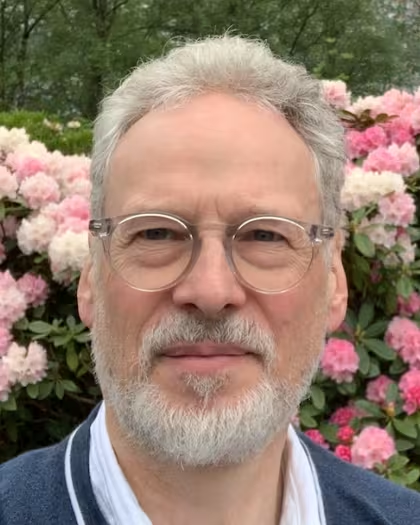
Koenraad De Smedt
Position
Emeriti, Computational Linguistics
Affiliation
- desmedt@uib.no
- Phone number
- +47 55582052
- Visitor address
-
Sydnesplassen 7
5007 Bergen - Postal address
-
P.O. Box 7805NO-5020 BergenNorway
Follow me
Koenraad De Smedt
Position
Emeriti, Computational Linguistics
Affiliation
Research
Research field: Computational Linguistics
Research documentation: Nasjonalt vitenarkiv
Publications
2024
- Miguel Angel Quesada Pacheco; Koenraad De Smedt (2024). Distancia lingüística entre la lengua cueva y la familia chocó. Aproximación estadística. (external link)
- Nedelina Vasileva Naydenova; Marita Kristiansen; Koenraad De Smedt (2024). Fremtidsrettet studium i digitale språkressurser. (external link)
- Koenraad de Smedt; Iulianna van der Lek; Henk van den Heuvel et al. (2024). CLARIN in training and education. (external link)
2023
- Iram Nazir; Koenraad De Smedt (2023). On the use of prepositional verbs by Pakistani ESL learners: A corpus study. (external link)
- Koenraad De Smedt (2023). CLARINO. (external link)
- Koenraad De Smedt; Ole Martin Skilleås (2023). Mineralitet som leksikografisk utfordring: maskinlæring som tilnærming til semantikken. (external link)
- Erik Ketzan; Kim Nayyer; Quinn Dombrowski et al. (2023). Legal Issues in Digital Humanities: Analysis of Recent Advocacy and Continuing and Emerging Issues. (external link)
2022
- Margunn Rauset; Gyri Smørdal Losnegaard; Helge J. Jakhelln Dyvik et al. (2022). Words, Words! Resources and Tools for Lexicography at the CLARINO Bergen Centre. (external link)
- Victoria Rosén; Koenraad De Smedt (2022). Managing Treebank Data with the Infrastructure for the Exploration of Syntax and Semantics (INESS). (external link)
- Philipp Conzett; Koenraad De Smedt (2022). Guidance for Citing Linguistic Data. (external link)
- Ole Martin Skilleås; Koenraad De Smedt (2022). Mineralitet - hva det egentlig betyr. (external link)
2021
- Koenraad De Smedt (2021). Contagious "Corona" Compounding by Journalists in a CLARIN Newspaper Monitor Corpus. (external link)
- Victoria Rosén; Helge J. Jakhelln Dyvik; Paul Meurer et al. (2021). Søk i NorGramBank for leksikografiske formål. (external link)
- Koenraad De Smedt (2021). A FAIR infrastructure for sharing, reusing and citing language data. (external link)
- Koenraad De Smedt (2021). Progressive aspect in Norwegian: A preliminary corpus study. (external link)
- Jan Magnus Aronsen; Koenraad De Smedt; Ingrid Heggland et al. (2021). Hvordan skal vi dele forskningsdata? Utredning og anbefalinger om lisensiering og tilgjengeliggjøring. (external link)
- Lauren Gawne; Andrea Berez-Kroeker; Helene N. Andreassen et al. (2021). Using the Tromsø Recommendations to cite data in language work. (external link)
- Christoph Trattner; Dietmar Jannach; Enrico Motta et al. (2021). Responsible media technology and AI: challenges and research directions. (external link)
CV
Koenraad de Smedt studied English and Linguistics at the University of Antwerp (Belgium) where he received his degree in 1977. He became researcher, first in Antwerp and from 1983 in Nijmegen (The Netherlands) in the areas of computational linguistics, psycholinguistics and language technology. In 1985 he became lecturer at the Dept. of Experimental Psychology in Nijmegen, where he obtained his PhD in 1990 with a dissertation titled Incremental sentence generation: A computer model of grammatical encoding. In 1993 he moved to Leiden University. Since 1995 he has been professor in Computational Linguistics at the University of Bergen (Norway) and has also been affiliated part time with Unifob and Uni Research. His current academic interests are in computational and corpus linguistics and language research infrastructure. From 1996 to 1999 he coordinated the Norwegian partnership in a European project on automatic proofreading. From 1996 to 2000 he coordinated a large scale Socrates thematic network project on Advanced Computing in the Humanities. From 2001 to 2005 he was coordinator of the Norwegian Documentation Center for Language Technology. From 2002 he coordinated three consecutive Marie Curie training projects on language resources and technologies. From 2004 to 2008 he led the Norwegian research project TREPIL on treebanking. From 2008 to 2024 he participated in CLARIN and planned and coordinated the national CLARINO research infrastructure.