

Mathematicians have calculated how a zombie epidemic could unfold
What would happen if zombies suddenly became real and a zombie epidemic broke out in Norway? Mathematicians at the University of Bergen and the University of Gothenburg have explored exactly that question. Their findings may help us better understand how infectious diseases spread through populations.
By: Amanda Schei
Published: (Updated: )
In popular culture, zombies are known as a type of "living dead" creature that does not do much thinking and has few goals in life. Usually, they have just one thing on their agenda: turning more people into zombies.
This has led physicists and mathematicians to view zombies as an interesting case for exploring how contagion spreads. What if the zombie analogy is used to represent something else entirely, such as a virus, a rumour, or misinformation?
That is precisely what researchers at the University of Bergen (UiB) and the University of Gothenburg (GU) set out to investigate.
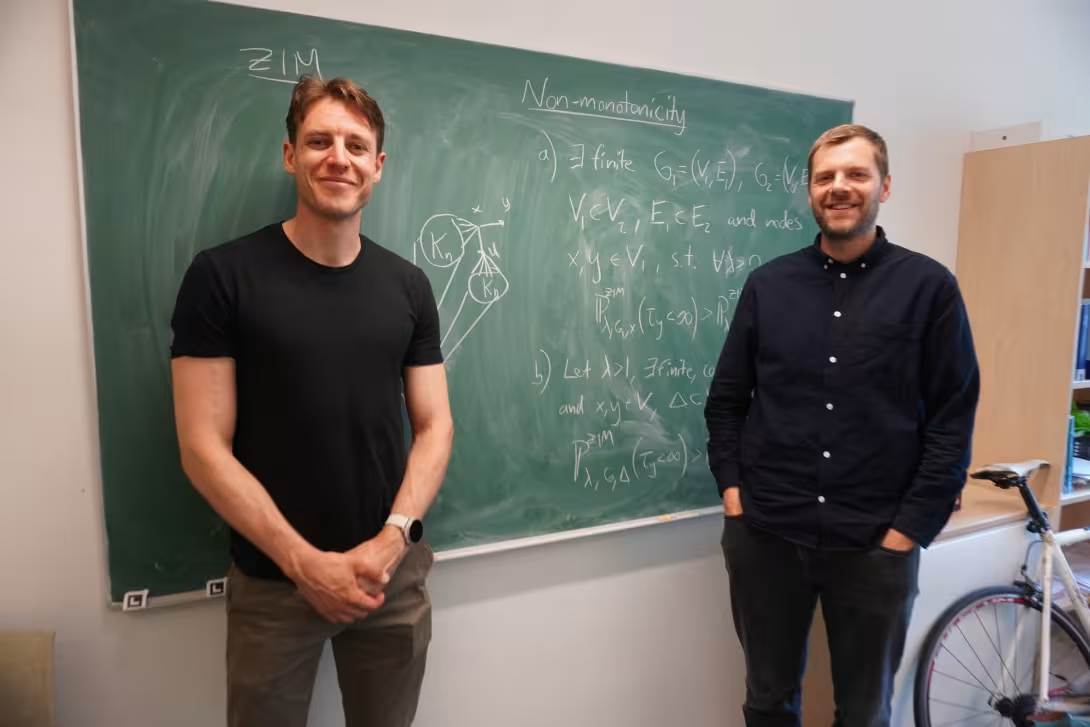
“We wanted to gain a better understanding of how infectious diseases spread through a population,” says Stein Andreas Bethuelsen, Associate Professor at the Department of Mathematics at UiB.
Pen, paper and logic
Previous studies of zombie epidemics have largely been based on computer simulations, including a model developed by researchers at Cornell University in the United States. The researchers at UiB and GU instead used mathematical proofs to analyse this very model, taking the work a step further.
“Simulations show what happens in specific scenarios. Mathematical analysis makes it possible to draw more general conclusions about how the model behaves,” says Samuel Modée, a PhD candidate at the Department of Mathematics at UiB.
So what does that actually mean?
Bethuelsen explains:
“We simply used pen, paper and logic. Then we applied mathematical arguments to prove how the model actually works.”
The work on the zombie model began when mathematician Erik Broman from the University of Gothenburg contacted the Bergen researchers with an idea he had been considering for several years.
The result is what the researchers believe to be the first thorough mathematical analysis of the model.
“We actually had a hypothesis about what we expected to find, but the results showed the opposite,” says Modée.
Zombies are just an excuse
The zombie model is a variation of the classical epidemic models, known as SIR models. These were used during the Covid-19 pandemic to explain and predict patterns of disease transmission.
In traditional epidemic models, a higher transmission rate makes it more likely that an outbreak will develop into a pandemic and spread throughout an entire network of people.
However, when the mathematicians analysed the zombie model, they found that this was not the case here.
“One of our main findings is that a higher infection rate can actually make it less likely that the epidemic will spread throughout the entire network. This came as a surprise to us,” says Modée.
The mathematical analyses show that extremely rapid transmission can, in some situations, cause an epidemic to die out earlier than it otherwise would have. Bethuelsen explains:
“If the infection spreads very quickly, it may reach small and vulnerable parts of the network first and be stopped there before it reaches the areas where it could really take off. In a sense, the infection can end up sabotaging itself.”
If the infection must pass through specific contact points or bottlenecks in order to continue spreading, the entire epidemic may effectively come to a halt if those connections are broken.
A kind of quarantine model
In a classical epidemic model, infected individuals eventually recover on their own. That would not work in a universe where zombies existed. For a zombie remains a zombie until it is taken out by a healthy human.
This is one reason why the zombie model differs from traditional disease models. Modée says it can also be interpreted as a kind of quarantine model.
“In a normal epidemic, we try to prevent further transmission by isolating infected individuals. With zombies, that would not work. The only way to stop the spread is to make sure the zombie can no longer infect anyone else. Mathematically, it is the same mechanism,” says Modée.
The mathematicians believe their findings could potentially be relevant to real-world disease outbreaks.
“Many models are based on the assumption that the faster a disease spreads, the greater the risk of a pandemic. Our results show that this is not necessarily always the case. This model challenges the assumption in traditional epidemic models that a higher transmission rate always leads to a greater pandemic risk,” says Bethuelsen.
Smart to live far from other people
The fictional zombie epidemic serves primarily as a tool for understanding other types of transmission processes.
But what would the researchers themselves do if they woke up one morning to headlines about a possible zombie apocalypse?
“I would move to a small village with very few connections to the outside world,” says Modée.
“Yes, ideally you should be somewhere so remote that nobody would expect anyone to live there,” Bethuelsen adds.
References
Bethuelsen, S. A., Broman, E., & Modée, S. (2026). The Zombie Infection Model. ArXiv Preprint. https://arxiv.org/abs/2607.29409 (external link)
Alemi, A., Bierbaum, M., Myers, C., & Sethna, J. (2015). You can run, you can hide: The epidemiology and statistical mechanics of zombies. Physical Review E, 92. https://doi.org/10.1103/PhysRevE.92.052801 (external link)