

Wants AI to tackle climate challenges in new centre: "Take advantage of the best of both worlds"
The main goal of the centre is to transform the provision of weather, climate and environmental information to enable better- informed decisions in the face of unprecedented environmental challenges. All this by using artificial intelligence.
By: Tori Pedersen
Published: (Updated: )

Stefan Sobolowski has together with a team of researchers and partners submitted a application to the Research Council of Norway to establish a centre, with the name Raise Up, Centre for Accelerating AI Advances for the Earth System and Society.
The centre also wants to accelerate the development and integration of cutting-edge AI with Earth sciences and improve the reliability, usability and delivery of weather, climate, and environmental information for society.
Sobolowski, who has written the application, is a researcher at the Geophysical Institute at the University of Bergen and the Bjerknes Centre for Climate Research (external link).
– The main objective of the centre is to leverage the current revolution that's happening in data science and the development of so-called artificial intelligence generally. To combine it with advances in Earth system sciences so we can provide information about the changing climate system. In both an improved and a more rapid manner, Sobolowski says.
Interaction
He adds that it also will be important to improve the observational networks and the ability to observe the environment around us, whether it is in the ocean, in the ecosystems or on land.
– And thirdly to improve the way that non expert users of all the data that we produce as scientists are utilized by society and changing the way that we interact with the data, he says.
The application covers a broad field. From incorporating machine learning and AI into climate models, developing entirely new models based on artificial intelligence, to utilizing large language models to make them more specific so they can be used more effectively to provide information about, for example, the consequences of climate change to decision-makers.
Early warnings
Together with research partners and stakeholders from the private and public sectors, they aim to build reliable quality assurance in all the solutions they develop. This will provide a better understanding of how generative AI works in the background.
– A lot of the work in the in the centre will be focusing on so-called explainable AI, which helps us understand how and why the algorithms come up with the answer. And this is especially important for things like early warning systems for extreme weather. Or for tipping points in the climate system in the future, it's really important to have an understanding of how it gets to the conclusions, Sobolowski says.
The application aims to achieve several goals along the way. Among other things, it seeks to move towards a hybrid model of the Norwegian Earth System Model, which has been an important tool for Norwegian climate researchers in studying past, present, and future climates. A hybrid model will then have components based on machine learning and artificial intelligence, but also physical components similar to the current physical models we use for climate and weather today.
– It will be a combination that takes advantages from the best of both worlds.
Time-saving
Another essential aspect of AI is reducing waiting times. Data-driven solutions can perform tasks much faster.
– AI can dramatically reduce what we would call the time to delivery. And that's critically important, especially for climate, because current approaches are too slow in the face of our rapidly changing Earth system, he says.
– Making models faster and less costly will be a significant advancement, but we cannot increase the speed without also ensuring that the results are robust and reliable. That is where the biggest challenges lie.
The idea behind the center is also to accelerate the development of tools that can downscale weather and climate information to local scales, which can be used to make decisions regarding extreme weather warnings and climate adaptation.
Trustworthy-AI
Sobolowski also highlights chat-based approaches and language models, where there is also an ethical responsibility, especially if they are to be used to support decisions made around climate change.
– We cannot have a system that hallucinates. We need robust quality assurance, which is something that is in its infancy for these tools.
This is something Sobolowski personally finds particularly exciting in the center's application. To see what they can achieve with the language models, if they can reach a point where they are reliable enough to support decision-makers.
– My scientific interest lies in our ability to say something about how the climate is changing and will change in the future. For example, for extreme events like heat waves, droughts and extreme precipitation. But as a citizen of the world, I would say that chat-based features are very interesting. I think it can open up in many other fields, not just for climates and disaster risk preparedness.
Partners
Jørn Kristiansen is the Director of forecasting service development at the Norwegian Meteorological Institute, which is one of the partners in the application.
– Artificial intelligence and machine learning have the potential to revolutionize weather and climate simulation, especially in weather forecasting. These technologies can not only improve accuracy, reduce computation time, and lower costs, but also open up new ways to address both existing and future challenges, Kristiansen says.
– For over ten years, MET has been running fully automated weather forecast production on Yr. With AI and ML, we see opportunities to put the user even more at the center of our research-driven service development. This can provide more interactive services and tailored forecasts – including for climate hazards and extreme weather – adapted to users' needs, he says.
Wide range
From the public sector, the Norwegian Climate Service Center (KSS) is also a partner. KSS will provide the knowledge base for climate adaptation in Norway, which involves advising municipalities, among others, on the consequences of climate change they need to consider in their planning, says Anita Verpe Dyrrdal, head of the Norwegian Climate Service Center and climate researcher at the Norwegian Meteorological Institute.
– To make this information locally relevant and tailored to different needs, we want to use AI-based language models. These can help quickly extract relevant data and information tailored to the user's questions. In this way, we can make the knowledge more accessible and easier to use, so that society can better handle climate change, Dyrrdal says.
She adds that it is important for users to receive professionally robust answers in Norwegian, so that the knowledge can be safely used in climate adaptation work.
– We therefore need to train the model with good datasets and conduct extensive testing. We also need to work across disciplines to present the knowledge in an understandable way, including a good description of the uncertainty.
To achieve its goals, the center aims to leverage the knowledge we have in systems science in Norway, but it will also collaborate internationally. Among others, the European Centre for Medium-Range Weather Forecasts and the National Center for Atmospheric Research in the USA.
– We recognize that it will require a range of approaches to come up with robust solutions. There will not be a single simple solution that provides new answers. It will not be one silver bullet.
– We look forward to utilizing the insights developed in this center, but also in the other centers, so that we can advance our understanding, says Sobolowski.
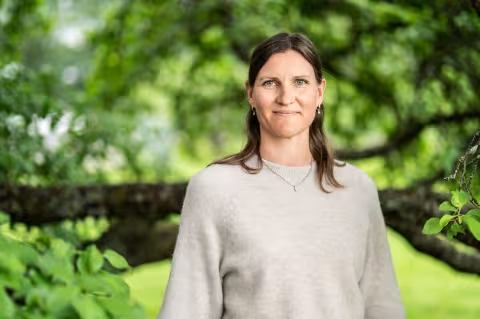
Anita Verpe Dyrrdal.