

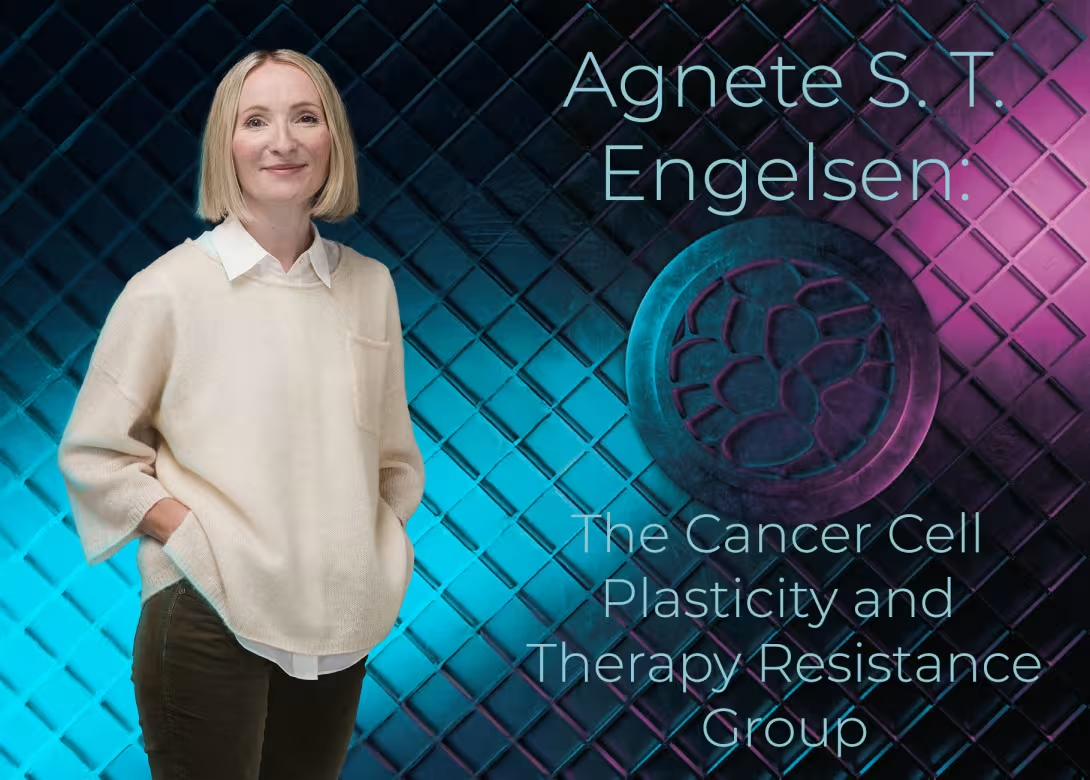
Agnete S.T. Engelsen
The Cancer Cell Plasticity and Therapy Resistance Group.
About the research group
Agnete Engelsen completed her Cand. Scient. in cell and developmental biology at the University of Bergen in 2003, and her PhD at the same university in 2013. Since 2013, Engelsen did her postdoctoral training in the Cellular Networks Laboratory, mentored by CCBIO PI Professor James B. Lorens. From 2017–2020 she continued as a Marie Skłodowska-Curie Actions (MSCA) fellow to pursue the research project Impact of cellular epithelial plasticity programs on the anti-tumor response, co-mentored by Professor James B. Lorens, Salem Chouaib and Jean Paul Thiery at the Gustave Roussy Cancer Center in Paris, France. From 2023 to 2025, Engelsen was heading the CCBIO Research School for Cancer Studies (RSCS).
Brief group presentation and history
The research group was established in 2022, when Engelsen became an associate PI of CCBIO’s Team 2: Discovery and validation of cancer biomarkers.
Research focus of the group
Recent research from CCBIO laboratories and others has shown that extracellular stressors, including exposure to anticancer therapies, low oxygen availability, immune editing, and extracellular matrix interactions, contribute to promoting phenotypic epithelial-to-mesenchymal plasticity, a well-recognized cancer hallmark. As a postdoc and later researcher with CCBIO, Engelsen has been dedicated to exploring how phenotypic plasticity interferes with therapeutic efficacy and immune cell-mediated killing. The existence of rare cancer cells that sporadically acquire drug tolerance through epigenetic mechanisms is proposed as one mechanism that drives cancer therapy failure. The group has shown that hypoxia, targeted therapies and specific microenvironments impose non-sporadic expression of Axl, a driver of epithelial phenotypic plasticity and therapy resistance.
Subprojects
The group has been dedicated to establishing improved preclinical models of non-small cell lung cancer (NSCLC) to explore how phenotypic plasticity interferes with therapeutic efficacy and immune cell-mediated killing. The current projects aim to unravel the best molecular targets to prevent phenotypic plasticity-driven therapy resistance and immune escape in solid tumors, and to elucidate the effect of phenotypic plasticity on the spatial organization of the tumor immune microenvironment, to uncover predictive mechanisms of resistance in ICI-treated NSCLC patients.
In one of the group’s subprojects, they explore a therapeutic intervention with hyperbaric oxygen therapy (HBOT) to improve the efficacy of immune checkpoint inhibition by modulating the metabolism of and crosstalk between malignant cells and cells of the tumor immune microenvironment. The goal of this project is to address the remaining clinical challenge, that most NSCLC patients do not experience long-term benefit from ICI therapy.
Translational, clinical, and societal importance
The group’s results provide insight into the complex molecular alterations and immune cell dynamics serving as potential biomarker signatures of the tumor microenvironment that predict response to ICI treatment in NSCLC. Results from their studies support the role of Axl as a negative-feedback mechanism to anti-tumor immunity and warrant future combination therapy trials to overcome ICI-resistance in NSCLC patients.
Future perspectives from 2024
From 2022, Engelsen coordinates the INTPART project “Bergen- Harvard Cancer Studies: A partnership for Excellent Education and Research”. It is her ambition to continue this successful research collaboration in CCBIO’s continuation phase. Together with peers from the Vascular Biology Program at Boston Children’s Hospital and Harvard Medical School, she recently organized the 2nd CCBIO-VBP Research Meeting, a great opportunity for trainees to engage in the fruitful research and education partnership initiated by CCBIO’s Director Lars A. Akslen together with the VBP Director Marsha A. Moses. As head of the Research School for Cancer Studies, Engelsen’s ambition is to continue developing the research school activities and provide an inspirational learning environment for new generations of cancer researchers in Bergen.
Results from the CoE period 2013-2024
Most important results
The Engelsen group has shown that targeting Axl impacts the immune system in several ways: 1) via the release of damage-associated molecular patterns (DAMPs) to attract immune cells to the tumor bed, 2) via the modulation of MHC class 1 molecules that aid in the presentation of peptides on the cell surface for recognition by T cells, and 3) via modulation of adhesion molecules involved in the successful formation of an immune synapse.
In collaboration with peers at the Gustave Roussy Cancer Center, the group has shown that Axl targeting overcomes resistance of mesenchymal phenotype human lung cancer cells to Natural Killer (NK) cells and Cytotoxic T-lymphocytes (CTL) mediated cytotoxicity. This is an important finding because it indicates that Axl plays an important role in mediating the fatal encounter, and the formation of a successful immunological synapse between the killer and the cancer cell.
Most important papers
- Jokela TA et al. Microenvironment-Induced Non-sporadic Expression of the AXL and cKIT Receptors Are Related to Epithelial Plasticity and Drug Resistance. Front Cell Dev Biol 2018. PMID: 29719832.
- Engelsen AST et al. AXL Is a Driver of Stemness in Normal Mammary Gland and Breast Cancer. iScience 2020. PMID: 33103086.
- Lotsberg ML et al. AXL Targeting Abrogates Autophagic Flux and Induces Immunogenic Cell Death in Drug-Resistant Cancer Cells. Journal of Thoracic Oncology (JTO) 2020. PMID: 32018052.
- Terry S et al. AXL Targeting Overcomes Human Lung Cancer Cell Resistance to NK- and CTL-Mediated Cytotoxicity. Cancer Immunol Res 2019. PMID: 31488404.
- Lotsberg ML et al. Intrinsic Differences in Spatiotemporal Organization and Stromal Cell Interactions Between Isogenic Lung Cancer Cells of Epithelial and Mesenchymal Phenotypes Revealed by High-Dimensional Single-Cell Analysis of Heterotypic 3D Spheroid Models. Front Oncol 2022. PMID: 35530312.
- Rayford A et al. AXL expression reflects tumor-immune cell dynamics impacting outcome in non-small cell lung cancer patients treated with immune checkpoint inhibitor monotherapy (in preparation, 2024).
Other important outputs and achievements
Books: Engelsen has contributed three book chapters as senior and corresponding author (Biomarkers of the Tumor Microenvironment: Basic Studies and Practical Applications (eds. Akslen and Watnick, 2017); Biomarkers of the Tumor Microenvironment (eds. Akslen and Watnick, 2022; and Autophagy in Immune Response: Impact on Cancer Immunotherapy (ed. Chouaib, 2020).
Awards: Best PhD of the Year at the Medical Faculty, UiB, 2014. Graduation certificate with distinction, and Recognition of excellence award on the Hallmarks of Cancer Team Project at HICR Postgraduate Medical Education, Harvard Medical School, 2019. Faculty of Medicine’s elect for the UiB’s career development program Momentum in 2019/20.
Memberships: Member of European Organization for Research and Treatment of Cancer Pharmacology and Molecular Mechanisms (EORTC PAMM) group, Marie Curie Alumni organization (MCAA), Harvard Alumni association (HAA).
Special grants: FRIPRO Mobility Grant, personal overseas mobility grant — Co-funded by RCN and the EU 7th FP Marie Curie Actions (MCA COFUND).
CCBIO significance
Engelsen is grateful for the continued support from CCBIO mentors Lars A. Akslen and James B. Lorens throughout the years and for fruitful collaborations within the extended CCBIO family, including international faculty. Furthermore, Engelsen is grateful for the opportunities to participate with increasing responsibilities in CCBIO’s research school activities.