

Elisabeth Wik
Breast Cancer of the Young - Bergen (BCY-B).
About the research group
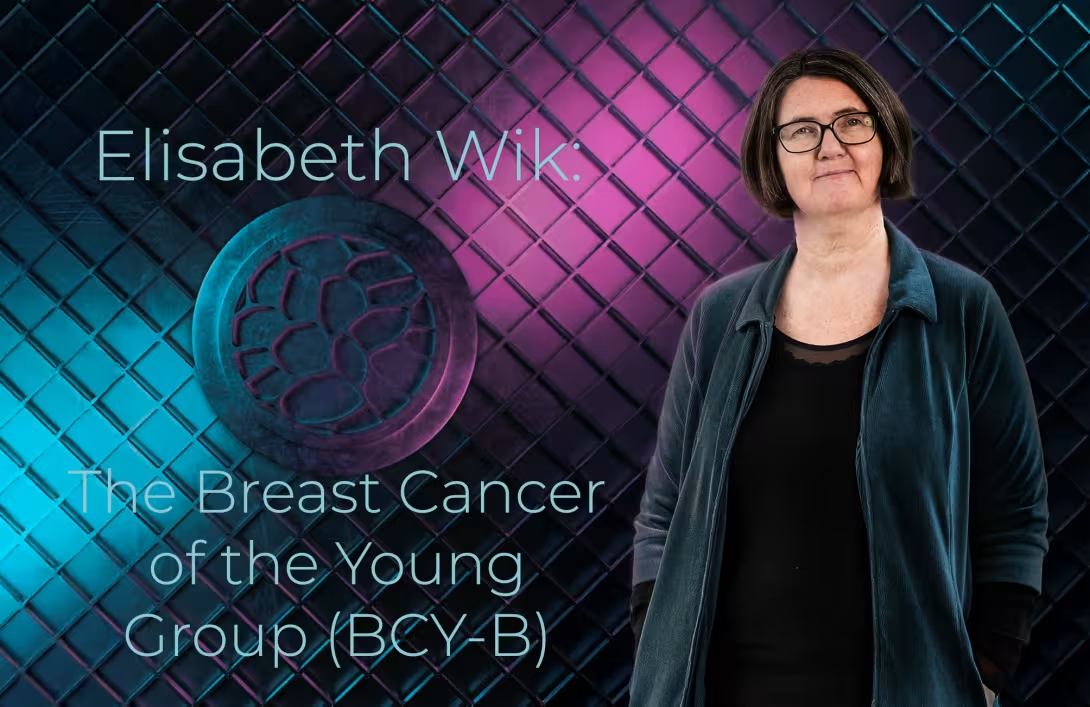
Elisabeth Wik completed her MD at the University of Bergen in 1998, and her PhD in 2013 (UiB). She did residency in gynecology, obstetrics and surgery in 2002–2007; and residency in pathology in 2013–2016. She was a postdoc at CCBIO in 2013–2018; consultant in pathology from 2017, and associate professor from 2018. From 2018–2023, she was Head of CCBIO’s Research School for Cancer Studies. She has also served as coordinator for the CCBIO-VBP INTPART project. From 2022, she is Head of the Department of Pathology, Haukeland University Hospital, and she has been group leader of the Breast Cancer of the Young Group since 2019.
Brief group presentation and history
The research group Breast Cancer of the Young — Bergen (BCY-B) was established in 2019. Two PhD candidates and two Medical Student Research Program students (UiB) were part of the group from the beginning. Since then, the group has expanded and today counts two PhD candidates (MD Anna K.M. Sæle, MD Rasmus O.C. Humlevik), three Medical Student Research Program students (Amalie Bark Kvamme, Ulrikke Hugaas, Amalie Fagerli Tegnander), and one pre-PhD student (MD Astrid A. Syrtveit). Researcher Erling A. Høivik teamed up with the group in 2022. In 2023, Lise M. Ingebriktsen completed the first PhD from the group.
Høivik was from 2023 co-leader of the CCBIO Research School for Cancer Studies together with Agnete Engelsen, and from 2025, he took over as the sole leader of the Research School as Engelsen took on new responsibilities. He is academically responsible for CCBIO908 (Scientific Writing and Communication Seminar) and CCBIO906 (Cancer Genomics).

Research focus
Young patients with breast cancer experience more aggressive tumors and poorer survival compared to what is expected based on traditional clinico-pathologic prognostic measures. Breast cancer (BC) in the young (age ≤ 40 at diagnosis) is one of the most frequent causes of death among women in this age group. The research group BCY-B studies age-related breast cancer biology, aiming for diagnostic biomarker development and improved prognostication for the group of young breast cancer patients — a project of high clinical relevance.
There is a gap in the understanding of age-related tumor alterations in BC, how these contribute to the increased tumor aggressiveness seen in young patients, and whether this should affect the diagnostic and treatment strategies. This also applies to the comprehension of immune cell and tumor angiogenesis phenotypes among the young, and how these inter-relate towards cancer aggressiveness, prediction of therapy resistance, and outcome. The group’s results show more frequent aggressive tumor features like high histologic grade, lymph node metastases, triple negative and HER2+ phenotypes, increased proliferation, and reduced survival in BC patients ≤40 years, clearly pointing out the need to consider age-related biological differences in clinical management.
Subprojects
- Age-related biological tumor characteristics affecting clinical outcome
- Estrogen receptor-related biology in breast cancer of the young
- Age-dependent transcriptomic alterations in breast cancer of the young
- Age-dependent differences in immuno-angiogenic responses in breast cancer
- Targets for therapy in primary and metastatic lesions in breast cancer of the young
Translational, clinical, and societal impact
Breast cancer of the young is recognized to pose specific societal challenges (e.g. contribution to family life; work life, etc.). The group regards this project as having the potential to contribute to major scientific, clinical, and societal impact. Study results from the BCY-B group have provided attention to the group of young breast cancer patients, and the particular attention this group would need, based on age-related tumor characteristics, pointing to a need for age-based therapy guidance and follow-up. The clinical and societal impacts from the BCY-B study results are emerging, as the group is asked to present data from their studies for the leading national diagnostic and clinical environment.
Future perspectives from 2024
The BCY-B studies will continue the tissue-based studies, integrating histopathologic, clinical, and molecular data, with support of large-scale (omics) data. Continued work includes projects focusing on age-dependent hormone receptor-related alterations, the breast cancer immune cell landscape across ages, and metastases in the young, and will include spatial biomarker information for improved understanding of cancer progress. The BCY-B leadership aims to establish international networks on cancer of the young — aiming for BCY-B to make a difference in research and clinical medicine, particular for the younger breast cancer patients.
Results from the CoE period 2013-2024
Most important results
- The identification of an age-related proliferation-based six-gene signature with strong prognostic value in breast cancer with potential clinical relevance is considered a major finding. Several follow-up studies on age-related breast cancer biology build on the results from this study.
- The proliferation marker Ki67 presents a poorer prognostic value in young patients with breast cancer.
- The estrogen receptor-related factors GATA3, TFF1, and AGR2 are identified as prognosticators with biological roles independent from estrogen receptors that may interfere with tumor progression and responses to anti-hormonal therapies.
Most important papers
- Ingebriktsen LM et al. Age-related clusters and favorable immune phenotypes in breast cancer of the young. Mod Pathol 2024. PMID: 38810731.
- Svanøe AA et al. Age-related phenotypes in breast cancer: A population-based study. Int J Cancer 2024. PMID: 38319154.
- Ingebriktsen LM et al. A novel age-related gene expression signature associates with proliferation and disease progression in breast cancer. Br J Cancer 2022. PMID: 35995935.
- Sæle AKM et al. Loss of GATA3 expression associates with immune responses and metabolic alterations in aggressive breast cancer. (Submitted 2024).
- Syrtveit AA et al. Tumor Necrosis Associates with Aggressive Breast Cancer Features, Increased Hypoxia Signaling and Reduced Patient Survival. (submitted 2024).
- Humlevik ROC et al. Young patients with breast cancer: more aggressive tumor features, reduced survival, and treatment differences. (submitted 2024).
Other important output and achievements
Members of BCY-B have co-authored several book chapters in the CCBIO period (2013–2023):
- Genomic Landscapes and Tumor Evolution in Metastatic Gynecological Cancers. E.A. Høivik. Book chapter in “Metastasis”. Editor Consolato M. Sergi. Exon Publications, 2022.
- HER2 revisited — Reflections on the future of cancer biomarker research. A. Bremer, E. Wik, L.A. Akslen. Book chapter in the anthology «Precision Oncology: Issues at Stake and Matters of Concern”. Editors Anne Bremer & Roger Strand. Springer Verlag, 2021.
- Gene Expression Signatures of the Tumor Microenvironment: Relation to Tumor Phenotypes and Progress in Breast Cancer. E. Wik, L.M. Ingebriktsen, L.A. Akslen. Book chapter in “Biomarkers of the Tumor Microenvironment (2. edition)”. Editors: L.A. Akslen & R. Watnick. Springer Verlag, 2021.
- What is a good (enough) biomarker? A. Blanchard & E. Wik. Book chapter in “Social, ethical and economic aspects of cancer biomarkers.” Editors: Anne Blanchard & Roger Strand. Megaloceros Press, 2017.
- Gene Expression Signatures of the Tumor Microenvironment: Relation to Tumor Progress in Breast Cancer. E. Wik & L.A. Akslen. Book Chapter in “Biomarkers of the Tumor Microenvironment.” Editors: LA Akslen R Watnick. Springer Verlag, 2017.
Awards:
- Ulrikke Hugaas (2022): Poster award winner, 6th SCANPATH 2022 (“Metastatic ER, PR and HER2 expression in young breast cancer patients”).
- Amalie Fagerli Tegnander: Talent award, Sparebank1 Midt-Norge.
- Elisabeth Wik (2019): UiB Medical Faculty Award for Internationalization in the study programs (for running the CCBIO-INTPART program).
- Elisabeth Wik and Lars A. Akslen (2017): Thon Foundation Prize for National Educational Research Projects («Harvard Cancer Research: Partnership for excellent education and research”).
- Amalie A. Svanøe (2016): Presentation award at the European Conference of Pathology.
- Elisabeth Wik (2016): Professor Kreyberg’s Award for second best PhD thesis in experimental pathology (the prize is being awarded every 4th year).
- Elisabeth Wik (2009–2015): International awards for scientific presentations (European Congress of Pathology, Belgrade/2015; European Congress of Pathology, Prague/2012; Research School Clinical Medicine, Haukeland University Hospital, Annual Meeting on Research Presentations; 2010; Bi-annual Meeting of European Society of Gynecologic Oncology, Belgrade/2009.)
CCBIO significance
"CCBIO has provided a motivating research (micro and macro) environment — stimulating us to establish our independent research group. It has been a vivid environment for our students and PhD candidates with vast possibilities for joining high-quality research courses, seminars, and workshops. Being part of CCBIO has also given us valuable networking possibilities both locally and with international faculty."