

Lars A. Akslen – The Cancer Biomarkers Group
Professor Akslen is a specialist in surgical pathology and is directing the Tumor Biology Research Group at the Department of Clinical Medicine (University of Bergen). Since 2013, he is also the director of Centre for Cancer Biomarkers CCBIO. Akslen´s team, as is CCBIO, is engaged in translational cancer research.
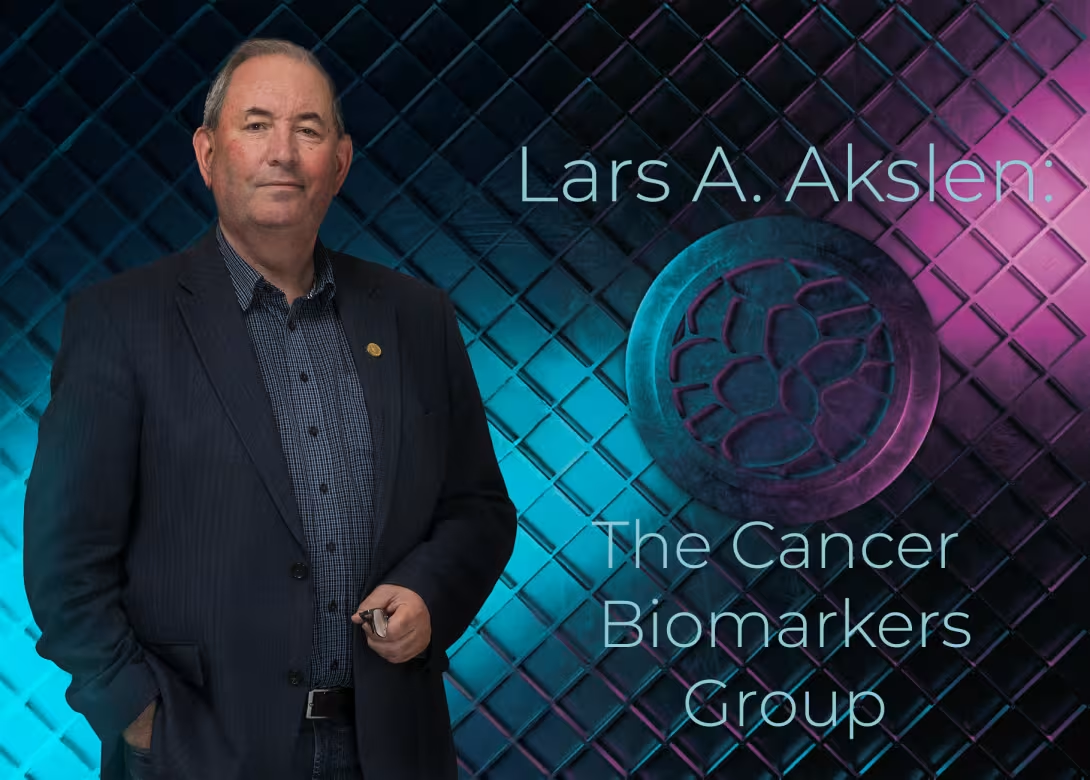
Lars A. Akslen
Lars A. Akslen, MD, PhD, is a trained surgical pathologist. He became an associate professor at UiB and senior consultant at Haukeland University Hospital in 1988, and a full professor in medicine (tumor pathology) in 1993 (UiB). His PhD thesis (1993, on thyroid cancer) was performed in part at the Cancer Registry of Norway. Akslen has had several research visits abroad, e.g. at the University of Pennsylvania (1998–1999), invited by Virginia A. LiVolsi, and at Harvard Medical School and Boston Children’s Hospital (2004–2005), invited by Judah Folkman. He has received multiple awards, such as King Olav V’s Cancer Research Award (2009) and the Helse Vest Research Award (2023; second time). Akslen is an elected member of the Norwegian Academy of Science and Letters (2013) and of Academia Europaea (2023). He has been the Director of CCBIO since 2013.
Brief group presentation and history
At first, Akslen’s research was pathology based and focused on markers and regulation of tumor proliferation (Ki67, p16, p53) in different tumor types. His research team, the Tumor Biology Research Group, was initiated in 1995 at The Gade Institute (UiB). At the same time, he became interested in the tumor microenvironment, and subsequently several papers were presented on tissue based vascular metrics and tumor biomarkers, especially in breast cancer (Salvesen et al., J Clin Oncol 1999; Foulkes et al., JNCI 2003; Stefansson et al., J Clin Oncol 2004; Bachmann et al., J Clin Oncol 2006; Stefansson et al., Cancer Res 2006; Gravdal et al., Cancer Res 2009; Salvesen et al., PNAS 2009; Straume et al., PNAS 2012). In a long-lasting collaboration with Randy Watnick from the Folkman lab and VBP, several papers have been presented on properties of the tumor microenvironment (Kang et al., PNAS 2009; Catena et al., Cancer Discov 2013; Wang et al., Science Transl Med, 2016; Sui et al., Nat Commun 2022).
CCBIO was established in 2013, and Akslen’s team decided to focus on proteomics of breast cancer. Later, the ‘in situ proteomics’ technique of imaging mass cytometry (IMC) was established, enabling single-cell spatial analytics of tumor tissue sections. Recently, the team has focused on the expanding field of cancer neuroscience.
Research Focus
The research focus is to discover and validate novel tissuebased cancer biomarkers for molecular grading, especially related to the tumor microenvironment — for improved biological understanding and better prediction of aggressive tumor behavior and treatment response.
Subprojects
1. Stromal proteomic patterns and stratification of breast cancer
2. Breast cancer hypoxia responses at the proteome level
3. Markers of cancer-neural interactions in primary and metastatic breast cancer
4. Roles of Nestin and Stathmin in BRCA1-related and basallike breast cancer
Future perspectives from 2024
The Akslen group will continue to use single-cell mapping of cancer architecture to define multicellular niches with potential functional importance. The group will explore the phenotypic diversity and complexity of breast cancer subtypes. In particular, interactions between tumor cells and nerves, immune cells and vascular cells will be focused upon. Hopefully, this strategy will increase the precision of prognostic and treatment-predictive biomarkers.
Results from the CoE period 2013-2024
Most important results
1. Proteomic profiling of laser captured micro-dissected breast cancer tissues has been performed, separating cancer cells and the microenvironment compartment. Stromal protein signatures are different between hormone receptor positive (luminal-like) and hormone receptor negative (basal-like) tumors, being prognostically independent of intrinsic molecular classification (PAM50 based), also after external validation. For the first time, the group demonstrated that
a stromal proteome signature can split the most frequent luminal A breast cancers in low-grade and high-grade categories (Finne et al., in submission).
2. Stromal protein profiles have been integrated with breast cancer cell line secretome data from baseline and hypoxic conditions, demonstrating metabolic reprogramming and differences between subtypes. The novel 33P stromal signature was identified and found to provide better prognostic stratification than standard factors including molecular subtype (Kjølle et al., Nat Commun 2023).
3. The group has studied the presence of neurogenesis and angiogenesis in breast cancer across subtypes, at the level of single protein expression (IHC), single-cell based multimarker mapping by imaging mass cytometry (IMC), and by proteomics and transcriptomics at case-level. First, co-cultures of breast cancer cells and neural progenitor cells demonstrate significant mutual effects, and the tumor cell proteomic response could be validated in human cohorts (Bjørnstad et al., eBioMedicine 2024). Also, data on neurogenesis and angiogenesis indicate that these programs are associated features and linked to aggressive breast cancer, suggesting novel tools for improved stratification and better treatment possibilities (Wik et al., eBioMedicine, in revision).
4. Data from the group have indicated that Stathmin might be a regulator of angiogenic and immunogenic responses in the microenvironment of aggressive breast cancer (Askeland et al., Sci Rep 2020). The project is followed up by single-cell spatial mapping (IMC) of Stathmin in relation to immunogenic and angiogenic cell populations. Further, Nestin, which is associated with Stathmin in breast cancer, has been linked to aggressive phenotypes and stemness (Krüger et al., Sci Rep 2017). The role of Nestin in breast cancer is being explored by CRISPR-based knockdown and animal models (Ardawatia et al., in preparation).
Most important papers
1. Kjølle S et al. Hypoxia induced responses are reflected in the stromal proteome of breast cancer. Nat Commun 2023. PMID: 37349288.
2. Bjørnstad OV et al. Global and single-cell proteomics view of the co-evolution between neural progenitors and breast cancer cells in a co-culture model. eBioMedicine 2024 (in press).
3. Wik E et al. Axonogenesis and angiogenesis are associated features of aggressive breast cancer. eBioMedicine 2024 (in revision).
4. Sui L et al. PRSS2 remodels the tumor microenvironment via repression of Tsp1 to stimulate tumor growth and progression. Nat Commun 2022. PMID: 36575174.
5. Krüger K et al. Predictive value of tissue-based angiogenesis markers in a randomized phase II clinical trial of neoadjuvant bevacizumab in locally advanced or large breast cancer. Sci Rep 2021. PMID: 28439082.
6. Askeland C et al. Stathmin expression associates with vascular and immune responses in aggressive breast cancer subgroups. Sci Rep 2020. PMID: 32076022.
Translational, clinical and societal importance
Several of the translational papers have provided biomarkers with improved ability to separate prognostic subgroups and provide a better basis for precise treatment. This is a prerequisite for better patient outcome. As a step further, some of the group’s studies have been mapped in clinical trials where markers have shown independent prognostic- and treatment-predictive value (Krüger et al., Sci Rep 2021; Finne et al., in preparation). Further, the group reported a pathology-based improvement of nodal substaging of breast cancer, which was implemented in national guidelines from the NBCG (Norwegian Breast Cancer Group) (Aziz et al., Plos One 2017). Ultimately, better tools for patient stratification will improve cost-effectiveness and societal responsibility of a given treatment. Importantly, some of the group’s datasets have been made available and can be used by other researchers.
Other important outputs and achievements
Akslen has developed fruitful contact and collaboration with several members of the CCBIO International Faculty during the CoE period, in particular with Watnick and Östman. Two book volumes have been presented (Akslen & Watnick, eds.; Springer 2017 (1st ed) and 2022 (2nd ed; as a Springer textbook). Book chapters and multiple media appearances have been provided. In 2016, Akslen & Östman founded SCANPATH, a Scandinavian-based network for basic and translational tumor research, with annual meetings (80–120 participants) and increasing collaboration. Akslen is an elected member of the Norwegian Academy of Science and Letters (2013) and of Academia Europaea (2023). In 2023, Helse Vest awarded Lars A. Akslen and CCBIO with its research prize. Also in 2023, Akslen chaired the 100th Anniversary Symposium for The Norwegian Society of Pathology and edited the anniversary book (Akslen LA, Alfsen GC, Chen Y (eds): Pathology and pathologists through 100 years: The Norwegian Society of Pathology 1923–2023; 2023 (495 pages; in Norwegian).
CCBIO significance
As the CCBIO Director since 2013, Akslen feels that it has been extremely rewarding to observe the increasing enthusiasm and motivation among all members and staff, with the continuous strengthening of joint projects and educational activities. There has been a strong focus on mentoring and career development, and the support from international collaborators and advisors has been essential. For the Akslen group, recruitment of young and energetic colleagues has been a key feature in later years, along with methods development and international contacts. CCBIO has introduced significant added value and strong synergism, and the center has become a prolific soil for future achievements.
Group members
Researchers
- Lars A. Akslen, CCBIO Director, Group leader, Professor, MD, PhD
- Arnes, Jarle B.: MD, PhD, associated researcher
- Aziz, Sura, MD, PhD, associated researcher
- Børretzen, Astrid: MD PhD, associated researcher
- Carrasco, Manuel: PhD, researcher
- Chen, Ying: MD PhD, associated researcher
- Edelmann, Reidunn J.: MD, PhD, associate professor
- Engelsen, Agnete S.T.: MS, PhD
- Halvorsen, Ole Johan: MD, PhD, professor emeritus
- Hugdahl, Emilia: MD, PhD, researcher
- Kjølle, Silje: MS, PhD, researcher
- Klingen, Tor Audun: MD, PhD, associated researcher
- Knutsvik, Gøril: MD, PhD, associated researcher
- Milosevic, Vladan: MD, PhD, researcher
- Ramnefjell, Maria: MD, PhD, associate professor
- Smeland, Hilde Ytre-Hauge: MD PhD, associated researcher
- Stefansson, Ingunn M.: MD, PhD, professor
- Wik, Elisabeth: MD, PhD, associate professor
Postdoctoral fellows
- Ehsani, Rezvan: PhD
- Kleftogiannis, Dimitrios: PhD
- Schuster, Cornelia: MD, PhD
- Vethe, Heidrun: PhD
PhD candidates
- Askeland, Cecilie: MD
- Bjørnstad, Ole Vidhammer: MS
- Ingebriktsen, Lise M.: MS
- Sæle, Anna Kristine Myrmel: MD
Pre-PhD projects
- Hugaas, Ulrikke: stud. med.
- Tegnander, Amalie: stud. med.
Technicians
- Ardawatia, Vandana: PhD, senior engineer
- Finne, Kenneth: PhD, senior engineer
- Kalvenes, May Britt: PhD, senior engineer