

Journey from Sunny Spain to the Arctic Deep Sea
Noemí Segura-Sole
Published: (Updated: )
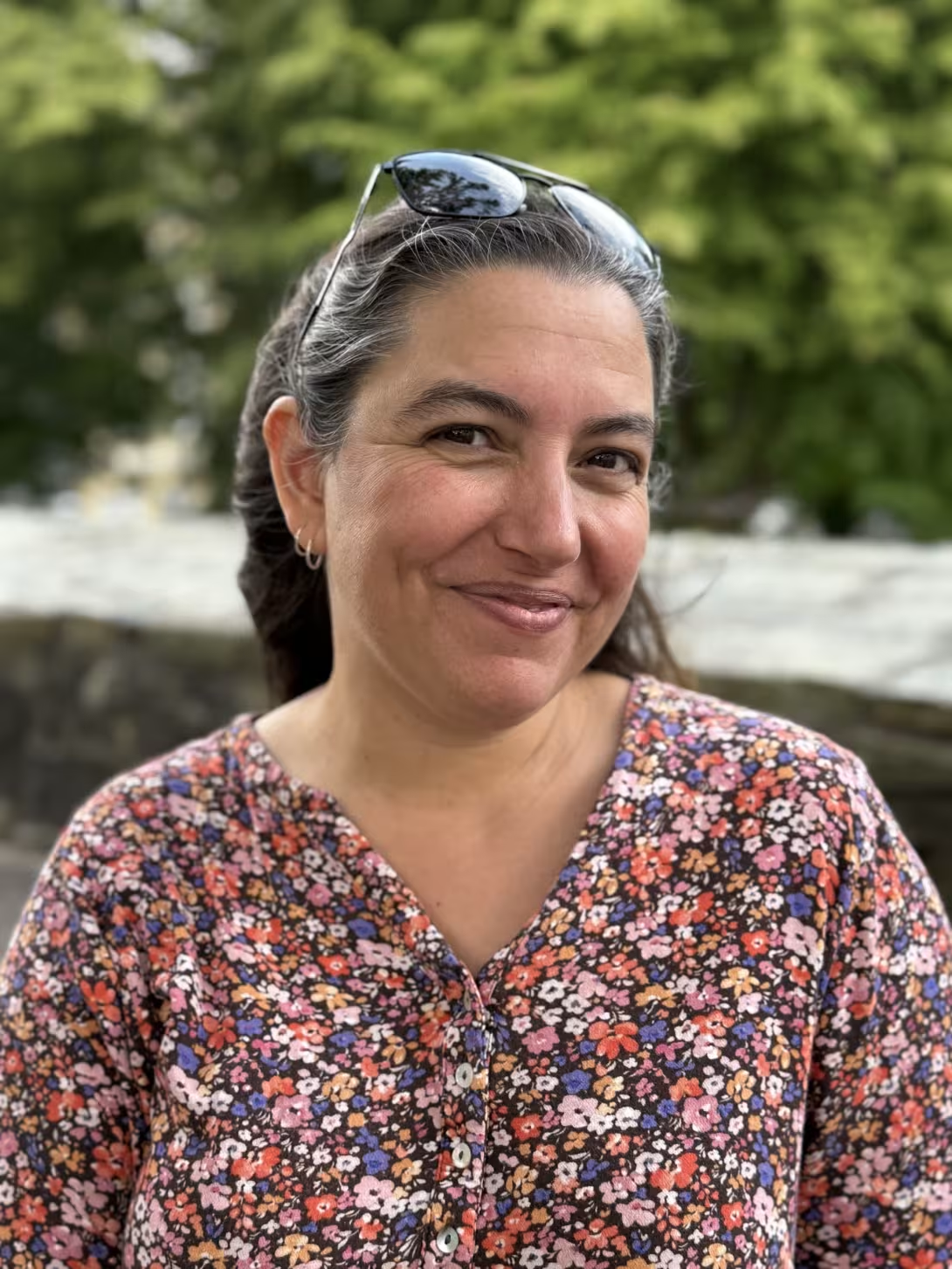
Noemí Segura graduated in 2025 as a Master’s student at the University of Bergen, affiliated with the Department of Biological Sciences and the Centre for Deep Sea Research. Originally from Catalonia, Spain, Noemí earned her Bachelor's degree in Biological Sciences at the University of Girona. Her path into science began unconventionally — she enrolled in her 30s after raising two children, inspired by biologists she met during a winter job in Finnmark, Norway. There, in the remote Arctic, she fell in love with the natural environment and the lifestyle.
Over three summers, Noemí worked in northern Norway in a research station collecting soil and fish samples for stable isotope analysis, extracting DNA from birds’ nests, checking camera traps for wild animals such as bears, and much more. These hands-on experiences in the field helped fuel her deep interest in biology. She also embraced the Arctic lifestyle — saunas, hytte life, boating, fishing and being immersed in nature.
While studying at Girona, her children often accompanied her to the library, working on their high-school assignments beside her. It took Noemi six years to finish her Bachelor’s degree while working part-time, but her determination never wavered. Today, her children are grown and living independently in Spain.
Noemí’s academic passion lies in microbial ecology and biogeochemistry. After completing her undergraduate studies (including six months on an Erasmus exchange at Umeå University in Sweden) she moved to Norway to pursue a Master’s in Biology/Microbiology at the University of Bergen. She deliberately chose UiB and reached out to Professor Ida Helene Steen at the Centre for Deep Sea Research, inspired by the group's focus in microbiology from Arctic hydrothermal systems. Under the supervision of Prof. Steen, Dr. Petra Hribovšek and Dr. Runar Stokke, she completed her Master’s thesis: "Syntrophic Interactions Between Anaerobic Methanotrophic Archaea and Sulfate Reducing Bacteria in Arctic Vents" in 2025.
Syntrophy — a mutualistic relationship where different microbial species depend on each other from a nutritional perspective — is central to her thesis work. She feels privileged to have learned how to sample anoxic deep-sea environments and to have had access to the microbial enrichments in the research group, some maintained for over six years. During her Master's, Noemí took the undergraduate research course BIO299, that together with her own research laid the foundation for valuable experience in sequencing, microbial community analysis, and learning the bioinformatics tools needed to work with complex metagenomic data — skills she plans to expand in her PhD.
Her next academic chapter will shift focus to aerobic methane oxidation in Arctic freshwater ecosystems. She has accepted a PhD position at Radboud University in Nijmegen, the Netherlands, starting in summer 2025 with fieldwork in Greenland.
Challenges and Passions
Living in Bergen has had its challenges, from financial pressures to navigating social integration into a new city. Despite this, she has maintained a strong support network of fellow early-career researchers — master students, PhDs and postdocs — and has worked part-time as a teaching assistant to support her studies. She has also taken full advantage of the opportunities at the Centre for Deep Sea Research, including fieldwork in Greece, Arctic research cruises, conferences, seminars and social events.
Outside academia, Noemí is a passionate science communicator. Back in Spain, she has taught courses, organized university conferences, and led scientific activities in her village — where she served as president of the local astronomical society.
Noemí views the current moment as a critical tipping point for our planet as a system and feels a strong sense of responsibility to contribute to our understanding of global changes. For her, at this point in her career, it is difficult to imagine anything more thrilling than working on Arctic deep-sea microbiomes, which may be linked to the origin of life and to astrobiology. She has found, in studying climate change and its impact on the Arctic, a research area that may also be applicable to our understanding of other planetary bodies.
Noemí’s Tips for Making the Most of a Master’s at the Centre for Deep Sea Research:
- Take part in everything the Centre, department, and university have to offer — fieldwork, seminars and social events.
- Stay curious and open to learning from all the scientific areas
- Find a good mentor. Noemí credits Professor Ida Steen as an excellent advisor and source of support and guidance for her present and future career
- Build connections beyond your Master’s cohort, especially if you're an international or mature student.
- Norwegian can be challenging, but learning the basics helps. Don’t hesitate to ask for help in English — or your own language — when needed.
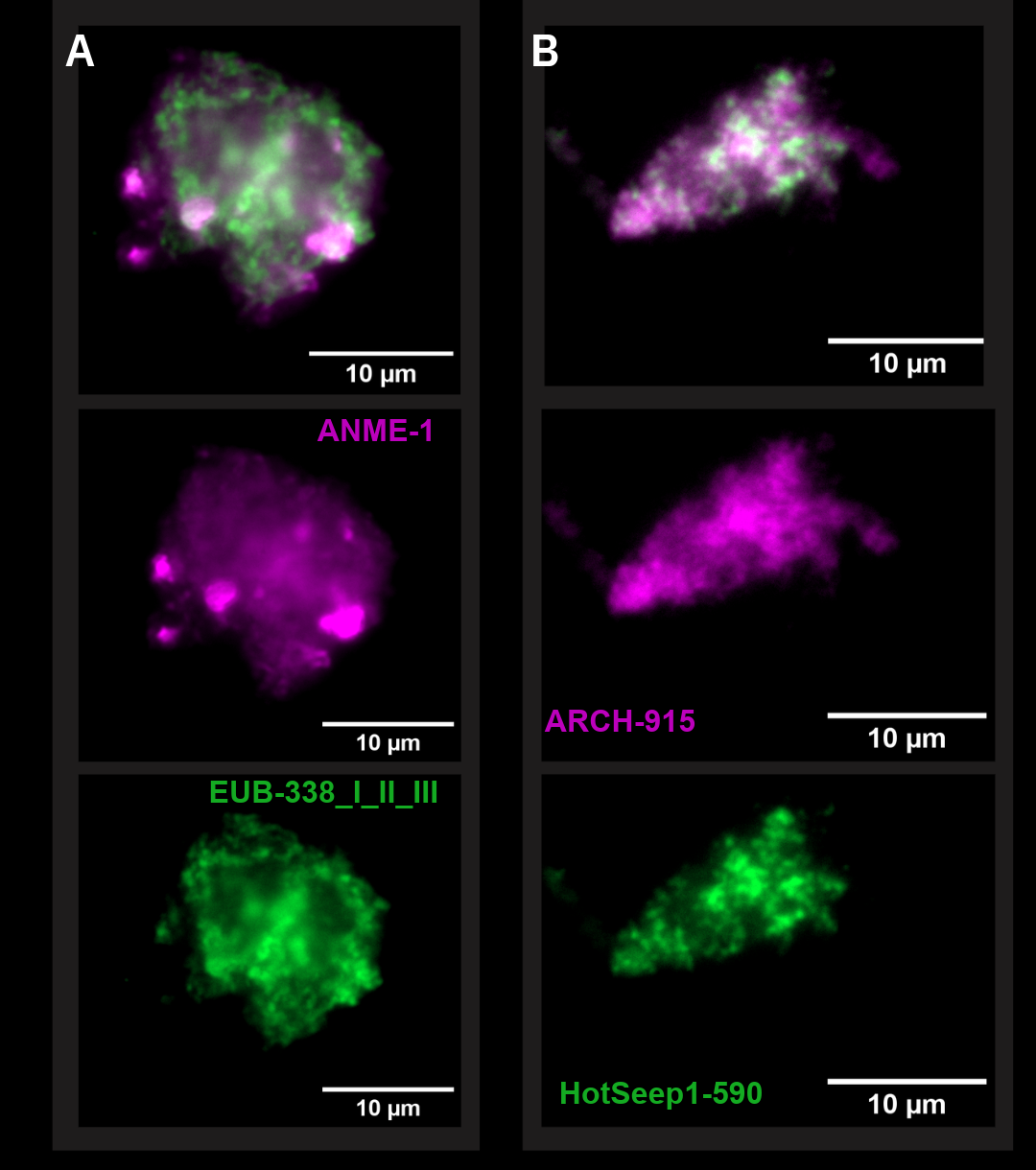
Figure from the master thesis: Micrographs of consortia from methane enrichments from AMOR hydrothermal vents, visualized with FISH (fluorescence in situ hybridization). Targeted probes for ANME1/bacteria (A), for archaea/HotSeep-1 (Ca. Desulfofervidus) (B).