

Key research questions
The interdisciplinary SapienCE team is carrying out macro- and micro-scale investigation of key Middle Stone Age archaeological sites. The team is looking for answers to questions that will bring us closer to an understanding of how we became modern humans like we are today.
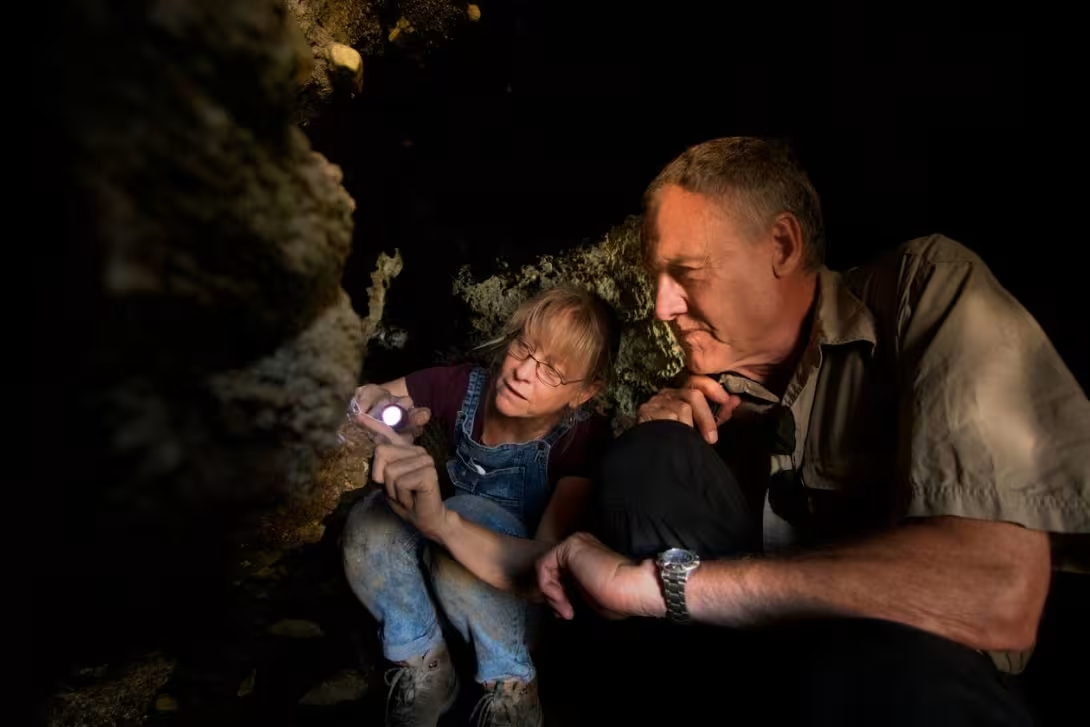
Investigating early humans
The primary objectives in our early Homo sapiens research is to address the following key research questions:
- When, why and how did humans first become behaviourally modern and how is this defined?
- Did cognitive changes accelerate behavioural variability?
- How were these groups of hunter gatherers socially organised?
- Was social cohesion enhanced by the adoption of symbolic material culture and did it lead to innovation?
- What cognitive skills had to be in place in order for other skills to develop?
- How adaptable were humans to environmental change and did climate impacts act as drivers for technological innovation and subsistence adaptations?
- Can we determine, from our planned genetic research, the relationship of these early H. sapiens to extant human populations?
Research areas
Q1: EXCAVATIONS | Excavation and Survey of Archaeological Sites
Excavations are at the very core of SapienCE, and the material excavated form the basis of the many fields of investigation that makes up this project. Our focus is on excavating three Middle Stone Age coastal sites dating from 100 000 to 50 000 thousand years ago in the southern and eastern Cape of South Africa.
The three Middle Stone Age sites are Blombos Cave, Klasies River main site and Klipdrift Shelter. The excavated archaeological levels have yielded well-preserved, undisturbed marine and terrestrial fauna and artefacts associated with Homo sapiens. Further surveys for sites in this region are planned.
3D recording
Excavating entails slow, meticulous and painstaking removal of soils in layers using a brush and a small trowel in 50x50cm square areas to expose the fragile artefacts and food remains left behind by humans over 50 000 years ago. Each artefact is recorded in 3D using a total station and the details of each layer (such as soil colour, texture, contents and slope) are recorded using a state of the art, specially designed for conditions at our sites, digital recording system. The soils are sieved through 3mm and 1.5mm mesh sieves to retain all the small pieces that were not plotted. All the materials are carefully curated.
Maintain and retain
When excavating complex and densely packed archaeological sites, a good understanding of where the material originates from and how it relates to each other is very important. It is as important for the unique artefacts as for the sediments that surround them and the walls and boulders that make up the caves and rock shelters. Only by having a complete picture can we try to understand how the living spaces of the past peoples were used and organised. In order to ensure that we maintain and retain a complete record of the site as we take it apart, we record the position of all the artefacts we identify and collect as well as all other samples and tests that we do.
In addition, we record uncovered surfaces and important features using a 3D documentation technique called digital photogrammetry. It provides photorealistic 3dimentional surface models with sub centimetre accuracy.
Studying the greater picture
All the various recorded artefacts, samples and surfaces uncovered over many years of excavation make up the puzzle pieces of our archaeological sites. Unlike conventional puzzle pieces, we would have no way of putting them back together if we didn’t record the position we found them in. Using this method, we are able to confidently combine them and study the greater picture that they form. In turn, this allows us to zoom in and analyse different moments in time of the caves’ occupation history or specific areas of the site.
Related researchers
- Christopher Stuart Henshilwood, Professor, Director - SFF Centre for Early Sapiens Behaviour (SapienCE), Department of Archaeology, History, Cultural Studies and Religion
- Karen Loise van Niekerk, Researcher, Principal Investigator, SapienCE, Department of Archaeology, History, Cultural Studies and Religion
- Sarah Jacoba Deborah Wurz, Professor II, Archaeology, Department of Archaeology, History, Cultural Studies and Religion
- Jovana Milic, PhD Candidate, Faculty of Humanities
- Elizabeth Catherine Velliky, Postdoctoral Fellow, Department of Archaeology, History, Cultural Studies and Religion
- Ole Fredrik Unhammer, PhD Candidate, Faculty of Humanities
- Turid Hillestad Nel, Postdoctoral Fellow, Department of Archaeology, History, Cultural Studies and Religion (former member)
- Magnus Mathisen Haaland, Postdoctoral Fellow, archaeology, Department of Archaeology, History, Cultural Studies and Religion (former member)
Q2: MATERIAL CULTURE | Symbols and innovation
Our goal at SapienCE is to understand when humans in the past started to behave like we do today. When did they start to think like us, and when did their culture and social structures become comparable to ours?
To explore these questions, we can look to the materials that humans left behind, and through these, we can start to understand the lives that they led. The study of these materials, also called artefacts, is the core of archaeology, and is what we at SapienCE do as part of the Material Cultural Analysis focus group.
Cultural innovations
The artefacts that were left at archaeological sites play an essential role in investigating the lives of humans in the past. Studying these materials in different ways allows researchers to document when specific key cultural innovations were established within a certain region, and how they evolved and subsequently spread. Through this, we can infer the prerequisites for these innovations, under what conditions they emerged, and ultimately how they impacted the cultural evolution of humans.
Unlocking the past
After artefacts are excavated at archaeological sites, certain laboratory analyses are used to document technological practices, and provide important information on the development of these practices over time. Dedicated methodologies are being applied by specialists to each artefact category (lithics, bone tools, modified shell, pigments, engravings on bone, ostrich eggshell, etc.). The aim is to reach an integrated and comprehensive picture of how humans behaved in the past and how these behaviours were impacted by other factors, such as climate and environment.
Cutting edge technology
The chaîne opératoire (chain of operation) approach is used to analyse technological processes and provide insight into the dynamic behavioural and cognitive processes of the artefact makers. This is an interpretive method that accounts for all aspects of an artefact’s life-cycle, including raw material procurement, processing, use and disposal. Other analytical techniques such as X-ray fluorescence (XRF), Fourier-transform infrared spectroscopy (FT-IR), micro-X-ray diffraction (µXRD), micro-Raman spectroscopy, scanning electron microscopy (SEM), 3D laser-scanning, and multi-focus and confocal microscopy are all being used to further investigate artefacts. These tests are being conducted at the University of Bergen, the University of Bordeaux, at the University of the Witwatersrand and at our satellite laboratory in Cape Town. Through these multi-scalar and interdisciplinary approaches, we can gain a more detailed picture into the past lifeways of our early human ancestors.
Related researchers
- Christopher Stuart Henshilwood, Professor, Director - SFF Centre for Early Sapiens Behaviour (SapienCE), Department of Archaeology, History, Cultural Studies and Religion
- Karen Loise van Niekerk, Researcher, Principal Investigator, SapienCE, Department of Archaeology, History, Cultural Studies and Religion
- Sarah Jacoba Deborah Wurz, Professor II, Archaeology, Department of Archaeology, History, Cultural Studies and Religion
- Elizabeth Catherine Velliky, Postdoctoral Fellow, Department of Archaeology, History, Cultural Studies and Religion
Q3: FAUNAL ANALYSIS | Valuable leftovers
Certain animals inhabit very specific ecological habitats. The environment during the time of occupation can be reconstructed through the presence of, and changes in, species at a site. Knowing the season of shellfish collection has proven to be very important to understand the subsistence and settlement patterns of early modern humans.
Faunal analysis entails examining the leftovers from people’s hunting and gathering activities. These typically consist of fragments of bone and shells. At the most basic level of analysis, these are, where possible, identified to species and quantified, giving us an indication of what the humans ate and how they used available resources in the past. The species present also allows us to think about what technology people used in the past to get their food. For example, if a site contains the remains of mostly small animals such as hares and hyraxes, this could point to the use of snares to catch them.
Reconstructing the palaeoenvironment
The presence of, and changes in, species in a site can be used to reconstruct the environment during the time that the site was occupied, as certain animals inhabit very specific ecological habitats. Faunal remains also provide information about animals that were using the sites when humans were not around, such as owls or hyenas. During the hiatus of human occupations, owls frequently utilized the sites. They left behind remains of their hunting activities, resulting in an abundance of small rodent bones that provide an additional proxy for reliable, high-grade information on local environmental conditions.
As with terrestrial fauna, shells can contribute to a better understanding of climatic and environmental changes in the past. As shellfish grow, information about their surrounding environment is recorded in the layers of the shell. The chemical composition of these layers shows what water temperatures were during growth. The water temperature recorded in the last shell layer can indicate the time of the year that the shellfish was collected, and thus the season that the site was inhabited by people. Knowing the season of shellfish collection can help us to better understand the subsistence and settlement patterns of early modern humans.
Surf and turf on the menu
What was on the menu 100 000 to 50 000 years ago? People hunted and gathered a wide variety of animals for food during the Middle Stone Age. At Blombos Cave, Klipdrift Shelter and Klasies River main site, remains of large and small antelope (e.g. eland, klipspringer), zebra, buffalo, carnivores (e.g. seals), tortoises, small rodents, hyrax, hares, ostrich eggs, abundant shellfish and more rarely fish, comprise most of the faunal material. Evidence for plant consumption is rare, as plant materials do not preserve well in coastal sites of this time period. However, as methods of analysis become more sophisticated, traces of plants are starting to appear.
In sum, identification and quantification of animal remains can refine our understanding of the interplay between the local-to-regional changes in the faunal communities and the evolution of subsistence strategies within a more precise timeline. We are investigating how subsistence strategies may correspond to changes in local environmental conditions, and comparing the timing of the emergence, or disappearance, of cultural innovations with faunal changes.
Identifying our ancestors
Human skeletal remains are rare in Middle Stone Age archaeological sites in southern Africa, though fortunately, the SapienCE sites have both human skeletal remains (Klasies River) and human teeth (Blombos Cave and Klipdrift Shelter). Genomic signatures can be extracted from teeth and have the potential to determine the genetic relationship of these early H. sapiens to extant human populations.
Related researchers
- Karen Loise van Niekerk, Researcher, Principal Investigator, SapienCE, Department of Archaeology, History, Cultural Studies and Religion
- Jovana Milic, PhD Candidate, Faculty of Humanities
- Turid Hillestad Nel, Postdoctoral Fellow, Department of Archaeology, History, Cultural Studies and Religion (former member)
Q4: CLIMATE | Reconstructing the climate of the past
When we wish to understand the major steps in the innovations our ancestors made 100 000 years ago, we also need to understand what environments these people lived in. How adaptable were humans to environmental change and did climate impacts act as drivers for technological innovation and subsistence adaptations?
The 100 000 - 50 000 time interval, which is the focus of SapienCE research, is within the last glacial period. Nevertheless, the period contained large global changes in climate ranging from a situation close to what we have today and a global deep glacial phase with sea level 80 meters lower than now.
Simulating past climates
While we know the global climate changes reasonably well, less is known about climate changes in local environments. We have, however, methods available to both reconstruct climate and environmental changes from natural deposits where climate sensitive tracers are preserved.
We use computer models to simulate climates at various stages of the period. These models are the same as scientists use to simulate ongoing and future climate change. The simulated climate gives us a regional perspective over the area. For this purpose, we first use simulations of the global climate. These models are quite coarse due to limitations in computer power and do not on their own give us the detailed picture we need to compare with the archaeological material. They provide a climatic framework that is downscaled to finer models tailored for the regional climate of southern Africa. In these simulations, we can get results down to a few km spacing to investigate changes in coastal and inland areas due to major sea level changes and regional shifts in temperature and precipitation. These simulations need excessive computer power and are run on the most powerful computers in the country.
Old layers of dirt
In order to compare the climate from the simulations and verify their accuracy we reconstruct the climate using a wide set of methods. Sediment cores drilled offshore the Blombos, Klipdrift and Klasies River sites contain sediment components transported out from land by rivers mixed with sediments from the ocean. Wetness of the land areas, its vegetation cover and type are inferred by using geochemical analyses on plant remains and minerals. We reconstruct the ambient ocean temperature and its variations by geochemical analyses on small fossil remains. Climate information is also distilled from speleothems (dripstones) recovered from caves near the archaeological sites, dated to the same period as the archaeological evidence. By use of carbonate minerals in the speleothems, we can calculate the temperature history of the time the archaeological sites were occupied by humans and variations in wetness/dryness of the area.
Inside the caves
Shellfish and other fossils allow us to infer what climatic conditions the humans experienced, and the sediments forming the floor on which they lived give us other clues. The seasonal range of temperature at the time and which time of the year the caves were occupied are also calculated from shell material.
All this climatic evidence will be compared with archaeological material to create a history of what environments were like in the area when the exciting phases of human innovations took place and what role climate and environmental change may have played.
Related researchers
- Eystein Jansen, Professor, in Earth Sciences /Paleoclimatology. Also affiliated with the Bjerknes Centre for Climate Research, Department of Earth Science
- Anna Nele Meckler, Professor, Department of Earth Science
- Jenny Marianne Maccali, Researcher, Department of Earth Science
- Jovana Milic, PhD Candidate, Faculty of Humanities
- Turid Hillestad Nel, Postdoctoral Fellow, Department of Archaeology, History, Cultural Studies and Religion (former member)
Q5: CHRONOLOGY | The age of deposits
What cognitive skills had to be in place in order for other skills to develop? Knowing the age of the archaeology that we study is interesting, but it also has an important scientific purpose – if we know when something happens, then we can begin to work out why it happens.
We can say that a change in climate (e.g. the nights became colder) led to a change in the archaeological material (e.g. more use of fires) if we know that both things occurred at the same time. Consequently, understanding the age of our records of climate change and archaeology is a theme in SapienCE research.
Timing is everything
One of the reasons that the Middle Stone Age sites excavated by SapienCE fascinate us is that the archaeology is so old. For example, the equipment used to make vivid red paint, excavated a Blombos Cave, is about 100,000 years old. To put that age in context, the paint “toolkit” is more than twenty times as old as the Great Pyramid of Giza in Egypt. We know this because of the work of “chronologists”, people who calculate the age of ancient materials. To make the best use of the information that we produce in SapienCE, it is essential that we know the age of the material that we study. This applies both to our archaeological excavations and to the records of past climates that we produce. Within any particular dataset, ages allow us to estimate the timing and rates of any changes that we observe.
However, when studying datasets from different sources (e.g. climate records from an ocean core and archaeology from a cave), ages allow us to make comparisons. Chronology is therefore vital for linking the archaeological and climate components of SapienCE, allowing us to test ideas about how past climate might have affected human behaviour. However, no single method is sufficient for determining the age of all of our material. Within SapienCE we use two main methods, called luminescence and uranium-series dating respectively, to calculate the age of our samples.
Luminescence dating
Luminescence dating measures the amount of time that has passed since sand grains were last exposed to sunlight. Small quantities of sand were constantly being blown into archaeological sites while they were occupied by early humans, and over time these sands became buried and shielded from sunlight. We can therefore date the Middle Stone Age materials at our sites by luminescence dating sand extracted from the sediments in which they were buried. We are also experimenting with using luminescence dating to determine the age of ocean cores. Uranium-series measurements allow us to date the formation of new carbonate minerals, such as stalagmites in caves, and ostrich eggshells. Stalagmites from the De Hoop Nature Reserve are being analysed by SapienCE team members to produce detailed records of climate during Middle Stone Age times, whilst dating ostrich eggshells from Blombos Cave and Klipdrift Shelter add important extra detail to the luminescence dating at these sites.
Related researchers
- Simon Armitage, Professor II, Department of Archaeology, History, Cultural Studies and Religion
- Stein Erik Lauritzen, Department of Earth Science
- Jenny Marianne Maccali, Researcher. Department of Earth Science
Q6: GEOARCHAEOLOGY | Micromorphology and 3D reconstruction
Archaeological sites are places where the physical remains of past human activities can be found. It is the job of archaeologists to painstakingly excavate and document such remains in high detail. We then use all the information available to put the puzzle back together.
Fragmentary evidence
Archaeological sites are places where the physical remains of past human activities can be found. It is the job of archaeologists to painstakingly excavate and document such remains in high detail. We then use all the information available to put the puzzle back together to gain a picture of how people in the past lived and developed through time.
When we think about the materials that people in the past left behind, we often think about the artifacts that we directly excavate and can hold in our hands, like stone tools, butchered bones, or beads and ochre. However, the prehistoric inhabitants left behind much more that we can only clearly see and study under magnification. For example, when past humans lit and used fire, they left behind microscopic particles of ash and charcoal that stain the sediments a dark color, but which can only be clearly identified under the microscope. By studying these microscopic remains, we are able to look at a whole range of past human activities that are largely invisible during excavation of the archaeological record.
Micromorphology
How can we identify and study these microscopic remains of past human behaviours? This is not always a straightforward task. Often, we need to study the smallest components of the archaeological record before reaching a robust conclusion; that is the sand, dirt and sediments, and all the microscopic fragments within them. In the SapienCE project, we achieve this level of analysis through archaeological micromorphology. This method involves the collection of intact blocks of sediments in the field and results in the making of petrographic thin sections at specialized laboratories. The thin sections, which essentially are glass slides (6 x 9 cm) on which intact archaeological sediments have been glued, allow us to evaluate the nature of the ancient occupation debris in minute detail through powerful microscopes.
3D reconstruction
As part of our current documentation strategy, we record the site and the excavation in 3D using a total station and photogrammetry, creating a detailed virtual record of the sites. Additionally, drawings and thousands of photos are available from past and current excavations. We use photogrammetry and field records to incorporate information from previous excavation seasons. Using this method, we can sit by the computer, reconstruct and review the work that has been completed and perform analyses of each individual layer at the site. This aids in the analyses of the material and the planning of future fieldwork. The data we produce using this method adds to the understanding of prehistoric life in the caves.
Related researchers
- Christopher Miller, Professor II, Department of Archaeology, History, Cultural Studies and Religion
- Simon Armitage, Professor II, Department of Archaeology, History, Cultural Studies and Religion
- Ole Fredrik Unhammer, PhD Candidate, Faculty of Humanities
- Magnus Mathisen Haaland, Postdoctoral Fellow, archaeology, Department of Archaeology, History, Cultural Studies and Religion (former member)
Q7: COGNITION | Symbolic mind and social organisation
As we want to understand technological innovations and early symbolic activities, we need to look at neurobiological, cognitive, and social processes that were driving them. Did cognitive changes accelerate behavioural variability?
The Middle Stone Age (MSA) was a watershed in human history. Particularly in the period between 70 000 and 100 000 years ago, many ‘typically human’ behaviours became discernible for the first time, in or around the cluster of sites studied by SapienCE scientists, such as Blombos Cave, the Klipdrift Complex, and Klasies River main site.
Thoughts of the past
Examples of such behaviours include the use of novel tool types and raw materials, the processing of colour pigments, the making of beads for ornamentation, the conception of visual sign systems, and the creation of abstract drawings. As we want to understand these technological innovations and early symbolic activities, we need to look at the neurobiological, cognitive, and social processes that were driving them.
Several strategies can be employed to address this exciting question. One is to draw on well-known cases of technological and behavioural innovation across cultures. By studying how people, throughout history, have invented, learned, shared and applied knowledge, we can make inferences about the contexts in which MSA innovations were conceived. This allows us to decide, for example, whether a novel behaviour was a response to changes in the social or natural environments, a result of demographic shifts, an adaptation to more or less intensive social interactions among groups, or a product of social transmission and accumulation (‘ratcheting’).
Another strategy is to look at how people generate, process, and combine information at the neural and cognitive levels. For instance, neuroscientific methods such as brain-imaging technologies allow us to identify the neural networks involved in those kinds of tool making, tool use, and symbol perception that we observe in the MSA. Such studies help us to understand the range of mental abilities that are required to create specific objects and therefore must have been available to those who first produced such objects.
Social and environmental factors
Finally, cultural evolution studies offer useful models of how artefactual and behavioural traditions spread over space and time, and allow us to investigate the social and environmental factors underlying such processes. For instance, phylogenetic methods from evolutionary biology can tell us how likely it is that cultural traditions are related, which features an ancestral artefact would have had, and which properties coevolved or converged over time.
Each of these strategies hinges on our knowledge of present-day cognition and its cultural variability, and each contributes towards our understanding of how early sapiens cognition has unfolded in the MSA – and ever since.
Related researchers
- Andrea Bender, Professor, Department of Psychosocial Science
- Larissa Mendoza Straffon, Researcher, Department of Psychosocial Science
- Torill Christine Lindstrøm, Emeritus, Department of Psychosocial Science
- Kenneth Hugdahl, Emeritus, Department of Biological and Medical Psychology