

International course: Preparedness for health crises: a multidisciplinary approach
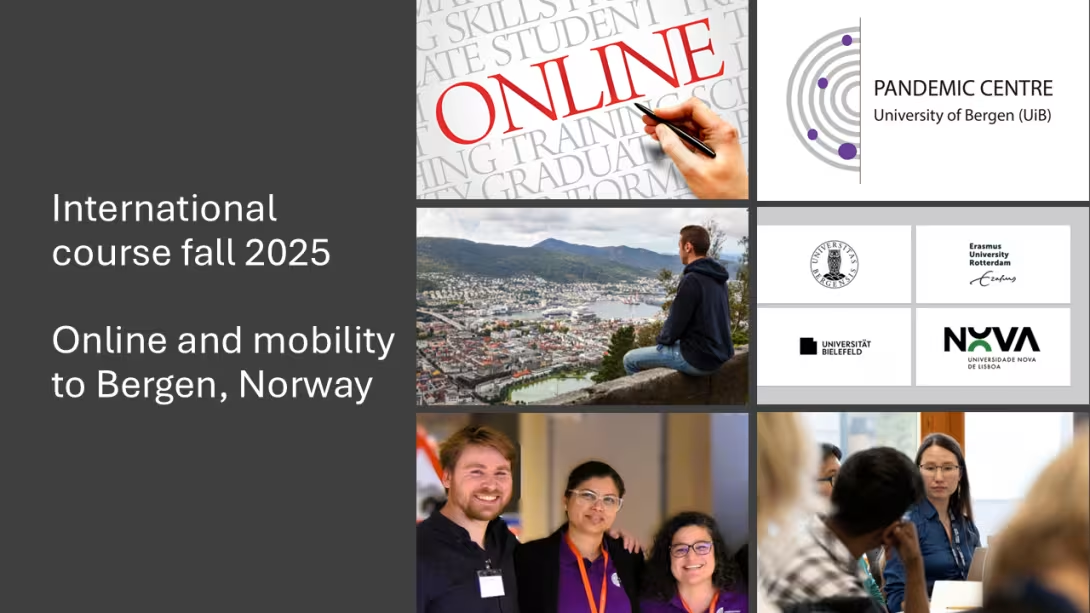
The Pandemic Center at the University of Bergen, in collaboration with NOVA University Lisboa, Bielefeld University, and Erasmus University Rotterdam, is excited to announce an upcoming online course with mobility option titled Preparedness for Health Crises: A Multidisciplinary Approach in fall 2025
About the Course
APPLY HERE
The course is open to master and PhD students from all disciplines from Erasmus+ affiliated institutions.
Applications within September 8th
- Choose "Preparedness for health crises" in the drop-down menu
- Choose to apply for either 4 ECTS version og 3 ECTS version
- Upload required documentation
- copy of passport with picture
- an official transcript of records
- up-to-date confirmation of active student status from your home university
Good knowledge of English, both written and oral, is required.
Course description
- Blended Intensive Programmes are short, intensive courses that leverage innovative learning and teaching methods, including online cooperation.
- Combines physical mobility with a virtual component, making it accessible to students from all backgrounds, study fields, and cycles (elective, master, and PhD students).
- Objective: To analyze health crises from international and interdisciplinary perspectives, enhancing understanding and preparedness for global health threats. The course will reflect on different approaches to collaborative work through complexity and uncertainty, aiming for better global preparedness for future health crises.
- Pedagogy: Emphasizes active learning through practical assignments and personal and group reflection exercises on the opportunities and limitations of an interdisciplinary approach.
Course content
The course will analyse health crises from multi- and interdisciplinary perspectives to enhance the knowledge required to address global health threats. Participants will reflect on different approaches to complexity and uncertainty to improve preparedness for future crises. Key topics include:
- Epidemiology and public health
- Legal and democratic decision-making during pandemics
- Pandemic surveillance and community health care
- Mathematical modelling of health crises
- Communication of risk and managing infodemics
- Biological lessons from past pandemics
- Economic impacts of health crises
- Building resilient healthcare systems
In the current geopolitical situation, narratives of war, conflict, health crises and climate disasters lead individuals and nations to mistrust and quickly changing priorities according to the latest events as presented by the media. A core foundation and red thread in this course is giving the students an opportunity for reflection about the possibilities of creating alternative narratives that can inform research and action for preparedness for future health crises in a collaborative, learning and sustainable fashion. The interdisciplinarity of the content is secured by more than 12 lecturers through the online course. In addition, we are proud to have Dr. John Launer both online and physically in Bergen to explain and help students practice how stories and narratives are fundamental to understanding and addressing health and social care issues in the outlined BIP course. Dr. John Launer will prepare the mentors on the concept of narrative thinking, hold a guest lecture in the online part of the course and give a keynote-speech and workshop in the mobility week sessions in Bergen with the students and staff.
Dr. John Launer is a renowned doctor, educator and award-winning writer. He has worked in the National Health Service in the UK continuously for over forty years. His current posts include honorary associate clinical professor of primary care at University College London and founding president of the Association of Narrative Practice in Healthcare. Narrative thinking helps us understand and address future health crises by using stories to make sense of complex situations and guide effective responses, and his thoughts is an important part of the challenge-based learning in the course to tackle challenges for example those linked to the United Nations’ sustainable development goals and added value considering preparedness for future health crises.
In addition Erasmus University Rotterdam will provide case scenarios developed as simulation exercises for students and professionals. These exercises will be part of the work-shops in Bergen and an innovative dimension to the students’ skills and knowledge for preparedness for future health crises.
Schedule
Day-to-day schedule
- Online lectures twice a week from September 15 until October 20, 2025
- Lectures normally from 4 p.m until 6.15 p.m (CET+1)
- Online interdisciplinary group work between lectures, organized by the students
- A group of students will be able to participate in physical mobility, a course week in Bergen, Norway the last week of October (subject to Eransus+ funding from home university)
Credits
The course has two versions:
- 4 ECTS upon successful and approved completion of the online course and the physical mobility (1 week) in Bergen.
- 3 ECTS upon successful and approved completion of the online course (no physical mobility)
Learning outcome
Upon completing this course the candidate will have the following learning outcomes defined in terms of knowledge, skills and general competence:
Knowledge. The candidate ...
-understands the complexity and uncertainty in the development of evidence regarding health crises such as the COVID-19 pandemic, recognizes the need of different disciplines, methods (interdisciplinary), processes and stakeholders in research and educationprojects related to health crises
-acknowledges and uses system approaches in research on health crises
- can contribute to the development of new transdisciplinary knowledge, new theories, methods, interpretations and forms of documentation in the field
- is aware of and understands different perspectives on building resilient health systems
- understands One Health approach
Skills. The candidate ...
- can formulate complex challenges and research questions incorporating different perspectives
- can challenge established knowledge and practice in the field in a constructive way
- can relate to uncertainty in research
- can work and collaborate in interdisciplinary research environments
- can disseminate information on complexity in an understandable way
General competence. The candidate ...
- can identify relevant ethical issues and carry out his/her research with scholarly integrity
- can discuss complex interdisciplinary assignments and projects within levels of uncertainty
- can assess the need for, initiate and practice interdisciplinary projects to improve knowledge preparedness
Target group and practicalities
This course will draw on lessons learned from the COVID-19 pandemic and other current crises to teach preparedness for future health threats.
- Open to students from all disciplines at the university level, including master and PhD students. It is not necessary for students to have existing projects related to health crises.
- The course is mainly online, with an elective mobility to Bergen at the end of the Course (October 27-October 31).
- Students must apply for Erasmus+ mobility grant from home university to cover travel and accomodation.
Language: English
Contact
Academic responsible
mailto:Esperanza.diaz@uib.no
Administrative responsible
mailto:goril.nokleby@uib.no
Admission questions
mailto:studie@igs.uib.no