

Broad and Practical Skills
Njål Frafjord pursued a specialization in multiphase systems to gain broad and versatile expertise. Today, he works as an engineer at Halliburton.
Published: (Updated: )
Why did you choose to study Energy and Process Technology at UiB?
I started with a bachelor’s degree in Petroleum and Process Technology, which covered a wide variety of subjects like physics, chemistry, geology, and mathematics, as well as more specialized petroleum-related courses. This gave me a solid foundation for further studies and opened up many opportunities within the natural sciences.
During my bachelor’s, I was most drawn to physics and petroleum subjects—not so much the deep theoretical theorems, but rather applied science. With that in mind, I looked for master’s programs with a strong physics focus but more engineering-oriented than a pure physics degree. The master’s program in Energy and Process Technology—more specifically in multiphase flow—matched my criteria perfectly. Within this program, you work with fluid dynamics, chemistry, and thermodynamics. These are fundamental physics subjects that provide a foundation for many fields and are great for further learning, whether in academia or engineering.
One of the main reasons I chose process technology was the flexibility in course selection—there were very few mandatory courses. Combustion physics, multiphase flow, and numerical methods (CFD – Computational Fluid Dynamics) became part of my daily studies. To add a point in favor of the process technology program: renewable energy is a hot topic today. Much of that technology involves fluid dynamics and thermodynamics, so there are plenty of opportunities.
What was your master’s thesis about?
My master’s thesis focused on heating continuous multiphase flow using microwave exposure. The plan was to include an experimental part in collaboration with NORCE and to create a numerical model using the CFD software STAR-CCM+. However, due to Covid-19, the NORCE lab was inaccessible, so the thesis became purely numerical analysis.
Working on the thesis teaches you independence and problem-solving skills: how to gather information, process and implement data in your project, and how to critically assess sources and references. Of course, this depends on your supervisor, but in process technology, being independent is essential and valuable for your future career.
When choosing a thesis topic, you have a lot of freedom within reasonable limits. If you have an idea, the supervisor is supportive and will guide you in the right direction. If you don’t, supervisors always have suggestions to discuss.
What do you work with?
After finishing my master’s, I wanted practical experience and a change of pace, so I worked for a year as a field engineer (offshore climbing) at Axess Group. My job mostly involved inspecting platforms and floating rigs—from the base of the legs to the top of the derrick (drilling tower). It was a very educational year with great exposure to the Norwegian continental shelf and the petroleum industry.
After that year, I wanted to move toward a role more related to my education and with a better future outlook. That led me to Halliburton, where I now work in their drilling division, Sperry Drilling.
How has your education been useful in your current and previous jobs?
As I mentioned, my bachelor’s and master’s studies built a solid foundation for further development. The independence gained during my thesis has really paid off. In offshore drilling, much of the work involves rocks and fluids—whether it’s mud, oil, gas, or water—and my studies gave me a general understanding of how fluids behave under different conditions. When new challenges arise, my prior knowledge helps me learn quickly.
How was the transition from study to work life?
My path was somewhat unconventional, so the change was significant—from working with CFD and theoretical analysis on a computer to climbing offshore structures. I really enjoyed that experience and wouldn’t trade it for anything. Now, in my job at Halliburton, I’m more involved with theoretical problems again, and my offshore experience gives me practical insight. So my current work feels more connected to what I studied.
Did you have relevant work or participate in activities during your studies?
I was quite active early in my studies in Bergen. I was on the board of the Petroleum Students’ Association (then called Gullflaks), on the board of the Society of Petroleum Engineers (SPE Bergen student chapter), and for a short period, I was equipment manager for BSI Friluftsliv.
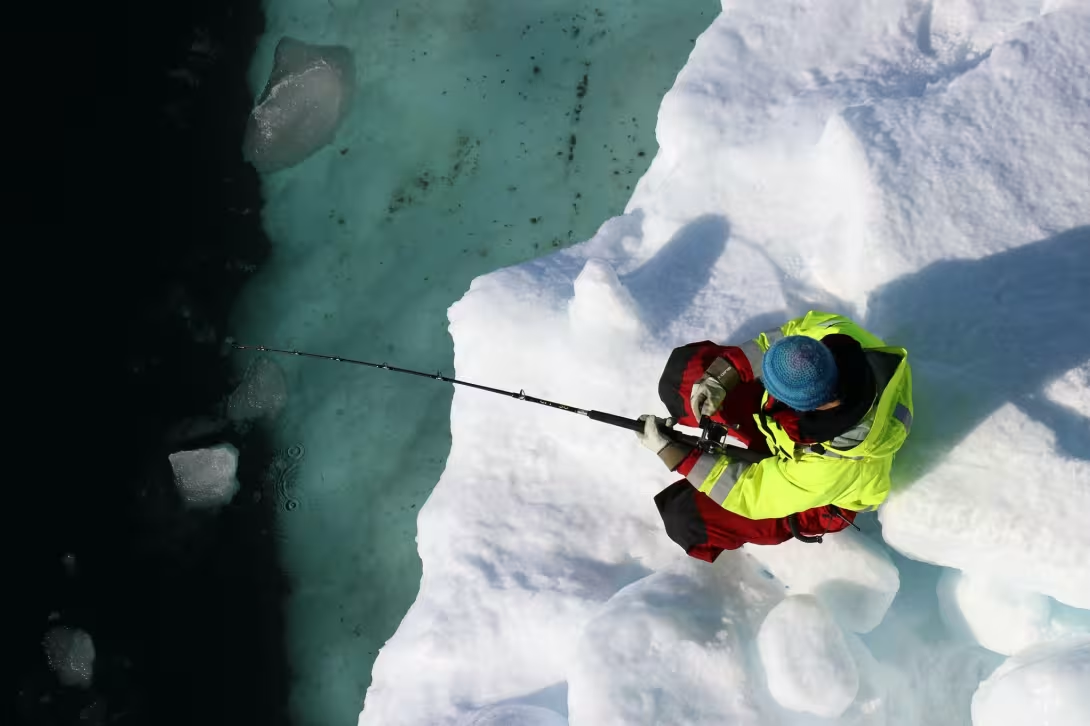
During my exchange year in Svalbard, I worked for UNIS helping with fieldwork outside of my studies. This included work on sea ice, lab experiments, and report writing. It was a very educational and enjoyable experience, working outdoors in beautiful surroundings.
Do you have any advice for students thinking about job opportunities after graduation?
Nowadays, having a master’s degree is often required for most engineering jobs, but the specific program or thesis topic is less important. What matters most is your ability to absorb information, process it, and present it well—that will take you far.
My advice is to choose a program you’re genuinely interested in, not just one with the most job opportunities but little passion for you. If you find both interest and job prospects, that’s the best combination.
When I chose my master’s, I focused on broad physics and a strong foundation across many areas rather than narrow specialization. I believe this helps you be more open to new knowledge by getting exposed early to many fields.