

Magne Espedal Professorship Awarded to Miriam Schulte
Professor Miriam Schulte from the University of Stuttgart has been awarded the Magne Espedal Professorship for 2025–2028. In connection with the award, she will give the Magne Espedal Lecture at the University of Bergen on 23 February 2026.
Published: (Updated: )
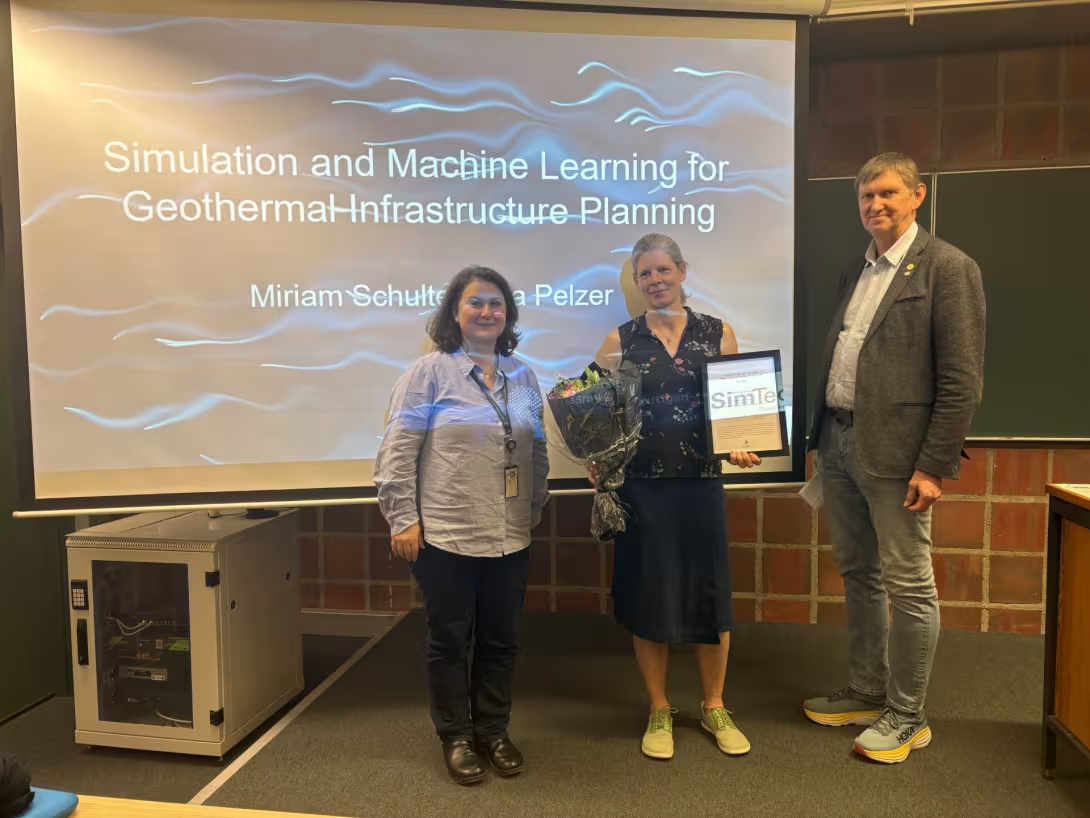
The Magne Espedal Professorship commemorates Magne Espedal (1942–2010), who played a central role in building internationally recognized research in applied and computational mathematics at UiB. The visiting professorship is awarded to leading international researchers in applied mathematics, computational science, mathematical modeling, and energy research.
Miriam Schulte is a full professor of computer science whose research lies at the interface between numerical mathematics and computer science, with a strong focus on large-scale scientific computing and multi-physics simulation. Her work addresses complex real-world problems involving coupled physical processes such as subsurface flow, structural dynamics, chemical reactions, and energy systems.
For Schulte, the award carries both professional and personal significance.
“It’s a great honor that feels a bit like advance praise,” she says. “Professionally, I hope that, at the end of the professorship period, we will have achieved the success in terms of new third-party funding and in terms of scientific progress that satisfies this honor."
She also highlights a personal connection to the legacy behind the professorship:
“I’ve become a professor in Stuttgart three years after Magne Espedal died during a visit to the University of Stuttgart. To me personally, it's a very good motivation to try and continue his efforts in both establishing even tighter links between Bergen and Stuttgart and to use methods of Applied Mathematics and Computer Science to predict subsurface processes for the benefit of our climate, our environment and our economy.”
Simulation, machine learning, and geothermal energy
As part of the professorship, Schulte will deliver the Magne Espedal Lecture titled “Simulation and Machine Learning for Geothermal Infrastructure Planning.” The lecture will present recent work on combining high-resolution simulations with machine learning to support planning of both shallow and deep geothermal systems.
Schulte points out that subsurface simulations are crucial—but extremely demanding.
“To make decisions in geothermal infrastructure planning, we typically have to simulate many different scenarios,” she explains. “These simulations are extremely expensive: we must include structures at the centimeter scale while making predictions on the kilometer scale, and we must account for both fast processes like pressure changes and very slow processes like temperature diffusion.”
For her, machine learning becomes a key tool:
“Machine learning can help us drastically speed up these simulations using models trained on a few large, high-fidelity simulations. It can also serve as a model-correction tool when observation data show effects in the real system that our classical simulation models do not yet capture.”
Looking forward to Bergen
Schulte is also enthusiastic about the research environment in Bergen.
“It’s hard to choose just one thing,” she says. “I’m looking forward to the combination of joint scientific challenges, complementary expertise between Stuttgart and Bergen, the great colleagues and students I’ve already met, the beautiful city and the mountains.”
She adds with a smile:
“And last but not least, the always welcome opportunity to get humbled and to learn while climbing with Inga Berre.”