

Morgane Kerdoncuff PhD defence
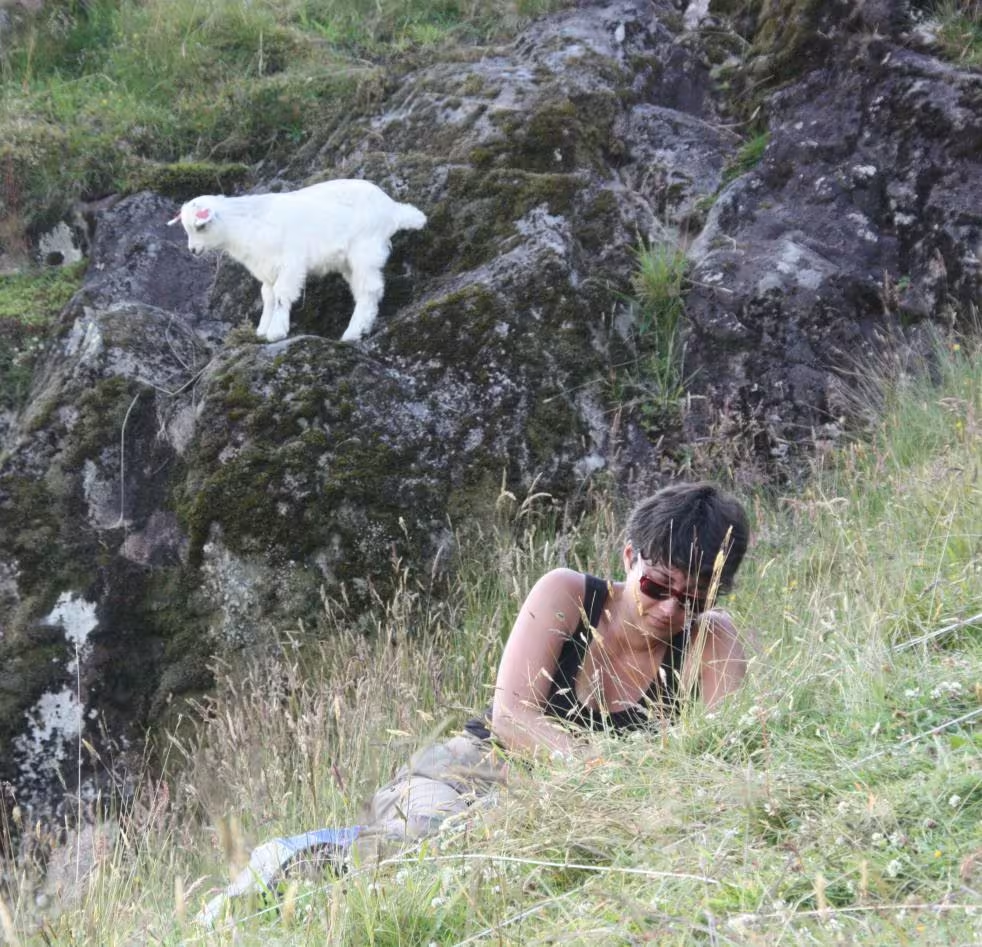
Morgane Kerduncuff shall defend her PhD on Marking the landscape – Ecological assessment of small-scale grazing systems in the fjord region of the Nordhordland UNESCO Biosphere Reserve
Following the development of globalised grain feeding systems, livestock production has become the land use with the greatest impact on nature. To ensure both food security and the preservation of ecosystems, it is necessary to develop agricultural models that support biodiversity and provide multiple benefits for people and communities. In Western Norway, a long tradition of small-scale grazing systems has shaped the fjord landscape. In her doctoral thesis, Morgane investigated how the fjord environment and different types of management affect plant and beetle communities and their associated ecosystem services in semi-natural grasslands and heathlands. She led observational studies of 42 grazing areas in the Nordhordland UNESCO Biosphere Reserve, which is a model area for the implementation of the Sustainable Development Goals in Vestland.
Morgane Kerdoncuff found that the fjord climate and topography were crucial for above-ground productivity at the regional level, but had little impact on the diversity and composition of grassland communities. In semi-natural grasslands, she showed that livestock type affected the cover of plant functional groups, but not the species diversity of vascular plants or the composition of dominant grass, herb, and beetle communities. In semi-natural heathlands, she found that controlled burning favoured the activity of xerophilous and sun-loving beetles at a local scale and contributed to heterogeneity at a regional scale. Both habitat types provided multiple benefits. In semi-natural grasslands, she found a synergy between indicators of nectar resources and forage resources. In semi-natural heathlands, she observed higher soil carbon content and greater diversity of cryptogams, indicating a greater contribution to climate stabilisation and water storage capacity. There was a balance between productivity and diversity for semi-natural grasslands and semi-natural heathlands, showing that the fjord landscape ensures complementary ecosystem services. Overall, her thesis helps to highlight that win-win strategies for livestock production are already within reach.