

Narratives of Religious Conversion in Old Norse Prose
Guest lecture by Saskia Rath
The roots of religious conversion and the phenomena that are associated with it lie deep in the heart of human nature, in the inherent desire to connect to the realm of the divine through belief. But despite its omnipresence in the history of humankind, the inherent nature of conversion is exceedingly hard to grasp. It is a fascinating, yet ever-changing, complex, multilayered object and elusive to a point where it seemingly defies straight forward definitions altogether.
Within the last years, the scientific study of religious conversion has undergone some radical changes, becoming increasingly interdisciplinary and globalized while new, holistic models and methods were developed.
Making use of these models and transferring a relatively recent and open definition of conversion onto medieval Icelandic and Norwegian prose narratives allows us to examine the medieval concepts of religious conversion from a new perspective. Furthermore, it enables us to take into consideration the cluster of ideas, concepts and ideologies that make up the extra-literary contexts of its narrative employment.
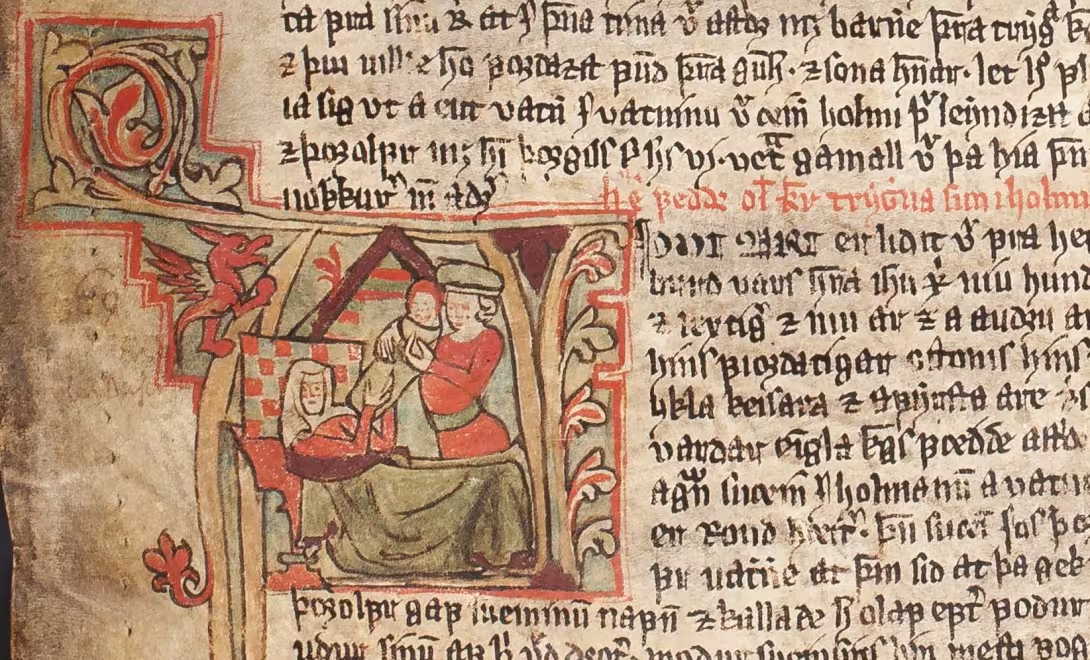
My starting point is the 14th century Óláfs saga Tryggvasonar en mesta, a large-scale compilation that is the result of a highly intricate process of literary transmission lasting more than two centuries. On its textual surface we can see both the contemporary perspective as well as the marks left by a heterogenous tradition of older sources. I follow these traces in my PhD thesis in order to uncover not only what conversion was in the eyes of the respective authors and compilers, but also how they made use of it, what kind of functions it could fulfill in the narratives they created.