

In/visible women of the sea. Gendering fishery politics and advocacy (GENMAR)
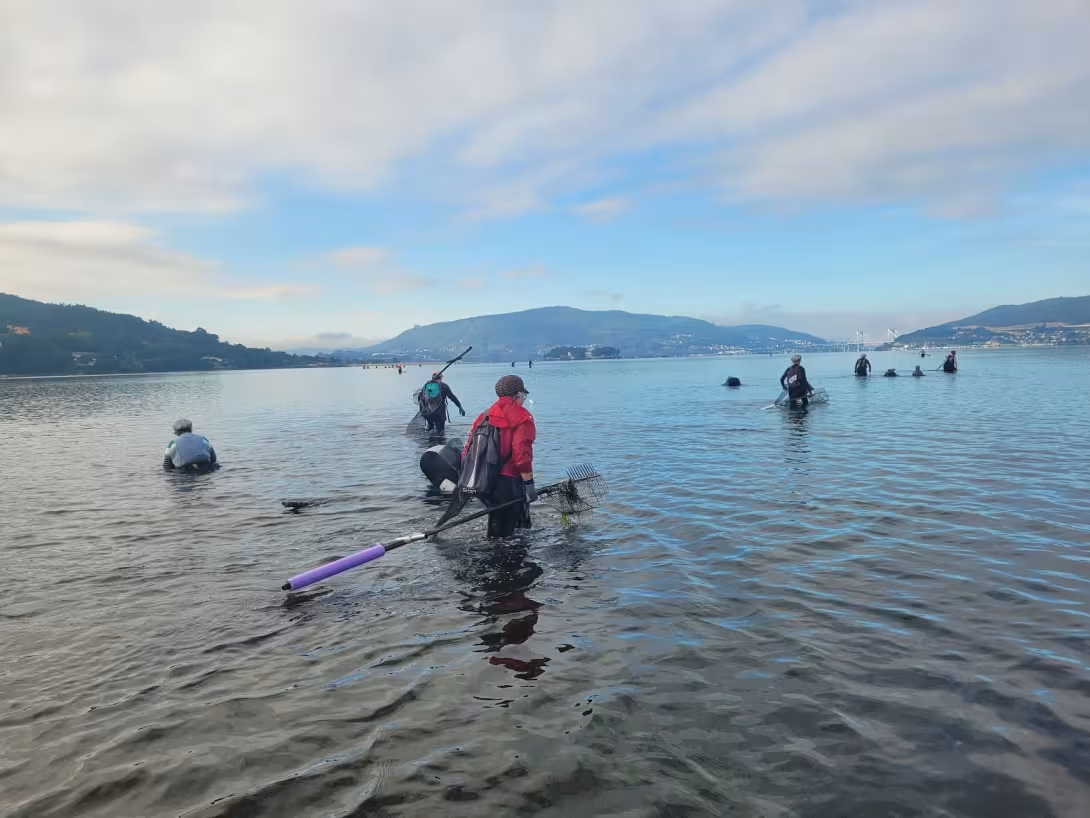
The fishery sector is often considered “a man’s world.” But in fact, women constitute half of the fisheries and aquaculture work force value chain globally. Even so, women’s roles and contributions are not only commonly underrecognized, but they are also poorer than men, frequently enjoy none or faulty social and economic rights, and face severe constraints upon attempting to partake in governance- and management processes. Drawing on a broad and tailormade theoretical framework, GENMAR will conduct qualitative research on the fishery sector in Spain, Tanzania, Thailand and Brazil, as well as in regional and international forums and institutions. The aim of the project is to produce groundbreaking empirical and theoretical knowledge about why and how women are continuously marginalized in fisheries.
About the research project
Gender inequality in the fishery sector has drawn the attention from policy advocates, NGOs, social-and cultural scientists, and, in some countries and regions, political authorities. Fishery women in different parts of the world have also joined together to improve their situation. Nevertheless, gender inequality is a persistent feature of the sector. Hitherto, there is a dearth of scientific knowledge explaining why this is the case. Firstly, we have very limited knowledge about how gender equality policies and policy recommendations in fishery are developed and negotiated through different political- and advocacy systems in different localities and contexts. Secondly, we do not know what are the “cogs in the wheels”; if there is increased political attention to gender inequality in fishery, where in the political system and why does it lose its momentum? And thirdly, women’s role and agency in fishery politics, advocacy and governance constitutes a major knowledge gap in the literature, leaving us with limited understanding of how and why their efforts to improve their livelihood conditions might be hindered.
Drawing on multiple qualitative methods, the GENMAR-project will build a multi-sited, multi-scalar and comparative ethnography of gender advocacy and gender policies in fisheries. As an ethnographic point of departure, the project researchers will study fisherwomen’s labour activities, networks and strategies in four different countries and continents (Spain, Tanzania, Thailand and Brazil). Further, we will scale up our inquiry and examine and analyse the ways in which gender inequality in fisheries is conceptualized, negotiated and proposed remedied by various actors and institutions in different contexts. These include public and political officials, advocacy actors, non-governmental bodies such as NGOs, the UNs Food and Agriculture Commission (FAO), the EU, and other relevant organizations, allowing for a broad and systematic comparison between different actor’s perspectives and agencies.
GENMAR’s main objective is to generate new empirical and theoretical knowledge about how the gendering of fisheries at the local level intersects and is shaped by political processes and policy instruments across various fields and scales. This aim is supported by three sub-objectives:
- Develop a broad and comparative ethnography of gender advocacy and gender policies in fisheries, cross-cutting local, national, regional and international scales.
- Develop new theoretical tools to understand and analyze the relationship between gender inequality in fisheries, policy agendas and political processes.
- Develop innovative research strategies for exploring socio-legal orders and policy development processes in fisheries through methodological and theoretical collaboration between anthropology and legal studies.
The fishery sector is characterised by gendered divisions of labour. Generally, but not universally, men dominate open-sea fishing, whilst women are the most present in shore-based and riverine fishery, gleaning, pre-and post-extraction activities, including net mending, bookkeeping, processing, marketing and lower-scale sales. In order to capture the breadth and value-added of women’s labour, and in recognition of the fishery sector’s complexity, the project will focus on small-scale (artisan) labourers extracting, processing, marketing or commercialising marine resources first hand, or otherwise providing essential direct services that enables marine extraction to take place.
Theoretically, the project departs from the existing anthropological and interdisciplinary body of literature on women in fisheries, bringing this into productive dialogue with gender studies, social science concept analysis, legal anthropology, and anthropological approaches to studying the state, organizations, law, and policy. Methodologically, the project will draw on ethnographic fieldwork, extended interviews, focus groups, document studies, media studies, and law- and policy analysis.
The project group will be composed by the PI, two doctoral candidates, one postdoctoral candidate, in addition to a legal scholar in order to advance the interdisciplinary aims and perspectives of the project.

Publications
2026
Defiant Women of the Sea: Challenging the Gendering of the Spanish Fishery Sector. Strønen, I. Å. 2026, Economic Anthropology 13, no. 1: e70025.
People
Project manager
Iselin Åsedotter Strønen Associate Professor
