

SmallFishClim: “Reimagining Food Systems for Climate Change Adaptation, Mitigation, and Social Justice”
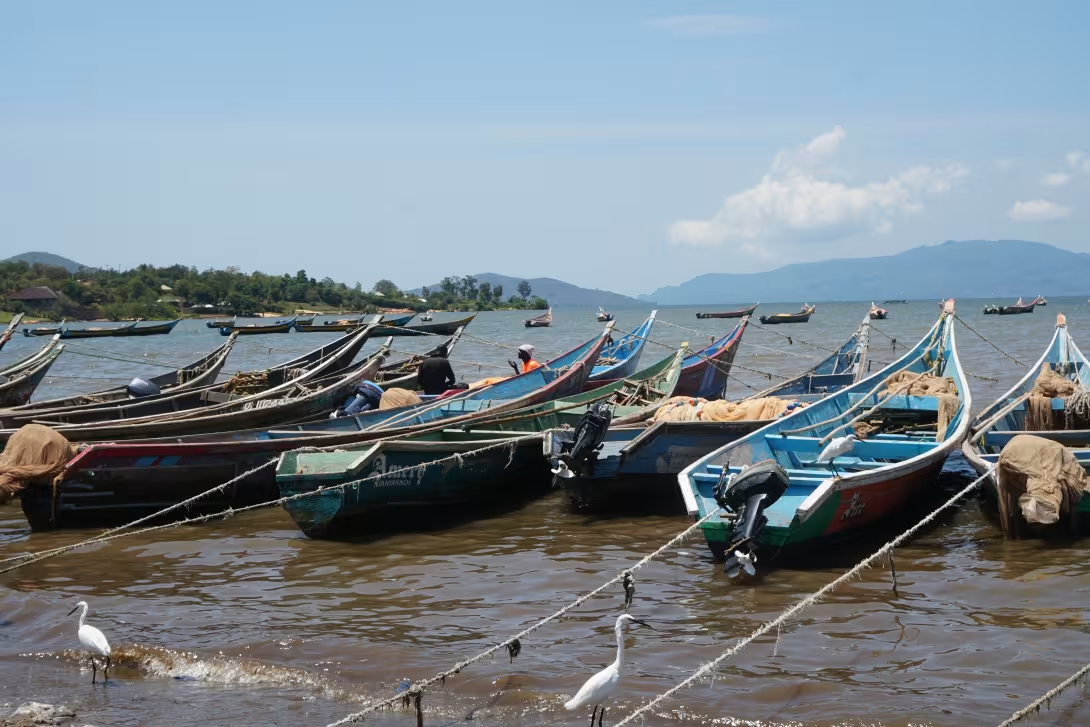
This project explores human rights, food security, and climate change in small scale fishing (SSF) networks in Lake Victoria. Its goal is to produce a mass balance model for the flows in the value chains, to better inform policy to mitigate climate change and human rights impacts, while enhancing trade, production, equality, women's rights, and adaptation given major transformation in fishing value chains.
About the research project
Of particular interest is the diversion of fish meal and fish oil (FMFO) to support aquaculture, which has inevitable and significant ramifications on food security and socioeconomic wages and jobs.
This Community Assessment Framework is developed by integrating the frameworks and approaches from related projects, including Dried Fish Matters, SmallFishForFood, the Ecopath model, and the Myera framework. This integrated framework offers a non-prescriptive guide for SFCC research teams to develop their workplans, foster methodological alignment across regional teams, and contribute to advancing the broader Reimagining Food Systems (RFS) vision in synergy with other partners in the project. Aligned with Objective 1 of the RFS project, which centers on community assessment through a climate change lens, the integrated framework incorporates diverse qualitative and quantitative methodologies to evaluate multiple facets of small fish value chains in Asia and Africa. Given that these value chains are connected to complex open systems, a food systems-value chain approach is necessary to analyze and address the challenges and opportunities related to climate change, human rights, and social justice across all segments of the value chain.
The RFS project also emphasizes the development of synergized frameworks for community assessment, including utilizing the Myera framework and asset inventory mapping to identify community strengths and weaknesses. While the Myera framework focuses on closed systems, Dried Fish Matters (DFM) adopts an asset-buy-make-sell approach, which serves as an asset inventory mechanism tailored to the value chain segments. This approach is rooted in understanding the assets, transactions, and exchanges that define different segments of the value chain. Importantly, however, the approach situates the asset-buy-make-sell within food systems that contextualize economic relationships as geographically and temporally specific. This integration not only aligns the research efforts across RFS project but also creates opportunities for more effective and holistic analysis of small fish value chains.
People
Project manager
Ragnhild Overå Professor
Jeppe Kolding Professor
Project members
Matthew Pflaum Postdoctoral Fellow