

The Norwegian Longitudinal Health Behaviour study (NLHBS)
The NLHB study is focused on health and health related behaviors throughout the life course. The purpose of the project is to increase our understanding of what factors promote the development of good health habits and behaviors. Findings from the project are intended to serve policy makers and societal organs that work to promote physical and mental health through early intervention and preventive efforts.
About the research project
Data collections
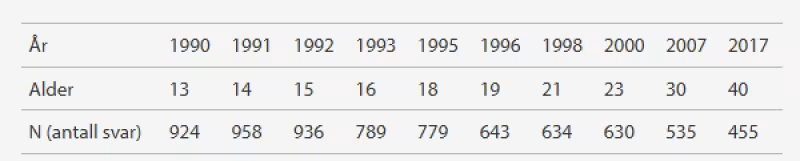
During autumn 1990, 1195 13-year-olds and their parents were randomly sampled from schools in Hordaland Fylke. They were invited to participate in a broad study on health. Since then, nine waves of data collections have followed - spanning 27-years in total - from age 13 to age 40. Parents participated from 1990 to 1996. 45,6% of the sample in 1990 were girls.
The dataset covers a wide range of variables, including depressive tendencies, self-esteem, body-image, life satisfaction, bullying, physical activity, criminal behavior, sexual development, eating habits, substance use, peer relations, parental relations, social support, living circumstances, life events, educational attainment, income level etc.
Purpose
The largest public health problems in the western world are intimately associated with people’s health habits and lifestyle. In particular, there are four health habits that are considered strong risk factors for common diseases such as cardiovascular diseases, cancer, depression and muscle disorders. These four health habits are: physical inactivity, unhealthy eating habits, smoking and substance abuse (e.g., drugs, alcohol). An effective reduction of these risk factors would contribute significantly to reduce illness and morality in the population. Preventive efforts and health promotion in this area must target the causes of unhealthy habits, therefore, we need to get a better understanding of why people smoke, are physically inactive and eat unhealthy. Better knowledge will enable policy makers as well as health organizations and practitioners to develop more effective initiatives to prevent common lifestyle diseases.
Issues in focus
- How does health behaviors (e.g., eating habits, physical activity, substance use) change throughout the life course (from age 13 to 40), and how are specific health behaviors associated with each other?
- What is the interplay between social and psychological factors in the development of health habits over time?
- To what extent, do children inherent their parents’ lifestyle and health habits and is this inheritance conditioned on social inequality in society and psychosocial relations in the family?
Partners
University of Oslo (Institutt for samfunnsernæring, Institute of Psychology), Norwegian Institute of Public Health, UniResearch Bergen.
Publications
Oversikt over publikasjoner med data fra prosjektet
Tidsskriftsartikler
2008- 2015:
- Thuen, F., Breivik, K., Wold, B. & Ulvesether, G. (2015). Growing up with one or both parents: The effects on physical health and health-related behavior through adolescence and into early adulthood. Journal of Divorce and Remarriage, 56:6, 451-474, DOI: 10.1080/10502556.2015.1058659
- Birkeland, M.S., Torsheim, T., Leversen, I., Wold, B. (2014). Pathways to adulthood and their precursors and outcomes. Scandinavian Journal of Psychology, 55(1), 26-32.
- Birkeland, M. S., Breivik, K., & Wold, B. (2014). Peer Acceptance Protects Global Self-esteem from Negative Effects of Low Closeness to Parents During Adolescence and Early Adulthood. Journal of youth and adolescence, 43:70-80.
- Birkeland, M.S., Melkevik, O., Holsen, I. & Wold, B.(2012) Trajectories of global self-esteem development during adolescence and associations with outcomes in adulthood. Journal of Adolescence 35, 43-54.
- Birkeland, M.S., Torsheim, T. & Wold, B. (2008) A longitudinal study of the relationship between leisure-time physical activity and depressed mood among adolescents. Psychology of Sport & Exercise. 10, 25-34.
- Holsen, I., Jones, D. C., & Birkeland, M. S. (2012). Body image satisfaction among Norwegian adolescents and young adults: A longitudinal study of the influence of interpersonal relationships and BMI. Body Image, 9(2), 201-208.
- Kjønniksen, L., Fjørtoft, I. & Wold, B. (2010). Attitude to physical education and participation in organized youth sports during adolescence related to physical activity in young adulthood: a 10-year longitudinal study. European Physical Education Review, 15 (2), 139-154: 345231.
- Kjønniksen, L., Anderssen, N. and Wold, B. (2009) Organized youth sport as a predictor of physical activity in adulthood. Scandinavian Journal of Science & Medicine in Sports, 19; 646-654. DOI: 10.1111/j.1600-0838.2008.00850.x
- Kjønniksen, L., Torsheim, T. & Wold, B. (2008). Tracking of leisure-time physical activity during adolescence and young adulthood: a 10-year longitudinal study. International Journal of Behavioural Nutrition and Physical Activity, 5:69, 1-11.
- Tjora, T., Hetland, J., Aarø, L. E., Wold, B., Wiium, N., & Øverland, S. (2014). The association between smoking and depression from adolescence to adulthood. Addiction, 109(6), 1022-1030.
- Tjora, T., Hetland, J., Aarø, L.E. & Wold, B. & Øverland, S. (2012) Late-onset smokers: how many, and associations with health behaviours and socioeconomic status. Scandinavian Journal of Public Health, 40(6), 537-543.
- Tjora, Tore, et al. "Distal and proximal family predictors of adolescents' smoking initiation and development: a longitudinal latent curve model analysis." BMC public health 11.1 (2011): 911.
- Åstrøm, A.N. & Wold, B. (2012) Socio-behavioural predictors of young adults’ self-reported oral health: 15 years of follow-up in the The Norwegian Longitudinal Health Behaviour study. Community Dentistry Oral Epidemiology, 40(3); 210-220.
2000 – 2007:
- Åstrøm AN. Stability of oral health related behaviour in a Norwegian cohort between the ages of 15 and 23 years. Community Dent Oral Epidemiol; 32, 354-62, 2004
- Anderssen N: Does contact with lesbians and gays lead to friendlier attitudes? A two year longitudinal study. Journal of Community and Applied Social Psychology, 12, 124-136, 2002.
- Anderssen, N., Wold, B., and Torsheim, T. Tracking of physical activity in adolescence. Research Quarterly for Exercise and Sport, 76 (2), 119-129, 2005
- Anderssen, N., Wold, B., and Torsheim, T. Are parental health habits transmitted to their children? An eight year follow-up of physical activity in adolescents and their parents. Journal of Adolescence, 29, 513-524; 2006
- Friestad C, Lien N, Klepp K-I. Educational plans – when are they established? Implications for the measurement of socioeconomic status in youth. Young; 9:18-32, 2001
- Friestad and Klepp: Socioeconomic status and health behaviour patterns through adolescence: Results from a prospective cohort study in Norway. European Journal of Public Health16 (1): 41-47, 2006.
- Holsen I, Kraft P & Vitterso J: Stability in depressed mood in adolescence: Results from a 6-year longitudinal panel study. Journal of Youth and Adolescence, 29 (1), 61-78, 2000.
- Holsen I, Kraft P & Roysamb E: The relationship between body image and depressed mood in adolescence: A 5-year longitudinal panel study. Journal of Health Psychology 6 (6), 613-627, 2001.
- Kraft P, Breivik S, Roysamb E & Holsen I: Body image and depressed mood- a longitudinal study of adolescents aged 13-18. Tidsskrift for Samfunnsforskning, 42 (2), 191-222, 2001.
- Lien N, Friestad C & Klepp K I: Adolecents`proxy reports of parents`socioeconomic status: How valid are they? Journal of Epidemiology and Community Health, 55 (10), 731-737, 2001.
- Lien N, Lytle L A & Klepp K I: Stability in consumption of fruit, vegetables, and sugary foods in cohort from age 14 to age 21. Preventive Medicine, 33 (3), 217-226, 2001.
- Lien N, Jacobs DR jr, Klepp K-I. Exploring predictors of eating behaviour among adolescents by gender and socioeconomic status. Public Health Nutr; 5, 671-81, 2002
- Skeie G, Klepp K I: Slanking blant jenter frå Hordaland. Tidsskrift for Den norske lægeforening, 122: 1771-1773, 2002.
- Strønstad K, Aarø L-E, Hetland J & Wold B: Depressivitet og røyking – En prospektiv panelstudie blant ungdom i Hordaland. Norsk Epidemiologi, 12(3), 221-230, 2002.
- Thrane, C. Utdanningens sosiale reproduksjon – et fokus på mekanismer, Sosiologisk Tidsskrift, 13:45-70, 2005.
1993- 1999:
- Aas H: Adaption of the Alcohol Expectancy Questionnaire AEQ-A: A short version for use among 13-year old adolescents in Norway. Scandinavian Journal of Psychology, 34: 107-118, 1993.
- Aas H, Jakobsen R, Anderssen N: Prediciting 13-year-olds’ drinking using parents' self-reported alcohol use and restrictiveness compared with offspring's perception. Scandinavian Journal of Psychology, 37 (2): 113-120, 1996.
- Anderssen N, Wold B: Parental and peer influences on leisure-time physical activity in young adolescents. Research Quarterly for Exercise and Sport, 63(4): 341-348, 1992.
- Anderssen N: Perceptions of physical education classes among young adolescents: Do physical education classes provide equal opportunities to all students? Health Education Research, 8(2): 167-179, 1993.
- Anderssen N, Klepp K-I, Aas H, Jakobsen R: Stability in physical activity levels in young adolescents: A 2-year follow-up of the Norwegian Longitudinal Health Behavior Study. European Journal of Public Health, 4(3): 175-180, 1994.
- Anderssen N, Jacobs DR Jr., Aas H, Jakobsen R: Do adolescents and parents report each other’s physical activity accurately? Scandinavian Journal of Medicine & Science in Sports, 5 (5): 302-307, 1995.
- Birkeland, M.S., Leversen, I., Torsheim, T., & Wold, B. (2014). Pathways to adulthood and their precursors and outcomes. Scandinavian journal of psychology, 55(1), 26-32.
- Birkeland, M. S., Breivik, K., & Wold, B. (2014). Peer acceptance protects global self-esteem from negative effects of low closeness to parents during adolescence and early adulthood. Journal of youth and adolescence, 43(1), 70-80.
- Birkeland, M. S., Melkevik, O., Holsen, I., & Wold, B. (2012). Trajectories of global self-esteem development during adolescence. Journal of adolescence, 35(1), 43-54.
- Friestad C, Klepp K-I: Fra eksperimentering til vanerøyking. En tre års oppfølgings-undersøkelse av ungdoms røykevaner. Tidsskrift for Den norske lœgeforening, 116: 635-638, 1996.
- Friestad C, Klepp K-I: Social influences on the development of boys’ and girls’ smoking behavior. Journal of Gender, Culture and Health, 2 (4): 287-304, 1997.
- Friestad C, Klepp K-I: Røyking, kroppsbilde og slankeatferd blant ungdom. Tre års oppfølging av ungdom i alderen 15-18 år. Tidsskrift for Den norske lœgeforeningen, 117 (23): 3342-3346, 1997.
- Friestad C, Klepp K-I: Røyking, kroppsbilde og slankeatferd blant ungdom. Tre års oppfølging av ungdom i alderen 15-18 år. Månadens artikel. Nordisk Medicin, 112 (9): 334-338, 1997.
- Friestad,C. & Rise, J. Smoking attributions and adolescents’ intention to try to quit smoking. Addiction Research, 6(1), 13-26, 1998.
- Jakobsen R, Rise J: Adolescents’ knowledge about HIV/AIDS: One dimensional or two dimensional? A confirmatory factor analysis. Journal of Health Psychology, 2 (1): 57-65, 1997.
- Jakobsen R, Rise J, Aas H, Anderssen N: Noncoital sexual interactions and problem behaviour among young adolescents. The Norwegian Longitudinal Health Behaviour Study. Journal of Adolescence, 20: 71-83, 1997.
- Jakobsen R: Stages of progression in non-coital sexaul interactions among young adolescents: An application of the Mokken Scale Analysis. International Journal of Behavioral Development, 21 (3): 537-553, 1997.
- Klepp K-I, Aas HN, Mœland JG, Alsaker F: Selvrapportert helse blant yngre tenåringer. En tre års oppfølgingsundersøkelse. Tidsskrift for Den norske lœgeforening, 116 (17): 2032-2037, 1996.
- Klepp K-I, Aas HN, Waahlberg R: Opplevd tilgang på alkohol blant ungdoms-skoleelever. En longitudinell undersøkelse. Tidsskrift for Den norske lœgeforening, 116 (26): 3132-3135, 1996.
- Lien N, Klepp K-I: Frukt- og grønnsakinntak i en tenåringskohort. Tidsskrift for Den norske lœgeforeningen, 119: 2327 - 30, 1999.
- Natvig Aas H, Leigh BC, Anderssen N, Jakobsen R: Two-year longitudinal study of alcohol expectancies and drinking among Norwegian adolescents. Addiction, 93 (3), 373-384, 1998.
- Rise J, Jakobsen R: Organization of HIV/AIDS related attitudes and predictors of attitudes. Scandinavian Journal of Social Medicine, 23 (3): 202-208, 1995.
- Rise J, Åstrøm AN, Sutton S: Predicting behaviour and use of dental floss among adolescents: An application of the theory of planned behaviour. Psychology and Health , 13, 223-236, 1998
- Thuen F, Rise J: The influence of parent-child relationship on young adolescents' use of safety equipment. The Norwegian Longitudinal Health Behavior Study. Scandinavian Journal of Psychology, 36: 399-405, 1995.
- Tjora, T., Hetland, J., Aarø, L. E., & Øverland, S. (2011). Distal and proximal family predictors of adolescents' smoking initiation and development: a longitudinal latent curve model analysis. BMC public health, 11(1), 911.
- Tjora, T., Hetland, J., Aarø, L. E., Wold, B., & Øverland, S. (2012). Late-onset smokers: How many, and associations with health behaviours and socioeconomic status. Scandinavian journal of public health, 40(6), 537-543.
- Tjora, T., Hetland, J., Aarø, L. E., Wold, B., Wiium, N., & Øverland, S. (2014). The association between smoking and depression from adolescence to adulthood. Addiction, 109(6), 1022-1030.
- Åstrøm AN: Dimensionality of dental-health behavior. American Journal of Health Behavior, 20 (3): 67-76, 1996.
- Åstrøm AN, Jakobsen R: The effect of parental dental health behaviour on that of their adolescent offspring. Acta Odontologica Scandinavica, 54: 235-241, 1996.
- Åstrøm AN, Rise J: Expectancy-value approach to drinking of non-sugared mineral water among adolescents. CommunityDentistry and Oral Epidemiology, 24: 72-78, 1996.
- Åstrøm AN, Rise J: Analysis of adolescents' beliefs about the outcomes of using dental floss and drinking non-sugared mineral water. Community Dentistry and Oral Epidemiology, 24: 211-216, 1996.
- Åstrøm AN. Parental influences on adolescents' oral health behavior: two year follow up of the Norwegian Longitudinal Health Behavior Study. European Journal of Oral Science,106,922-930, 1998.
- Åstrøm AN, Jakobsen R. Stability of dental health behavior: a 3 year prospective cohort study of 15,-16,- and 18-year old Norwegian adolescents. Community dentistry Oral Epidemiology, 26, 129-138, 1998.
Avhandlinger basert på data fra Voksen i år 2000
Aas HN: Alcohol expectancies and socialization: Adolescents learning to drink. Doctoral thesis submitted in partial fulfillment of the requirements for the Degree of Doctor Psychologiae. Bergen: University of Bergen, 1995.
Anderssen N: Physical activity of young people in a public health perspective: Stability, change and social influences. Doctoral thesis submitted in partial fulfillment of the requirements for the Degree of Doctor Psychologiae. Bergen: University of Bergen, 1995.
Birkeland, M.S. Development of global self-esteem.The transition from adolescence to adulthood. Doctoral thesis submitted in partial fulfillment of the requirements for the Degree of Doctor Psychologiae. Bergen: University of Bergen,2013.
Friestad C: Social psychological approaches to smoking. Doctoral thesis submitted in partial fulfillment of the requirements for the Degree of Doctor Philosophiae. Bergen: University of Bergen, 1998.
Holsen I : Depressed mood from adolescence to 'emerging adulthood'. Course and longitudinal influences of body image and parent-adolescent relationship. Doctoral thesis submitted in partial fulfillment of the requirements for the Degree of Doctor Philosophiae. Bergen: University of Bergen, 2002.
Jakobsen R.: Empiriske studier av kunnskap og holdninger om hiv/aids og den normative seksuelle utvikling i ungdomsårene. Doctoral thesis submitted in partial fulfillment of the requirements for the Degree of Doctor Psychologiae. Bergen: University of Bergen, 1998
Kjønniksen, L. The association between adolescent experiences in physical activity and leisure time physical activity in adulthood: -a ten year longitudinal study, PhD Thesis, Faculty of Psychology, University of Bergen, 2008.
Lien N: Stability and predictors of eating behaviors during adolescence and early adulthood. Doctoral thesis submitted in partial fulfillment of the requirements for the Degree of Doctor Psychologiae. Oslo: University of Oslo, 2002
Thuen F: Accident-related behaviour among children and young adolescents: prediction and prevention. Doctoral thesis submitted in partial fulfillment of the requirements for the Degree of Doctor Psychologiae. Bergen: University of Bergen, 1993.
Tjora, T: Smoking from adolescence through adulthood: the role of family, friends, depression and socioeconomic status. PhD thesis. Bergen: University of Bergen, 2014.
Åstrøm AN: Dental health behaviour among adolescents - a socio psychological approach. Doctoral thesis submitted in partial fulfillment of the requirements for the Degree of Doctor Odont. Bergen: University of Bergen, 1996.
Bokkapitler, rapporter og øvrige publikasjoner
- Aas H: Ungdoms alkoholforventninger og sosialisering til alkoholbruk. I S. L. Beckmann & H. Storvik (Red.): Epidemiologisk forskning om sammen-hengen mellom miljø og helse: Rapport for perioden 1987-1992. (s. 207-218). Oslo, Norges Forskningsråd, 1994.
- Aas H: Om samspillet mellom resultatforventninger, selektiv persepsjon, selvoppfyllende profetier, forsterkning og alkoholbruk hos ungdom. I: N. Anderssen, B. Wold (red.): Psykologisk tenkning i helsefremmende arbeid. Universitetet i Bergen: Hemil-rapport nr. 2: 9-14, 1995.
- Anderssen N, Klepp K-I: Development of coronary-related behaviors among adolescents: The Norwegian Longitudinal Health Behavior Study. Symposium on Health Behavior in Adolescence: Implications for prevention of coronary heart disease. University of Bergen, Proceedings, pp 34-44, 1993.
- Bolneset T: Tenåringer: Livsstil kan forutsi risikosex. AIDS Info, Nr. 2, s. 4, mai 1993.
- Holsen I: Ungdom som ikke trives med livet. I: Klepp K-I, Aarø LE (red.): Ungdom, livsstil og helsefremmende arbeid. 2. utg. Oslo: Universitetsforlaget, 1997.
- Jakobsen R: Ungdommers seksuelle erfaringer: Fra uskyld til helserisiko. I: Klepp K-I, Aarø LE (red.): Ungdom, livsstil og helsefremmende arbeid. 2. utg. Oslo: Universitetsforlaget, 1997.
- Klepp K-I, Aarø LE, Rimpelä M: Ungdom, samfunn og helse. I: Klepp K-I, Aarø LE (red.): Ungdom, livsstil og helsefremmende arbeid. 2. utg. Oslo: Universitetsforlaget, 1997.
- Klepp K-I: Rusmiddelforebyggende arbeid. I: Klepp K-I, Aarø LE (red.): Ungdom, livsstil og helsefremmende arbeid. 2. utg. Oslo: Universitetsforlaget, 1997.
- Røysamb E, Friestad C: Rusbruk og foreldrerelasjoner gjennom ungdomsårene. Bergen: Hemil-senteret, Universitetet i Bergen. Rapport til Folkhälsoinstitutet, Stockholm, 1998.
- Wold B, Anderssen N, Aarø LE: Concordance between self-report and family surrogate report of smoking behaviour in young adolescents and their parents. In K. Slama (Ed.): Tobacco and health. New York: Plenum Press: 595-597, 1995.
- Åstrøm AN, Rise J: Tannhelseatferd blant 15 åringer i Hordaland. Universitetet i Bergen, HEMIL rapport nr. 4, 1993.
- Åstrøm AN: Sosial-psykologisk perspektiv på ungdommers tannhelseatferd. I: Klepp K-I, Aarø LE (red.): Ungdom, livsstil og helsefremmende arbeid. 2. utg. Oslo: Universitetsforlaget, 1997.
People
Project manager
Bente Wold Project leader
Funding

Research Council of Norway, Norwegian Council for Mental Health, L. Meltzers Høyskolefond, National Institute for Alcohol and Drug Research (SIFA) and the Norwegian Cancer Society.