

It is time for an Interdisciplinary Network for Research on Gender and Games
We are living in a political moment globally in which research on gender is increasingly under pressure. Games studies scholars working on gender and games are all too familiar with these pressures and with the challenges that come with it. While #Gamergate is amongst the most illustrative historical examples of this, the violent harassment of scholars in our field, especially those who occupy marginalized identity positions, unfortunately still continues.
Av: Tom Legierse og Ida Martine Gard Rysjedal
Published: (Oppdatert: )
Besides the pressures from the outside, Amanda Phillips (ekstern lenke) has critiqued game studies own history of being unwelcoming to feminist perspectives and the negging of marginalized scholars. Kelly Bergström (ekstern lenke) further directs our attention to the ‘blood on the tracks’ of games and game studies, underscoring the exclusionary harms that these fields so often sustain themselves on. We must learn from these experiences, and work on creating sustainable and inclusive cultures around games and gender scholarship.
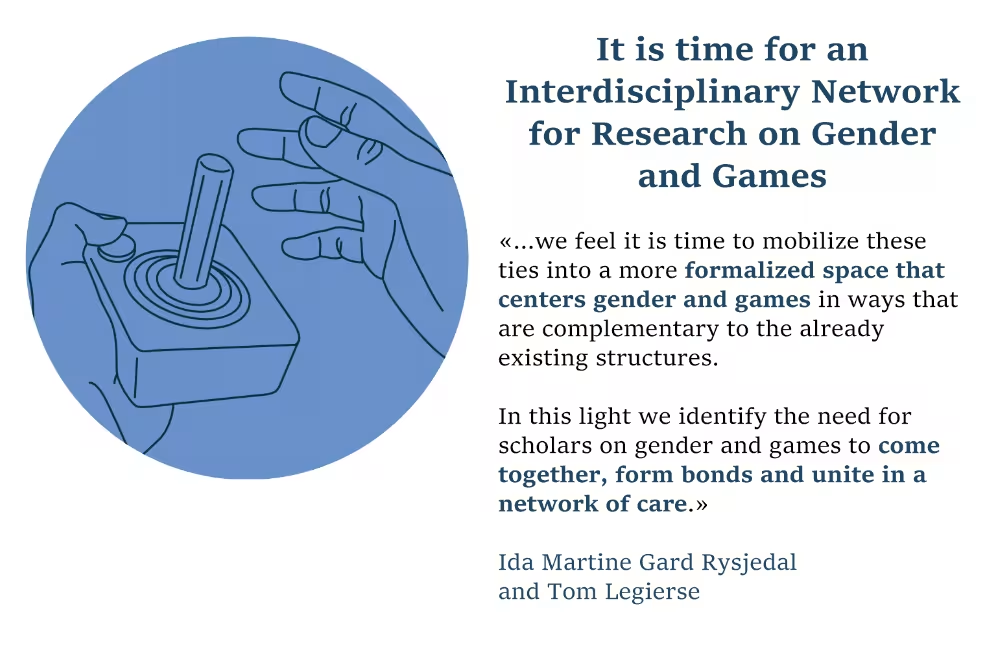
It is all the more challenging to create sustainable practices and cultures as Game studies scholars are scattered across universities and departments, and gender and games researchers maybe even more so. Thankfully, we regularly find each other at (inter)national game studies conferences and events. Gender and games researchers form informal ties within more formalized game studies networks, like DiGRA and its local chapters. However, we feel it is time to mobilize these ties into a more formalized space that centers gender and games in ways that are complementary to the already existing structures.
In this light we identify the need for scholars on gender and games to come together, form bonds and unite in a network of care. Such a network should bring together the various disciplinary traditions, theoretical and methodological approaches in order to think across boundaries on how our work on gender and games can lead up to progressive change. The work we do is often regarded to be killing joy, but following Sara Ahmed (ekstern lenke) we consider this productive. But when we kill joy alone, our efforts are more easily dismissed. Ahmed (ekstern lenke) reminds us of a simple truth: “The more we are, the louder.” Making ourselves louder is not just about making ourselves heard, it is about the force with which we make (and demand) progressive changes in the world.
This year we, together with Maria Ruotsalainen, are organizing a series of three workshops focusing on gender and games in which we lay the fundaments for the Interdisciplinary Network for Research on Gender and Games. The first workshop in this series, themed around feminist approaches to esports research, took place in November 2024 in Jyväskylä. We are hosting our second workshop at CEEGS 2025 in collaboration with Robin Zingarelli Longobardi and Giulio Enea Bevione, where we will discuss future directions for research on gender and games. After that, we are concluding our workshop series in Bergen with a 2-day event in November that highlights doctoral research on gender and games that is funded through the Nordic Gender Fund.
With these workshops we have continuously considered two interrelated goals. Firstly, the workshops function as standalone events that aim to further the individual works of scholars and the field as a whole. Secondly, we consider the connective tissue between these workshops to be their relation to the network. We envision the network to be a space in which the fruitful discussions and potential collaborations that spring out of these workshops can be sustained. Whether it is through reading groups, workshops, co-authored pieces, joint projects, or other forms of collaboration, we wish for the network to be a space in which scholars find a community from which they can build up their careers.
We cannot talk about this network without acknowledging the key role Usva Friman, Maria Ruotsalainen and Matilda Ståhl have played for us. By setting up a reading group on sustainable esports cultures after CEEGS 2022 they laid the foundation for what we aim to achieve with the network. To us, the reading group has exemplified the crucial importance of feminist communities from which we can draw a sense of belonging. We build on the informal bonds and ties that developed through and around this initiative in an effort to establish a formal space to which scholars can turn when seeking community and safety. We imagine this as especially important for junior scholars, who are affected most by the precarious existence that being a gender and games studies scholar can be.
In the coming months we will make moves to materialize the Interdisciplinary Network for Research on Gender and Games.
Part of it will happen through the workshops, but if you are reading this as a gender and games scholar; please reach out! Share your ideas, thoughts and hopes with us, and get involved in planning the network’s launch in 2026. We are looking forward to it!
Interdisciplinary Network for Research on Gender and Games
The network is being established to foster inclusive, sustainable scholarly communities across disciplines, centering on feminist perspectives in game studies. It builds on informal ties and workshops to create a formal space for collaboration, support, and progressive change in gender and games research. The network aims to amplify marginalized voices and provide a sense of belonging – especially for junior scholars.
For more information, contact Tom Legierse or Ida Martine Gard Rysjedal.