

KMD takes on a key role in national centre for AI and creativity
Researchers at the Faculty of Fine Art, Music and Design (KMD) at the University of Bergen (UiB) have been given a central role in the new national research center MishMash – Center for AI and Creativity.
By: Åshild Nylund and Thomas De Ridder
Published: (Updated: )

The grant is part of the national initiative on artificial intelligence (AI) and marks an important breakthrough for artistic research in the face of emerging technologies.
The government recently announced (external link) that six national research centres focused on artificial intelligence (AI) will receive funding from the Research Council of Norway. MishMash – Centre for AI and Creativity – is one of these national centres and will receive NOK 173 million over the next five years.
“This is a game changer,” says Dean Frode Thorsen at KMD. “The grant shows that the arts are being recognized as a key player in the development of future AI solutions, both within and beyond academia,” he emphasizes.
Professor Alexander Refsum Jensenius (external link) at the University of Oslo will lead the center, which is set to launch this fall. The University of Bergen is one of four institutions in the centre’s leadership, alongside the University of Oslo (UiO), the University of Agder (UiA), and the University of Inland Norway (INN).
Research at the intersection of art and technology
MishMash will explore how artificial intelligence influences and interacts with machines, humans, and society. The aim is to establish a major national centre dedicated to investigating the meeting point between AI and creativity.
A significant portion of Norway’s creative and performing arts communities are involved. The project also seeks to strengthen the link between the cultural sector and the academic arts field within the higher education sector.
The primary objective is to create, explore, and reflect on AI for, through, and within creative practices. The centre will examine AI’s impact on creative processes, develop co-creative AI systems, and reflect on the ethical, cultural, and societal consequences of AI for creative professions.
The Faculty of Fine Art, Music and Design (KMD) has played a key role in the development of the project, which combines artistic research and scientific inquiry across disciplines such as music, health, gaming, film, cultural heritage, and technology. Last year, the faculty submitted its own proposal for such a centre, and the new initiative is the result of merging four key centre proposals into one national centre.
Sound art, music therapy, and cultural heritage
KMD is leading two key components (work packages) of the centre’s work, contributing to a third, and taking part in the administrative leadership:
AI for Artistic Processes: Work package lead Budhaditya Chattopadhyay, a researcher at KMD and internationally recognised sound artist, brings artistic and technological expertise to the project. He combines AI with sound and media art.
Creative Use of AI in Health and Wellbeing: Work package lead Claire Ghetti, Professor of music therapy, will research how AI can be used inclusively in health-promoting artistic contexts. She will also develop new research methods that integrate AI within the health field.
AI for Cultural Heritage: Arnulf Mattes, Professor of musicology, contributes insights into how AI can be used to analyse and preserve Norwegian cultural heritage. This work package is led by the National Library of Norway.
Senior Adviser Thomas de Ridder from the faculty will join the administrative leadership group for MishMash.
In total, 17 academic staff from KMD are expected to participate in the project over the next five years. Centre status entails a NOK 15 million allocation to the faculty. Other UiB contributors include researchers from the Center for Digital Narrative, the Department of Mathematics, and the University Library.
A boost for artistic research – and for Bergen
MishMash will have a strong presence in Bergen, with a large portion of its activities based at the Faculty of Fine Art, Music and Design. The project is network-based, bringing together creative and performing arts communities from across the country. A key aim is to strengthen the ties between the cultural sector and the academic arts field.
In total, 19 Norwegian universities, university colleges and research institutes are participating in the centre, located throughout the country. Participating institutions include AHO, BI, HiØ, HVL, INN, Kristiania, NLA, NMH, Nord, NTNU, UiA, UiB, UiO, and UiT. The participating research institutes are NILU, NORSUS, SimulaMet, and SINTEF. The National Library of Norway is also involved.
In addition, a wide range of associated partners from both Norway and abroad are connected to the project. These include leading institutions in AI, technology, and the creative disciplines, as well as museums, studios, associations, and players within the creative industries.
In Western Norway, several key cultural institutions are part of the centre, including Bergen Centre for Electronic Arts (BEK), the Bergen International Festival, Borealis, KODE Art Museums and Composer Homes, Media City Bergen, the Music Tech Conference Bergen, and the Polyfon Knowledge Cluster for Music Therapy.
More information about the centre and its partners can be found in the fact sheet (external link) available on the University of Oslo’s website.

Postdoctoral Fellow Budhaditya Chattopadhyay combines AI with sound and media art. He will lead the work package on AI for artistic processes in MishMash.
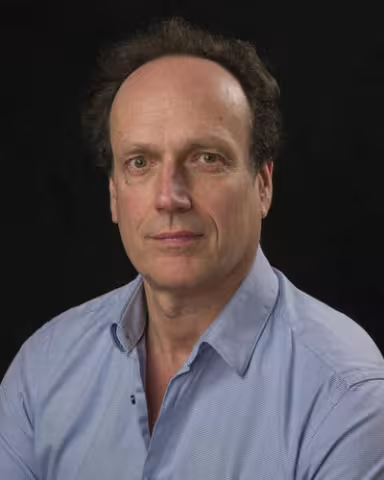
Professor Arnulf Mattes is the Director of the Grieg Research Centre at the University of Bergen (UiB) and leads the project Norwegian Musical Heritage. In MishMash, he will work on how AI can be used to analyse and preserve Norwegian cultural heritage.