

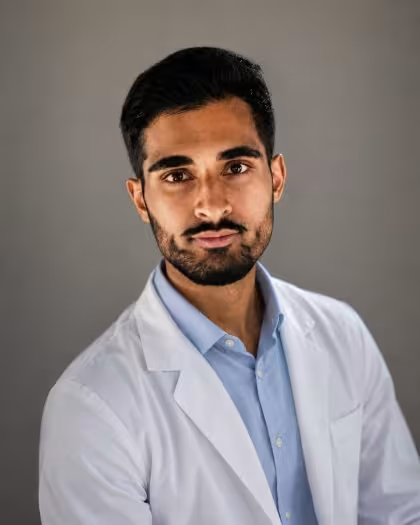
Jatinder Hayre
Position
Phd Candidate, Health Equity and Implementation Science
Affiliation
- jatinder.hayre@student.uib.no
- Visitor address
-
Haukeland Universitetssykehus Laboratoriebygget, 7. etg. Heis øst
5009 Bergen - Postal address
-
P.O. Box 7804NO-5020 BergenNorway
Jatinder Hayre
Position
Phd Candidate, Health Equity and Implementation Science
Affiliation
Research groups
Short info
Research
My research examines how social and structural disadvantage becomes translated into unequal experiences, opportunities and outcomes within health and healthcare. Working across public health, clinical medicine, health services research and implementation science, I am particularly interested in how healthcare systems distribute access, responsibility and opportunity, and how models of care can be designed to reduce, rather than reproduce, existing inequalities.
My previous research has examined socioeconomic and structural inequalities across public health, including the unequal consequences of the COVID-19 pandemic, evidence on interventions and policies intended to reduce health inequalities, and the relationship between disadvantage and access to effective healthcare. More recently, at Leicester Cancer Research Centre, my work extended into cancer survivorship and patient-centred intervention research, with particular emphasis on embedding patient voice and equity considerations within the design and evaluation of survivorship pathways.
A central theoretical strand of my work is Agentic Demand Theory, which seeks to explain how health inequities may arise when healthcare systems and health-promoting environments place unequal informational, administrative, behavioural and organisational demands upon individuals. This perspective shifts attention beyond whether healthcare or resources are nominally available, towards what people must know, navigate, organise and sustain in order to benefit from them, and how the capacity to meet these demands is socially patterned.
My doctoral research at the University of Bergen applies and develops these ideas within chronic kidney disease. The project is concerned with creating and evaluating an equity-embedded model of structured, longitudinal surveillance and responsive care. It brings together patient-reported outcomes and symptom burden, health literacy, routine clinical information, longitudinal monitoring, signal detection and clearly defined clinical response pathways, alongside a Digital Kidney School designed to strengthen knowledge, activation and self-management.
The ambition is to establish a genuinely equitable model of care: patient-generated information should not simply be collected, but should contribute to meaningful feedback, identify important changes over time and, where appropriate, trigger a proportionate response; simultaneously, longitudinal information should remain available to clinicians to inform subsequent clinical review and decision-making. Methodologically, the programme brings together co-design, health equity research, implementation science and pragmatic experimental evaluation. A central question throughout is therefore not simply whether an intervention works, but for whom it works, under which circumstances, through which mechanisms, and whether its implementation narrows or inadvertently widens existing inequalities.
My broader research interests include health inequity, social determinants of health, patient agency, health literacy, chronic disease, patient-reported outcomes, health services research, complex intervention development, implementation science, evidence synthesis and the design of more equitable health systems.
Outreach
My outreach and academic service centre on improving the translation of evidence on health inequalities into policy, practice and public understanding. I have contributed to commissioned work on inequalities arising from the COVID 19 pandemic for Independent SAGE, and have held wider roles spanning health policy, NHS governance, and professional academic service. I also contribute to scholarly communication through editorial and peer review roles across public health, nephrology and clinical research.
Teaching
My teaching interests lie at the intersection of clinical medicine, public health and health equity. I have contributed to undergraduate medical education, including co-leading curriculum development at the University of Nottingham around health systems and the social determinants of health. I also co-founded and directed an international medical interview teaching programme with a particular emphasis on widening participation and supporting students from less advantaged backgrounds.