

BCEPS Researchers at International Health Economics Association (IHEA) Congress 2025
Several BCEPS researchers presented their work at the International Health Economics Association (IHEA) Congress in Bali, Indonesia, held from July 19-23, 2025.
By: Jana Wilbricht
Published: (Updated: )
About the IHEA Congress
According to IHEA, "the IHEA congress, held every second year, is the only global forum for health economists to engage around the latest methodological developments, present recent research findings and explore the implications of this research for health policy and practice. The IHEA congress includes presentations across the full spectrum of health economics’ fields." You can read more about IHEA and the Congress on the IHEA website (external link).
Lancet Commission on Investing in Health Presentations
At the IHEA Congress 2025, Commissioners from the Lancet Commission on Investing in Health, many of whom are affiliated with BCEPS, presented their work on a global goal with wide-reaching implications: halving premature mortality by 2050 (“50 by 50”). This target, launched in the Commission’s 2024 report, reflects both the urgency and feasibility of focused health system reforms in the wake of the COVID-19 pandemic.
The session drew a strong audience, with over 50 attendees, and featured four presentations exploring how economic evidence can inform health policy change in low- and middle-income countries.

The session began with a presentation by Dr. Angela Chang on how declines in mortality have contributed to national well-being. Using a “full income” framework, the study quantified the economic value of mortality reductions from 1990–2019 and the losses associated with pandemic excess deaths—showing that improved survival has contributed as much to well-being as income growth. Dr. David Watkins then introduced “modular cost-effectiveness analysis,” a new approach to priority setting that accounts for how services are delivered and financed in practice, offering a more flexible framework for designing health benefits packages.
Sarah Bolongaita, a BCEPS PhD Research Fellow, presented next, highlighting recent reversals in domestic health financing and proposing strategies to support the 50 by 50 agenda: targeted domestic resource mobilization and improved access to essential medicines through an “Arrow mechanism” that links budget transfers to priority drug procurement. Dr. Eduardo González Pier closed the session with a political economy analysis of health financing reform, emphasizing how context-specific strategies and fiscal feasibility must be considered alongside technical recommendations to ensure lasting impact.

The session was chaired by Dr. Stéphane Verguet, with Dr. Beverly Essue leading a lively and well-received Q&A discussion. As countries reassess health priorities in the post-pandemic era, the Commission offers practical, evidence-based tools to help governments move from ambition to implementation—and make measurable progress toward a more equitable global health future.
BCEPS Nepal Team Presentations
Several members of the BCEPS Nepal team, led by Senior Researcher Krishna Aryal, presented at the IHEA Congress.

Among the BCEPS Nepal team, in order of presentation time, the following papers were presented at the Congress:
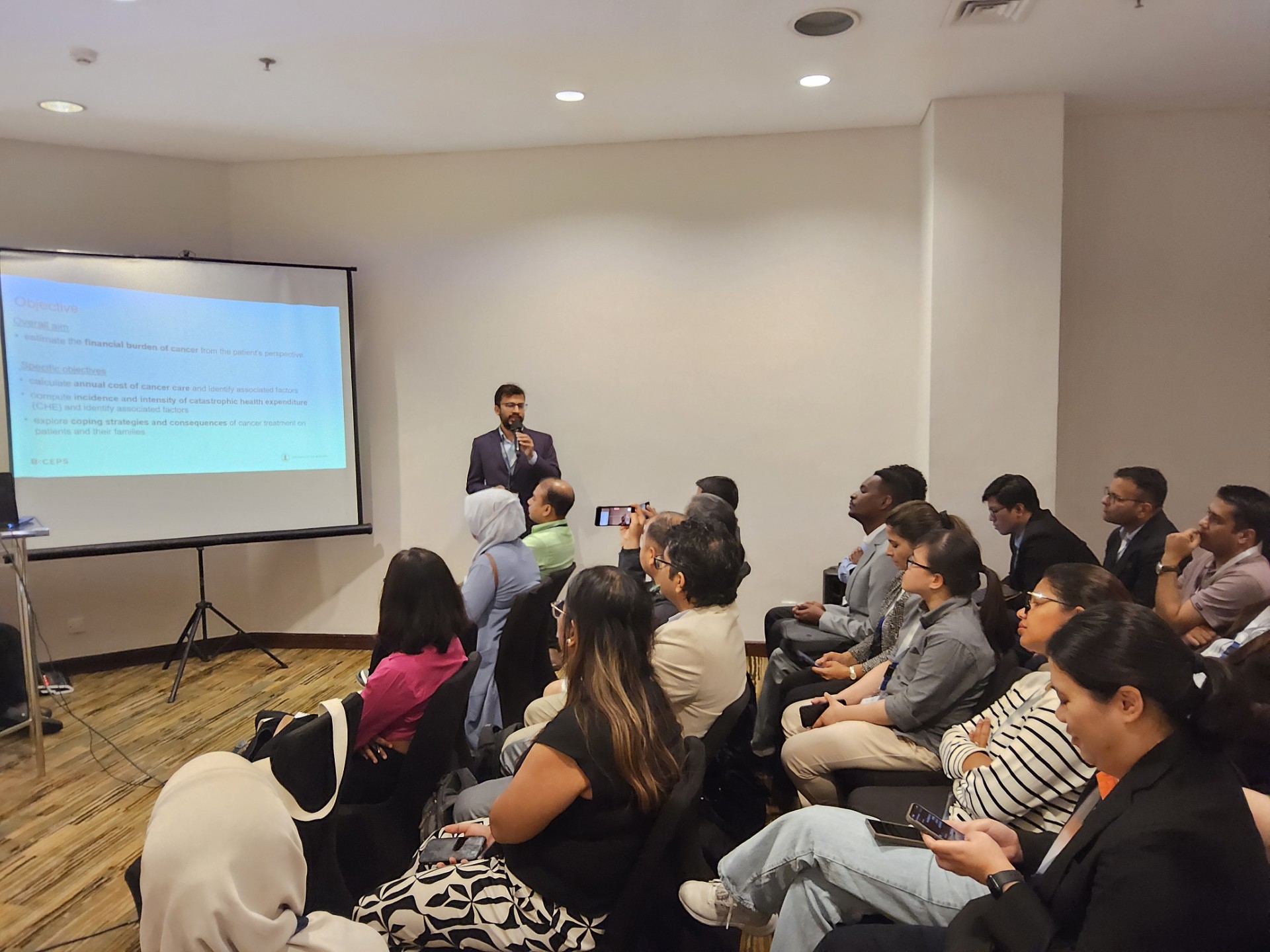
- BCEPS PhD Research Fellow Pratik Khanal presented his paper on "Estimating the financial burden of cancer in Nepal: A cross-sectional study of patient costs".
- In his presentation, Pratik shared the annual patient cost of selected cancers in Nepal and its associated factors.
- His presentation also addressed the incidence and intensity of catastrophic health expenditure and its associated factors along with coping strategies used by patients to finance cancer care.
Pratik Khanal also contributed to the IHEA congress by moderating the session "Analysis of Health Expenditures" on July 23, 2025. The session featured presentations on the impact of public debt on social spending in developing countries, healthcare expenditure trends in South Korea, Japan, and China, as well as institutional variation in healthcare costs. The session provided valuable insights into the drivers and implications of healthcare spending across diverse global contexts.

- BCEPS PhD Research Fellow Achyut Raj Pandey presented not one but two research papers: "Health Financing Reform in Nepal: Bridging the Gap Between Resources and Disease Burden" and "Poverty and Intersecting Inequities in Health Service Access and Utilization in Nepal: Insights from Nationally Representative Surveys".
- In his first presentation, Achyut discussed the shifting burden of disease and emphasized the need to realign resource allocation to reflect these changes. He highlighted the importance of institutionalizing a systematic priority setting process to ensure that resource distribution aligns with the country’s evolving health needs.
- In his second presentation, he discussed inequities in access to and use of health services, noting that these disparities become more pronounced when individuals experience multiple forms of marginalization.

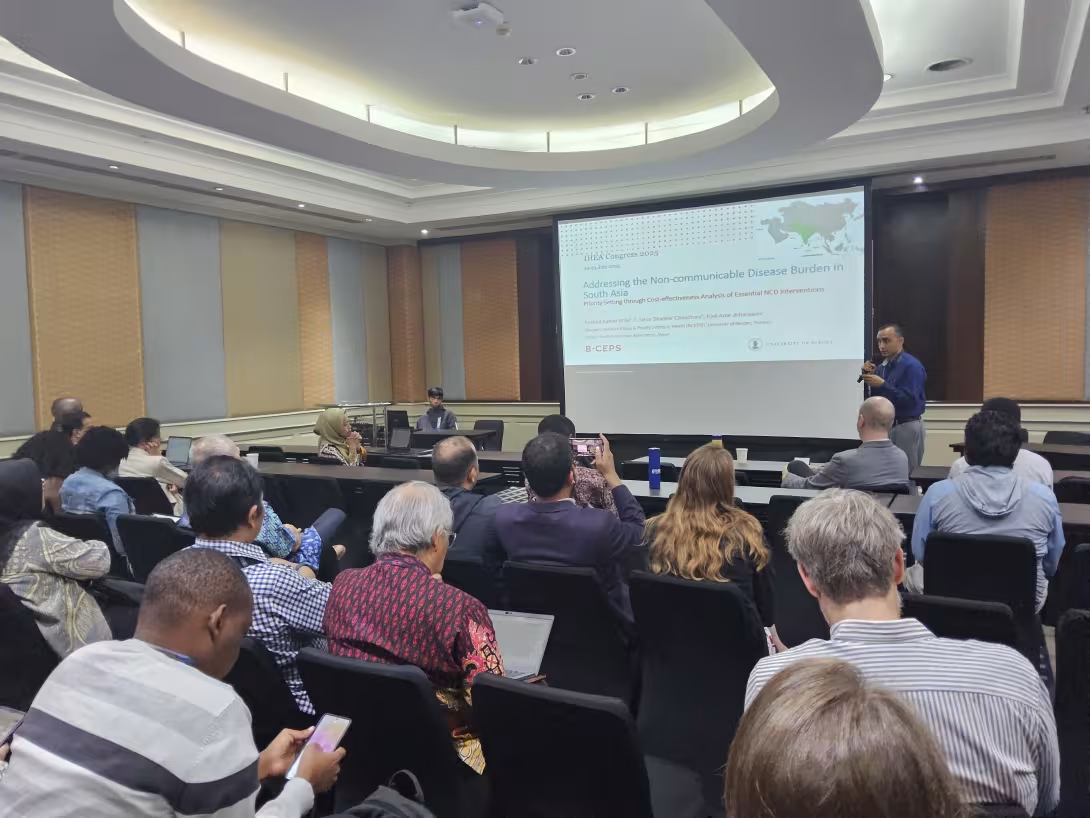
- BCEPS Senior Researcher and Lead of the Nepal Team Krishna Aryal presented on "Addressing the Non-communicable Disease Burden in South Asia: Priority Setting through Cost-effectiveness Analysis of Essential NCD Interventions". In his presentation, he highlighted:
- A cost-effective package of essential NCD services/interventions designed through a systematic process of priority setting results in a similar gain in healthy life years and lives saved as that of a full package of essential NCD services.
- He shared the results of a cost-effectiveness analysis of essential NCD interventions for 8 South Asian countries, which was done using the FairChoices DCP analytics tool, developed by Kjell Arne Johansson, Øystein Ariansen Haaland and team at BCEPS. This easy-to-use platform allows for the ranking of essential healthcare interventions for countries.
- Krishna Aryal underscored that country contextualization of the input data and the use of additional criteria and processes for priority setting will have to be applied at the country level in order to develop country-specific benefit packages.

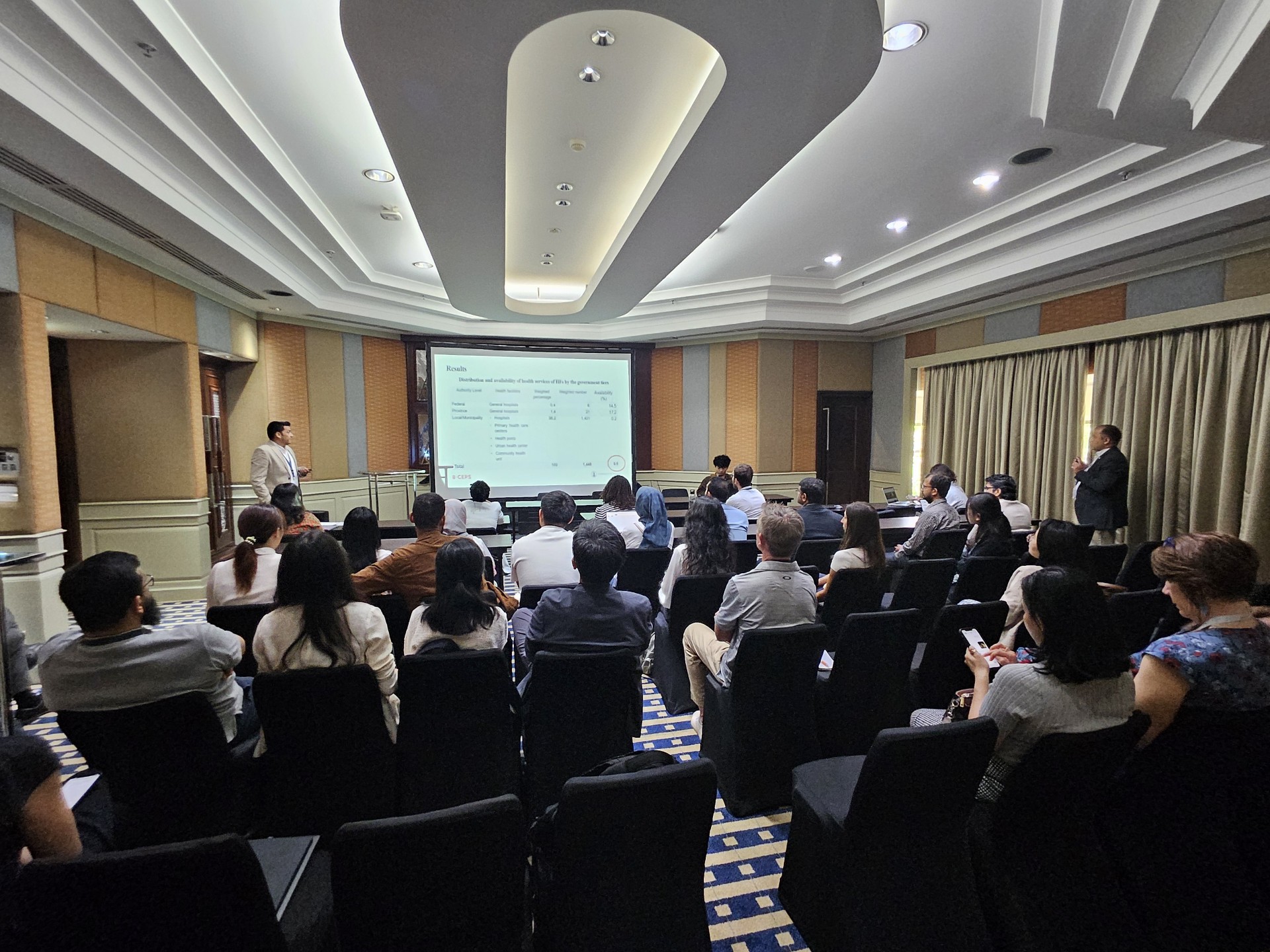
- BCEPS PhD Research Fellow Ravi Kanta Mishra presented his research in a presentation titled “From Constitutional Provision to Implementation of Basic Health Care Services (BHCS) Delivery in Nepal: Towards Achieving UHC”.
- In his presentation, Ravi shared key findings on the delivery of in following the country’s transition to federalism.
- He also highlighted the role of health care financing in enhancing the delivery and effectiveness of BHCS in the context of Nepal’s pursuit of Universal health coverage (UHC).
- BCEPS Research Associate Suman Sapkota presented on "Wealth-related Inequality in Antenatal Care Service Utilization: Evidence from Nepal Multiple Indicator Cluster Surveys 2014 and 2019"
