

Cheat sheet to the Kunming-Montréal Global Biodiversity Framework
In December 2022, two years after it was planned, 196 nations signed on to the historic Kunming-Montréal Global Biodiversity Framework (KM-GBF).
By: Dagmar Dorothea Egelkraut
Published: (Updated: )

Why historic? Well, where do we even start? It is historic because it is the first global environmental agreement ever to have been delayed for a full two years and moved across continents due to a pandemic. It is historic because it therefore happened to be published exactly 50 years after the landmark Club of Rome The Limits to Growth (external link)[4] (external link) report. Published in 1972, this report was the first thorough scientific analysis to suggest that economic growth (external link) could not continue indefinitely because of resource depletion (external link). And true to that inheritance, it is historic because it is, arguably, the first global agreement to fully acknowledge and incorporate ‘societal transformation’ as a necessary prerequisite to solve global environmental crises (see goals 14-23!). In that vein, it is also historic because it is the first global biodiversity agreement to not only set goals for what we want tot achieve, but also to set a number of quite operational goals for how we should go about to achieve it. And it is historic because it’s the first global biodiversity agreement based on science*.
It is also historic for being a bit of a... heavy read. With 23 goals, 4 targets, and ample surrounding text amounting to a 15 page document altogether, getting to grips with what it actually says, means and implies requires a bit of investment. Many of us are invested, want everyone else to be invested, and are excited to see that across the globe and across societies, there is a lot of investment. Still, many of us also need a nice, simple way to talk and communicate about the goals.
So, as a service to the community – here’s the CeSAM cheat sheet to the Kunming-Montréal Global Biodiversity Framework! Scroll down to download the PDF.
In our view, the KM-GBF can be summarized as
- four targets refer to what we should safeguard (biodiversity and nature, everywhere, including where it could be restored, and where it currently exists),
- four targets on the drivers that we should avoid or limit (unsustainable harvest, alien species, pollution, and climate change)
- five target on what we need to safeguard for people to accept the first eight (nature’s goods and services!)
- ten targets on how society can achieve the first 13 (transforming our policies, economies, and societies towards a better, more equitable world for all)
Please enjoy, share, and also do refer to the KM-GBF framework homepages for the full agreement text, and all the gory detail in the form of (important!) underlying documents and technical support.
*Yes it is! The work of the Intergovernmental Panel for Biodiversity and Ecosystem Services (IPBES) heavily underlies and runs through the KM-GBF. While the ambition level of the targets are politically set compromises, the nature of the targets, everything from what and where to focus actions (nature! everywhere!) via what we need to limit (direct drivers of biodiversity change), who and what we need to serve to ensure societal buy-in (nature’s goods, equitably, for everyone), to what is needed to drive action (fair, transparent political systems, management and economics) are heavily based on the science and frameworks provided by IPBES.

The COP15 leadership celebrates the adoption of the Kunming-Montreal Global Biodiversity Framework on December 19th 2022.

Part of the IPBES team at COP15: IPBES Chair Ana María Hernández Salgar, and members of the IPBES Invasive Species assessment team Helen Roy, Peter Steatt, and Vigdis Vandvik
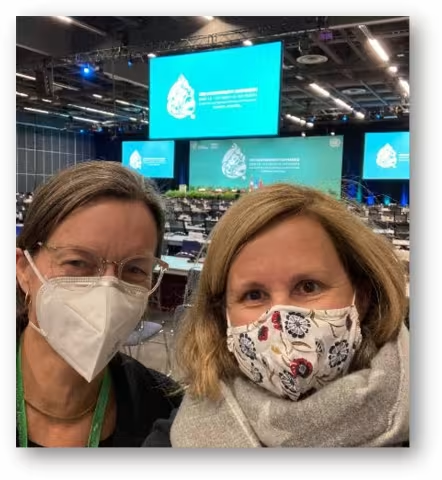
Selfie from the COP15 plenary - Vigdis Vandvik and Helen Roy.
Related content
- The Kunming-Montreal Global biodiversity framework
- Article - Mye glede, litt skuffelse i Montreal
- Podcast - Naturpodden: Får vi en ny global naturavtale i Montreal?
- Podcast - COP15: Blir 196 land enige om å stanse tap av natur?
- Article: Verdens land er nå enige om å beskytte naturen
- Podcast: Den nye globale naturavtalen. — Hva slags avtale fikk vi? (Naturviterne)