

Research infrastructure at Bergen Sleep and Chronobiology Network
Sleep infrastructure
Teaching room with light therapy
In 2025, a very special teaching room opened at Christies gate 12. In auditorium 128, research and groundbreaking technology are combined to show how the right light can promote learning, health and well-being. The teaching room has especially bright lights installed in the ceiling, and you can vary both the amount of light, the white color level and the color spectrum. By using different color temperatures and brightnesses, you can, among other things, trigger attention and increase alertness in students. This provides the opportunity for more innovative studies on how lighting conditions affect people. The auditorium will be used for both teaching and research, and will function as a classroom and a lighting laboratory at the same time. The installation was made in collaboration with Glamox, which produces and distributes professional lighting solutions for the global market. Glamox has also sponsored parts of the lighting in the lecture hall.
Cognitive tests
Primarily, the research group has used the software e-prime (external link) to develop and administer computerized cognitive performance tests. The software provides stable and precise measurements and a flexible solution that enables development and adjustments of tests based on needs in each project. However, there is an online experiment library (external link) where tests for assessment of different cognitive functions can be downloaded. Testing can be conducted on stationary computers in the laboratory or using laptops in field studies.
The research group has used different tests for assessment of performance and functioning, e.g., in experiments assessing effects of different shift schedules. In each project, a relevant test battery is developed for measurement of relevant cognitive functions.
Read more about some of the tests researchers from the research group are using on this webpage.
Light boxes
A light box/light therapy lamp is a specially designed lighting device, which emits light with a certain intensity, usually around 10,000 lux. The light’s wavelength influences the treatment effect, but most light boxes emit white light that contains all wavelengths. It is the blue wavelengths that have the greatest effect on the circadian rhythm. However, the effect of the light depends on when in the day you are exposed to the light. Light can be used both to speed up and delay the circadian rhythm.
Other laboratories
In Christies gate 12, there is also a video analysis room, lab for individual testing, analysis room and a multiple testing lab for research studies with up to five participants simultaneously.
Sleep lab
The sleep lab has an isolated room adapted for research studies in a controlled environment where the researchers can follow the test person (s) from an external control room.
Light lab
In Christies gate 12, the research group has a light lab. The light lab, which is partly sponsored by the company Glamox, provides unique opportunities to simulate work under different lighting conditions. Since the lab was established, the research community has conducted several research studies that have investigated the effect of different lighting conditions at night work.
Actigraphs
The research group uses three models of actigraphs from Philips: Actiwatch 2, Actiwatch Spectrum and Actiwatch Spectrum Pluss.
Sleep radars
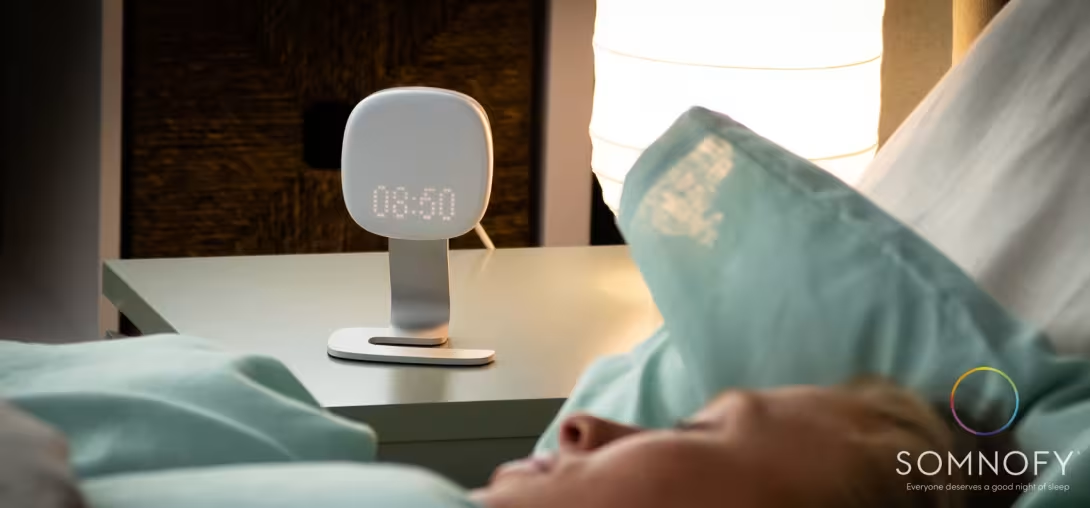
Sleep radars are new technology for contactless sleep measurement. It is widely considered to be better than actigraphy, and easier and cheaper to use than PSG, which is the gold standard for objective sleep registration. The research group uses sleep radars from Somnofy, to gain insight, among other things, into how Quick Returns (short rest time between two work shifts) affect sleep.