

Microfluidic platform for real-life exposure to nanomaterials
The microscopy setup consists of a BioStation IM (Nikon) with automated XYZ stage, temperature and CO2 control for incubation of living cells. Impedance is monitored in real-time with a LCR meter (HIOKI). The platform is equipped with a OB1 MK4 pressure flow controller (Elveflow). Microfluidic chips and Au-microelectrode arrays are designed and made in-house at the clean-room facilities of the Dept. of Physics and Technology (UiB).

Multiplexed microfluidic platform for label-free, real-time electrical impedance spectroscopy (EIS) and live-cell imaging of cells exposed to nanomaterials.
The microscopy setup consists of a fluorescence microscope (Olympus) with automated XYZ stage (Prior Scientific), Andor’s differential spinning disk (DSD) unit with CMOS camera for semi-confocal image acquisition (Oxford Instruments). The microscope is enclosed in an environmental chamber with temperature, humidity and CO2/O2 control for incubation of living cells. EIS instrumentation consists of an Autolab PGSTAT potentiostat (Metrohm) with multiplexing module (up to 16 channels) or 64-channel ISX3 impedance analyser (Sciospec). The platform is equipped with pulsation-free syringe pumps (CETONI), high-precision peristaltic pumps (CETONI) and OB1 MK4 pressure flow controller (Elveflow). Microfluidic chips and Au-microelectrode arrays are designed and made in-house at the clean-room facilities of the Dept. of Physics and Technology (UiB).


Microfluidic set-up. A) Schematic diagram depicting the components of the microfluidic platform. B) Different designs of interdigitated MEAs used. C) Multiplexed microfluidic chip made in polydimethylsiloxane with Au-microelectrode arrays.
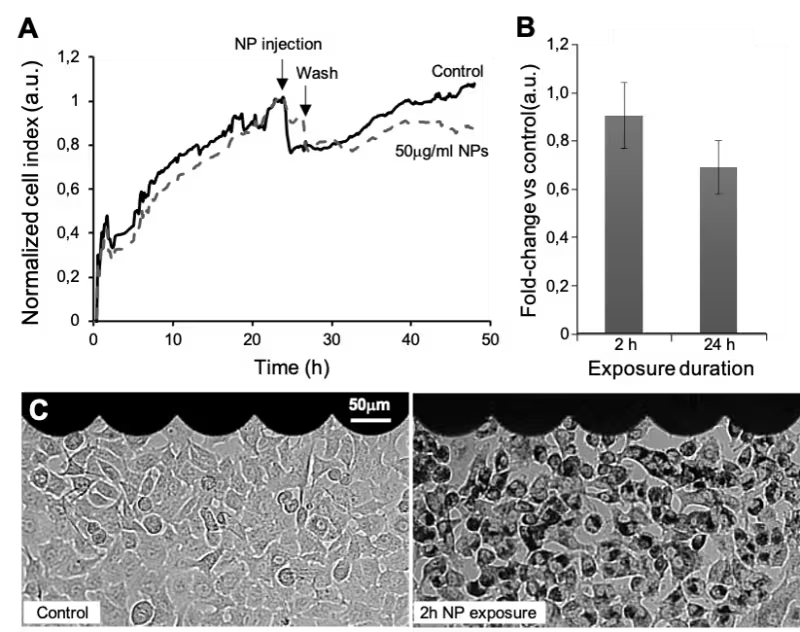
A549 lung cancer cells exposed to multi-layered graphene encapsulated magnetic nanoparticles (GEMNS) for 2h at a flow rate of 1ul/min. A) Impedimetric analysis at 25KHz AC frequency. B) Fold-change relative to control 2 and 22h after treatment. C) Brightfield images 22h after exposure.
Researcher: Ivan Rios-Mondragon, PhD, PI: Mihaela Roxana Cimpan, Professor