

Iron and slag as archaeological artefacts and how to study them from home
This weeks’ post will give a short view into the other PhD-project in BKP, which deals with processing and consumption of iron in Borgund.
By: Brita Hope
Published: (Updated: )
The main goal of this project is to get new insight into the role small towns like Borgund played in the economy of iron, and at the same time how the exploitation and economy of iron played out in the society of Borgund. The high amount of slag and iron objects from the excavations in Borgund leave the impression that iron played an important role in the economy in Borgund and provide a good opportunity to get new insight into the exploitation of this resource.
The amount of iron objects and slag in the archaeological material from Borgund is high compared to what have been found in other medieval towns of Norway. According to Borgund’s find-database c. 23 % of all objects are catalogued as metal. In comparison, the extensive excavations that took place at Bryggen in Bergen simultaneously (known as The Bryggen Excavations) revealed less than 4 % metal objects of all collected items. Both these numbers contain all types of metals as the find catalogues do not provide a detailed overview of the different object categories. For both sites, however, the vast majority of all the metal objects are artefacts made from iron or pieces of slag.
The situation in Bergen has been discussed by Gitte earlier. Bad preservation conditions in layers that have been exposed to salty water might explain some of the low representation of iron objects in Bergen. Nonetheless it seems that in the higher dry layers there is still a low representation of iron. Gitte argues that it is mostly due to extensive reuse of the material. A starting point for my project will be to investigate why iron objects and slag is this heavily represented in the Borgund material compared to other towns.
One question is whether there were different methodological approaches to how the two sites were excavated. Both excavations started off in the mid 1950’s and are considered to be the two first modern medieval archaeological excavations of Norway. Until these two excavations, production waste like slag and fragments of nails and other common or indeterminable objects of iron were not considered to be of scientific interest. Perhaps not all such material was equally considered in the two projects? However, both excavations were directed by Asbjørn E. Herteig, who brought these new methods into medieval archaeology. It is therefore likely that they were based on the same collecting principles from the beginning.
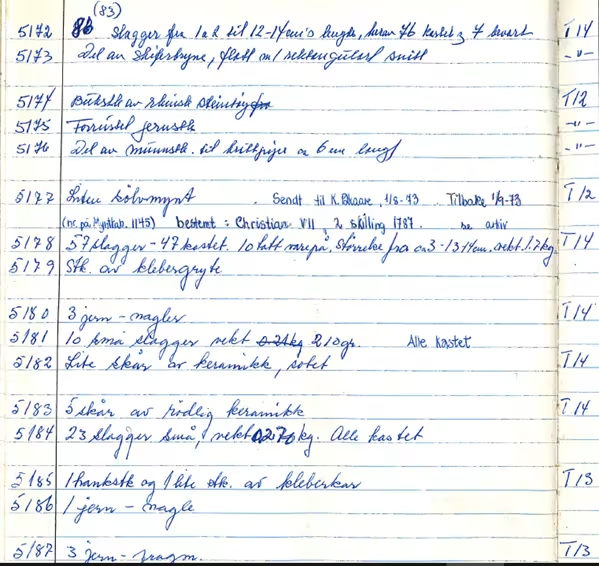
It seems, however, that not all slag from Borgund was in fact collected. Some of the slag exist only as a number in the find-database with a note on how many pieces there used to be before most were thrown away. This page from the find-catalogue of 1973 shows a few examples of inventory numbers representing several pieces of slag, where only a small portion has been kept.
It says for instance that no. 5172 represents 86 (83) slagger fra 1 .. 2 til 12-14 cm’s lengde, herav 76 kastet, 7 bevart, meaning only 7 out of 83 pieces of slag measuring from 1-14 cm have been kept. No. 5184: 23 slagger små, vekt 0,270 kg. Alle kastet shows a case where none of the 23 pieces, with a total weight of 0,27 kg, has been kept. The examples show that I have quite some work to do, before making more refined estimates of the actual amount of slag found in Borgund.
Ideally these next weeks should have been spent in The University Museum’s ‘Finds-laboratory’ Funnmottaket working with classifying and weighing metal objects and pieces of slag. However, there are ways to work with the material from home. To be able to measure more accurately the range of iron working in Borgund, it is necessary to go through the archive documentation to clean the data and to find ways of estimating the weight or amount of what was found but not collected. I am also looking for information in the documentation that might indicate activity related to iron working, such as a higher concentration of slag in certain areas. This is a nice way to dig deeper into the old excavations with all data and related documentation. By creating ArcMap distribution maps of the find location for slag and iron objects, I hope that some places in Borgund will stand out as possible iron working areas, and by this reveal more about how the economy of iron was organized in Borgund.