

Low-T thermochronology as a tool to decipher differential exhumation of crustal blocks of western Norway
This Master's project was designed for Erlend Bjelland who started the Master's program in Earth sciences, UiB, fall 2024. The Master's project is given by the research group Geodynamics and basin studies.
Project description
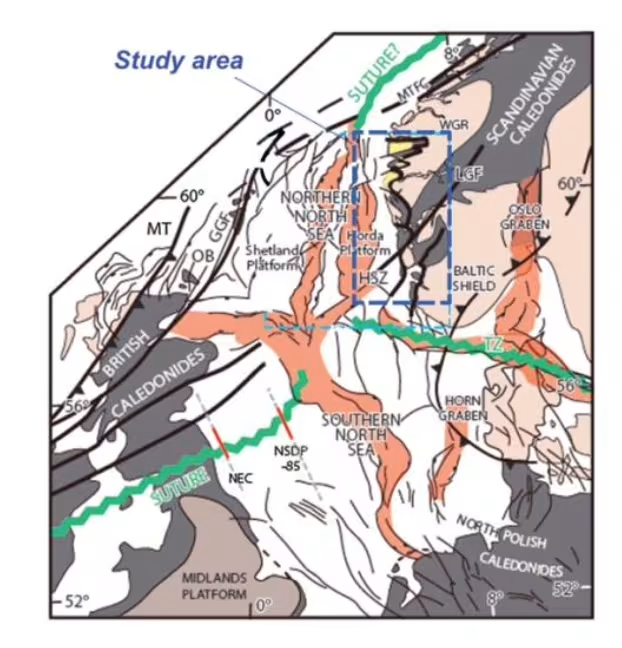
Western Norway is dissected by the major, late-Caledonian Hardangerfjord shear zone (HSZ) into a northwestern and a southeastern part. To the SW, the HSZ continues through the North Sea into northern England, while its NE extension is the Lærdal-Gjende fault. It also subdivides western Norway into slightly different “thermochronological blocks” to the NW and SE that show different post-Caledonian exhumation histories on either side. Coastal western Norway underwent further structural segmentation during North Sea rifting along N-S trending faults. Overall, the distribution pattern of apatite fission-track and (U-Th)/He ages shows a strong structural control of this shear zone and fault pattern, with significant age jumps across some of these structures.
This MSc project will either fission-track- or He-date existing samples of a near-vertical - but so far undated profile - along the southern margin of the HSZ, or a suite of new samples of a selected crustal block with poor age coverage so far that was affected by combined faulting along the HSZ and along N-S faults. The main aim will be to gain a better understanding of the differential post-Caledonian exhumation history of the different fault-bounded blocks of Western Norway.
The project is integrated into the PhD project of Rebecca Jacoby that will re-evaluate the post-Caledonian exhumation history of Western Norway from a low-T thermochronological perspective in a wholistic way. The project requires training in low-T thermochronological techniques, including apatite fission-track analysis and (U-Th)/He dating.
Proposed course plan during the master's degree (60 ECTS)
Geov 341
Field-, lab- and analysis work
Sampling Hardangerfjord, mineral separation, fission-track analysis
Student
Erlend Bjelland
Supervisors
Joachim Jacobs (main supervisor)
Rebecca Jacoby, GEO-UiB