

Project description
It has been known for some time that fault permeability has been overestimated by a factor of 100 in early reservoir models of deep structures at the Halten Terrace. A recent MSc thesis at the UiB has shown that such overestimation also happened at the Njord Field, and that adjusting for this error resulted in a reduction of ca 20% in modelled recoverable reserves. Recent research has also demonstrated that fault permeability is more dependent on burial depth than previously acknowledged, and that the relationship between fault permeability, fault displacement and clay content in the fault zone is more complex than what current models suggest.
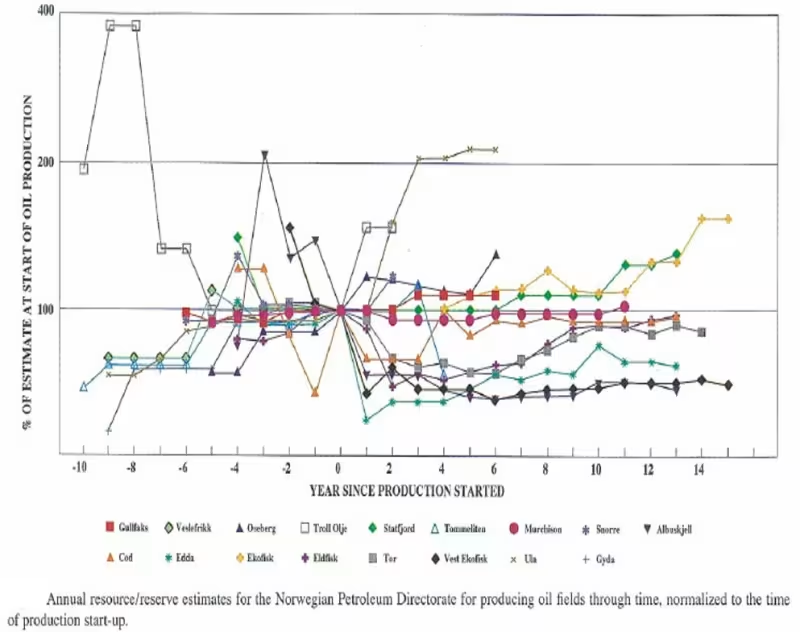
This thesis will examine early and recent models of oil production from a set of Norwegian oil and gas fields and evaluate to which extent past overprediction may have been caused by too optimistic fault permeability assessments. Different relationships between fault permeability, modelled fluid flow and production attainment will be tested with the aim of generating an unbiased and geologically sound model for fault permeability. It is hoped that, by doing so, a significant part of the production attainment challenges in the oil industry can be eliminated.
Proposed course plan
The courses will most likely, and depending on the student, be selected from
Spring courses:
GEOV 252 (10 ECT) Field Course in Geological Mapping | UiB
GEOV 352 (5 ECT) Field course in reservoir geology | UiB
GEOV 261 (10 ECT) Basin analysis and subsurface interpretation | UiB
GEOV 302 (10 ECT) Data analysis in earth science | UiB
Autumn courses:
GEOV 251(10 ECT) Advanced Structural Geology | UiB
GEOV 272 (10 ECT) Seismic Interpretation | UiB
GEOV 274 (10 ECT) Environmental and Reservoir Geophysics | UiB
GEOV 300 (5 ECT) Scientific writing and communication in Earth Science | UiB
GEOV 364 (5 ECT) Advanced basin analysis | UiB
NB! This project is not yet approved by the program board