

Revealing dynamic glacier activity from geophysical data
Glaciers are dynamic ice bodies that undergo various deformation processes driven by internal and external forcing. In the Arctic, rapid surface warming has led to accelerated glacier mass loss, increasing the need to understand the processes controlling glacier motion. Key factors include the subglacial topography, thermal conditions at the base of the glacier (i.e., frozen or wet glacier bed), and frequency of fracture processes such as crevassing and calving. These processes are difficult to observe directly in the typically remote locations of Arctic glaciers, and particularly when the processes occur below the surface.
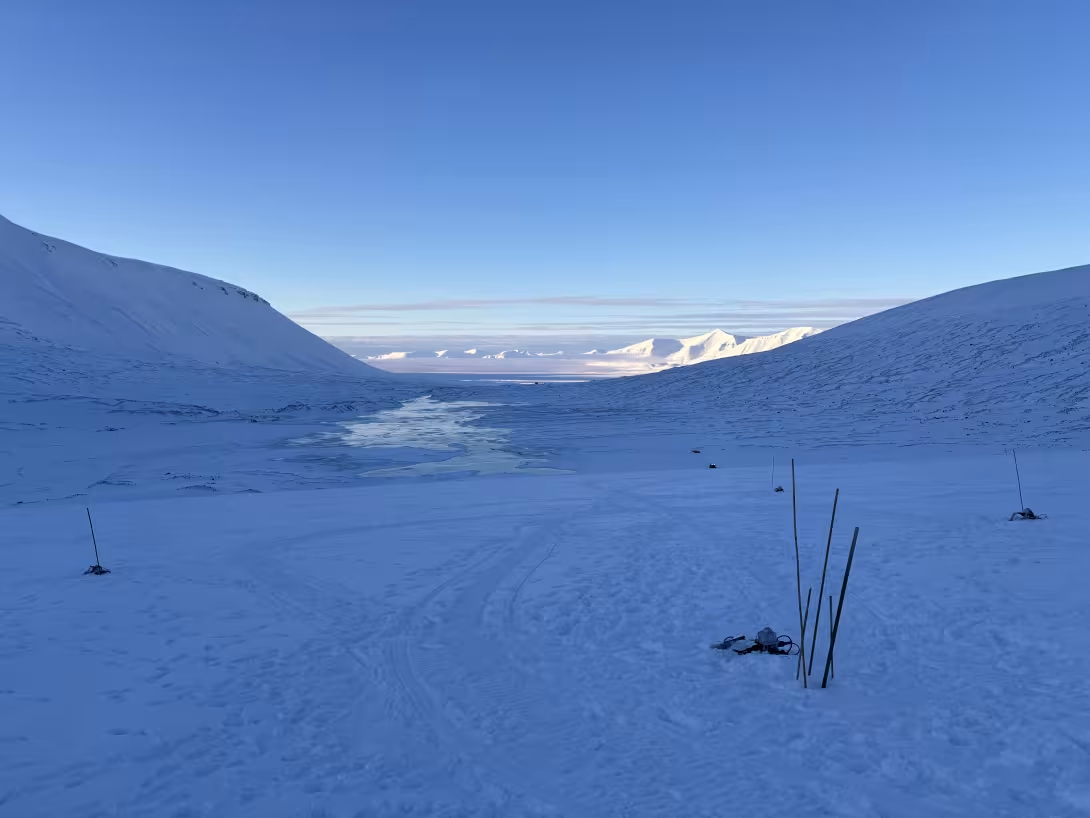
Project description
Passive seismic is potentially a powerful tool to investigate and monitor glacier dynamics. Seismic receivers deployed on top of or near glaciers can be used to listen to discrete seismic signals (icequakes) generated by the glacier due to cracking, fluid movements, and basal processes. Signals produced by different sources vary in the time and frequency domain, and will likely also vary spatially across the glacier. Analysis of these events can therefore provide insight into glacier behavior. However, a major challenge is that datasets from continuously recording seismic receivers will typically be very large, requiring efficient methods to process the datasets. This project will investigate which methods are most effective for detecting and classifying icequakes, and what analysis of these events can reveal about glacier dynamics.
In this project, several passive seismic datasets from fast-flowing glaciers on Svalbard will be analyzed for icequakes. Existing datasets have been acquired at different locations and time periods on the same glaciers. In addition, the student should be involved in the acquisition of a new dataset on Svalbard during spring of 2027. The work of this master’s project includes (i) reviewing existing techniques for event detection, (ii) implementing and testing some of these techniques for passive seismic event detection using MATLAB and/or Python, and (iii) analyzing the detected events through classification and localization to infer glacier dynamics and structure.
In this project, several passive seismic datasets from fast-flowing glaciers on Svalbard will be analyzed for icequakes. Existing datasets have been acquired at different locations and time periods on the same glaciers. In addition, the student should be involved in the acquisition of a new dataset on Svalbard during spring of 2027. The work of this master’s project includes (i) reviewing existing techniques for event detection, (ii) implementing and testing some of these techniques for passive seismic event detection using MATLAB and/or Python, and (iii) analyzing the detected events through classification and localization to infer glacier dynamics and structure.
Field-, lab- and analysis work
Approximately 1 week, Svalbard, spring 2027