

The Neurotargeting group is leveraging large data sets and diverse methodological approaches to discover and target biological mechanisms and proteins in the central nervous system implicated in neuropsychiatric disorders. Our methods include deep phenotypic characterization of patient samples using clinical data, brain imaging and multi-omics (proteomics, genomics)- as well as animal models and cell-based systems.
Biology of neuropsychiatric disorders
Human Brain imaging
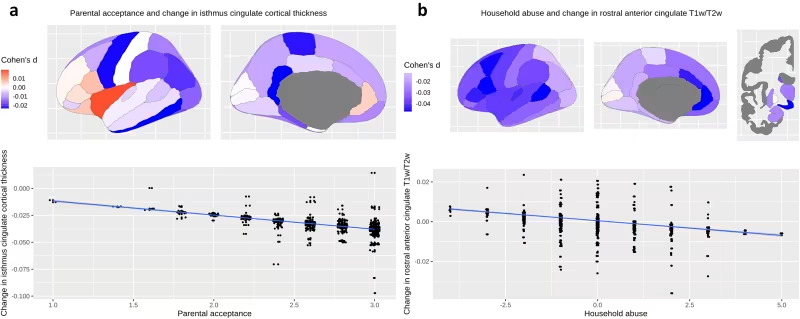
We use multimodal MRI data from local studies and international databases (f.ex. ABCD) to uncover how the brain may change prior to or following the development of depression, OCD and anxiety disorders.
Recent examples of neuroimaging studies include:
doi.org/10.1017/S0033291725102651
Human Genomics
High throughput discovery of genetic variants is achieved using DNA array genotyping and whole exome and whole genome sequencing.
Examples of target discovery using these technologies:
https://www.nature.com/articles/s41588-025-02189-z
https://www.nature.com/articles/s41586-025-09820-3
https://www.nature.com/articles/s41380-025-03242-3
Animal models
To advance our understanding of the biology of depression and anxiety disorders, we perform translational studies using state-of-the -art MRI sequences in both human patient samples and established animal models.
New treatments for depression and anxiety disorders; behavioral therapy, brain stimulation and pharmacotherapy
Behavioral therapy
The Bergen 4-Day Treatment (B4DT) is an intensive exposure therapy designed for individuals with OCD and anxiety disorders. Although studies show that the B4DT is highly effective, we lack an understanding of its underlying biological mechanisms. Ousdal and Haavik are affiliated with the Bergen Center for Brain Plasticity which aims to identify biomarkers and mechanisms of response to B4DT, with the research spanning from longitudinal MRI of the brain to genetics.
doi.org/10.1016/j.jadr.2025.100872
Brain stimulation (ECT and TMS)
Electroconvulsive Therapy (ECT) or repetitive Transcranial Magnetic Stimulation (rTMS) are effective treatments for severe or treatment-resistant depression. However, as with behavioral therapy, the biological mechanisms underlying these treatments remain poorly understood. Our lab employs a translational approach to investigate the mechanisms of action of ECT and rTMS, leveraging large multisite MRI and multi‑omics datasets (e.g., GEMRIC, Gen‑ECT) from patients with depression as well as established animal models of ECT.
doi.org/10.1038/s43856-025-01120-1
doi.org/10.1038/s41380-023-02318-2
doi.org/10.1016/j.biopsych.2021.05.023
doi.org/10.1016/j.biopsych.2019.07.010
doi.org/10.1038/s41398-025-03772-y
Pharmacology
The drug targets investigated in the Neurotargeting group include ion channels, regulatory proteins, enzymes, and other proteins involved in brain development and function.
Monoamines (including serotonin, dopamine and noradrenaline) are involved in many physiological functions in the brain and peripheral tissues. Monoamine receptors, transporters and related enzymes are major treatment targets. We explore enzymes and regulatory proteins (including 14-3-3 proteins) involved in monoamine synthesis and how these proteins can be targeted by new and repurposed drugs.
doi.org/10.3389/fpsyt.2024.1492126
doi.org/10.1021/acschemneuro.4c00346
doi.org/10.1124/molpharm.120.000184
Sodium and potassium channels are found in all brain areas and are promising drug targets in epilepsy, pain syndromes, migraine, as well as behavioral neuropsychiatric disorders.
doi.org/10.1016/j.neubiorev.2023.105301
doi.org/10.1038/s41588-023-01538-0
doi.org/10.1186/s13195-024-01609-2
Collapsin Response Mediator Protein 2 (CRMP2) is a regulatory protein that is a substrate ofglycogen synthase kinase 3β (GSK3β) and a possible and is suggested to be involved in chronic pain, bipolar disorder, schizophrenia, bipolar disorder, and Alzheimer’s. We study the structure of CRMP2, its post-translational modifications and interactions with novel lead compounds.
doi.org/10.1007/s00726-016-2376-z
G-Protein Coupled Receptors (GPCRs): We are developing nanobody-based modulators of Oxytocin and Vasopressin receptors to address disorders like anxiety, addiction, and autism.
CX3CR1, a neuroimmune receptor implicated in neuroinflammation, with potential applications in neurodegenerative diseases. The work includes protein biochemistry, X-ray crystallography, cryo-EM, and functional assays in cell lines.
TAR DNA-binding protein 43 kDa (TDP-43) is implicated in amyotrophic lateral sclerosis (ALS), frontotemporal dementia (FTD) and other NPDs. We combine molecular, cellular, and systems-level approaches to explore the pathophysiology of disease associated variants of this protein.
Taurine and beta-alanine are abundant amino acids with antioxidant, anti-inflammatory and neuroprotective roles. Dietary supplementation with taurine and beta-alanine has been suggested as a preventative strategy against diabetes, aging and Alzheimer’s. We study the rate limiting enzyme in taurine synthesis (Cysteine sulfinic acid decarboxylase, CSAD) and glutamate decarboxylase-like 1 (GADL1) using knockout animal models and drug repurposing strategies. We are also studying how these enzymes can interact with commonly used drugs, with an aim of exploring how tissue levels of taurine and beta-alanine are affected by drug treatment and dietary factors.
doi.org/10.1126/sciadv.abb3713
doi.org/10.1016/j.jsb.2020.107674
