

Supervisors: Eirik Keilegavlen, Inga Berre, Einar Iversen
Short description of the project:
Numerical modeling is a key to understanding complex physical processes in applications such as geothermal energy extraction and CO2 storage, as experimental methods are often impractical or difficult to implement. Models for these applications are typically formulated as systems of partial differential equations, which, after discretization, lead to large sparse linear systems. Solving these systems efficiently is necessary for running computationally expensive simulations of coupled processes, such as thermo-hydro-mechanics in porous media with fractures, governed by frictional contact mechanics (contact-THM). Iterative linear solvers with preconditioners are the practical choice for such problems, but designing robust and scalable preconditioners remains a major challenge. It requires a deep understanding of the underlying physics to develop the core algorithm, followed by extensive performance analysis to optimize it to a particular simulation. This dissertation addresses these two objectives: (i) developing robust, scalable preconditioners for nonlinear, time-dependent contact-THM problems, and (ii) designing a data-driven algorithm for automated preconditioned linear solver selection and parameter tuning.
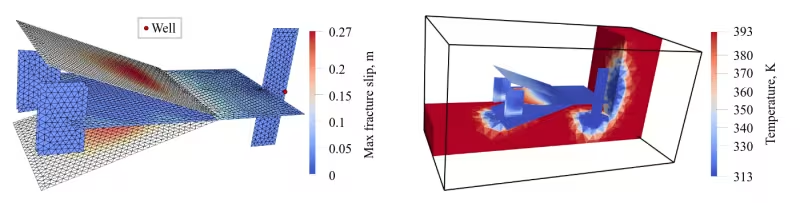
The first contribution introduces preconditioners for contact-THM. The preconditioners are built upon prior studies, which introduce preconditioners for the isolated sets of the contact-THM subproblems: contact mechanics, coupled flow and heat transport in porous media, poromechanics, and fluid flow in fractures and the porous matrix. The robustness is demonstrated across diverse geometries and physical regimes, and the scalability is confirmed through grid refinement studies. In addition, the preconditioner for the isothermal case of contact-THM is analyzed to show the convergence of the equivalent sequential iterative scheme.
The second contribution presents an incremental machine learning approach that optimizes solver configurations during runtime, adapting to evolving simulation conditions without requiring extensive pre-collected datasets. This approach enables adaptive solver selection that responds to dominant physical processes within a single simulation. We demonstrate the efficiency of the automated solver selection approach, applying it to the contact-THM problem, where we select among tens of thousands of realistic combinations of preconditioner parameters.
The proposed methods are implemented in the open-source simulation tool, PorePy, ensuring reproducibility and facilitating future research. Together, these contributions advance the efficiency and reliability of large-scale multiphysics simulations in porous media.