

Advisors: Inga Berre and Eirik Keilegavlen
Short description of the project:
Several problems in fractured porous media come as a result of chemical reactions with
some combination of fluid flow, heat transfer and solute transport. Such problems rep-
resent a tight coupling between chemical and physical processes, while fractures are
characterised as extreme heterogeneities in the geological formation. The fractures have
a substantial impact on the reactive transport processes, as they can serve as channels
or be barriers for the flow and transport processes. In turn, chemical reactions affect the
fracture conductivity by, e.g., mineral dissolution or precipitation.
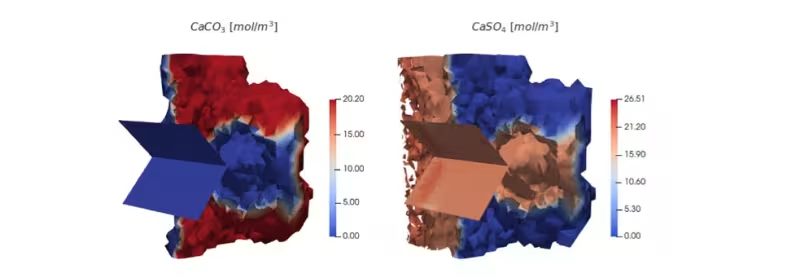
For several applications, analytical solutions are not available, and the geological
formation cannot be observed. Therefore, numerical simulations are necessary to inves-
tigate the coupling between the chemical and physical processes and their interplay with
the geological formation. This requires mathematical models that describe the inter-
action between the governing processes and the mutual coupling between the processes
and the geological structure. Additionally, it requires numerical methods that handle
the strong non-linearities in the interactions, as well as parameters that span several or-
ders of magnitude and are dynamically updated. The numerical methods must also be
efficient to ensure a computationally feasible simulation time.
This thesis presents a mathematical model and numerical workflow for simulating re-
active transport coupled with fluid flow and heat transfer in fractured porous media. The
model is formulated in a discrete fracture-matrix mixed-dimensional framework, where
the porous matrix, fractures and fracture intersections are represented in a hierarchy of
subdomains. The model equations are assigned to each subdomain, and the subdomains
are coupled through interfaces.