

Helium Scattering Lab
The Department of Physics and Technology offers unique facilities for studying materials at the atomic scale.
About
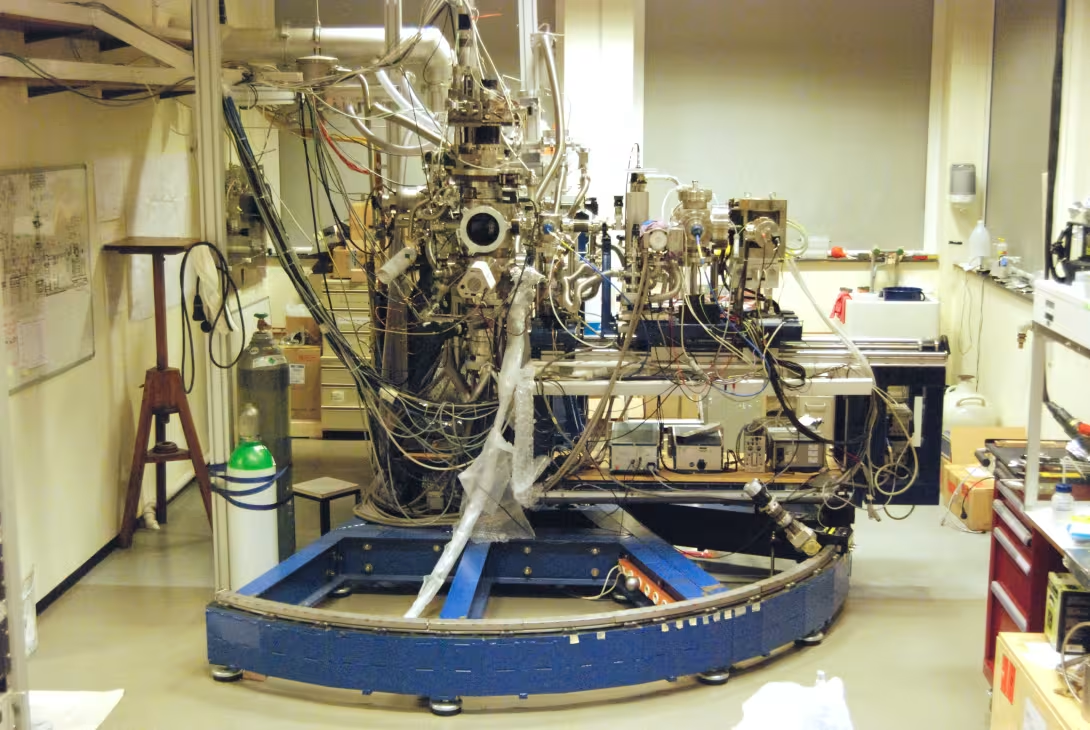
Magie (Molecular Beam Apparatus for Gas-Surface Interaction Experiments)
Magie is our atom and molecular scattering apparatus at the University of Bergen, primarily used for helium atom scattering (HAS) experiments. It has a uniquely specialized design, and only a handful of comparable instruments exist worldwide. Magie enables highly surface‑sensitive measurements, providing material information that is not accessible with other techniques.
Using a low‑energy (20–100 meV), neutral helium beam, we can probe a wide range of materials without causing any damage to the samples, while obtaining atomic‑scale information about their surface structure. In addition, Magie supports inelastic helium atom scattering spectroscopy (time‑of‑flight measurements), allowing us to study surface vibrations such as phonons/surface acoustic waves. This gives unique insights into material properties, for example, the bending rigidity and binding energy of various 2D materials.
Furthermore, Magie can be used for atom diffraction experiments through freestanding structures, opening opportunities for fundamental physics studies that few other instruments can perform.
NEMI (NEutral Helium Atom MIcroscopy)
Nemi is one of only four Scanning Neutral Helium Microscopes (SHeM) in the world. These instruments are still prototypes, and the Nanogroup at the University of Bergen has played a key role in developing this new imaging technique. Nemi was designed and built in Bergen and is the only instrument worldwide that uses a focusing element, known as a Fresnel zone plate, to shape the imaging beam. All other existing systems use a pinhole-based approach.
SHeM uses a beam of neutral helium atoms to create images, offering unique advantages for material characterization. Because the helium atoms do not penetrate the sample, image formation is highly surface sensitive. Few other techniques provide surface sensitivity at this level. The imaging is also completely non-destructive, thanks to the very low beam energies involved, typically in the 20–100 meV range. Since the helium atoms are neutral, there is no sample charging.
Contact
For more information regarding these instruments, contact the following persons:
Prof. Bodil Holst