

2026 CryptoT&T Meeting in Bergen
The meeting gathered professionals of many disciplines around one common goal - effectivizing coupled diagnosis and treatment of cryptosporidiosis in children in Ethiopia and Mozambique.
By: Olivera Bozickovic
Published: (Updated: )

Project coordinator Kurt Hanevik opened the meeting with general introduction to the project, and its scientific, organizational and economic aspects. He highlighted project milestones, immediate tasks and the individual roles for every collaborator. We are grateful that the project also receives support in matters of administrative timelines, audits and other legalities from the UiB's Division of Research and Innovation.
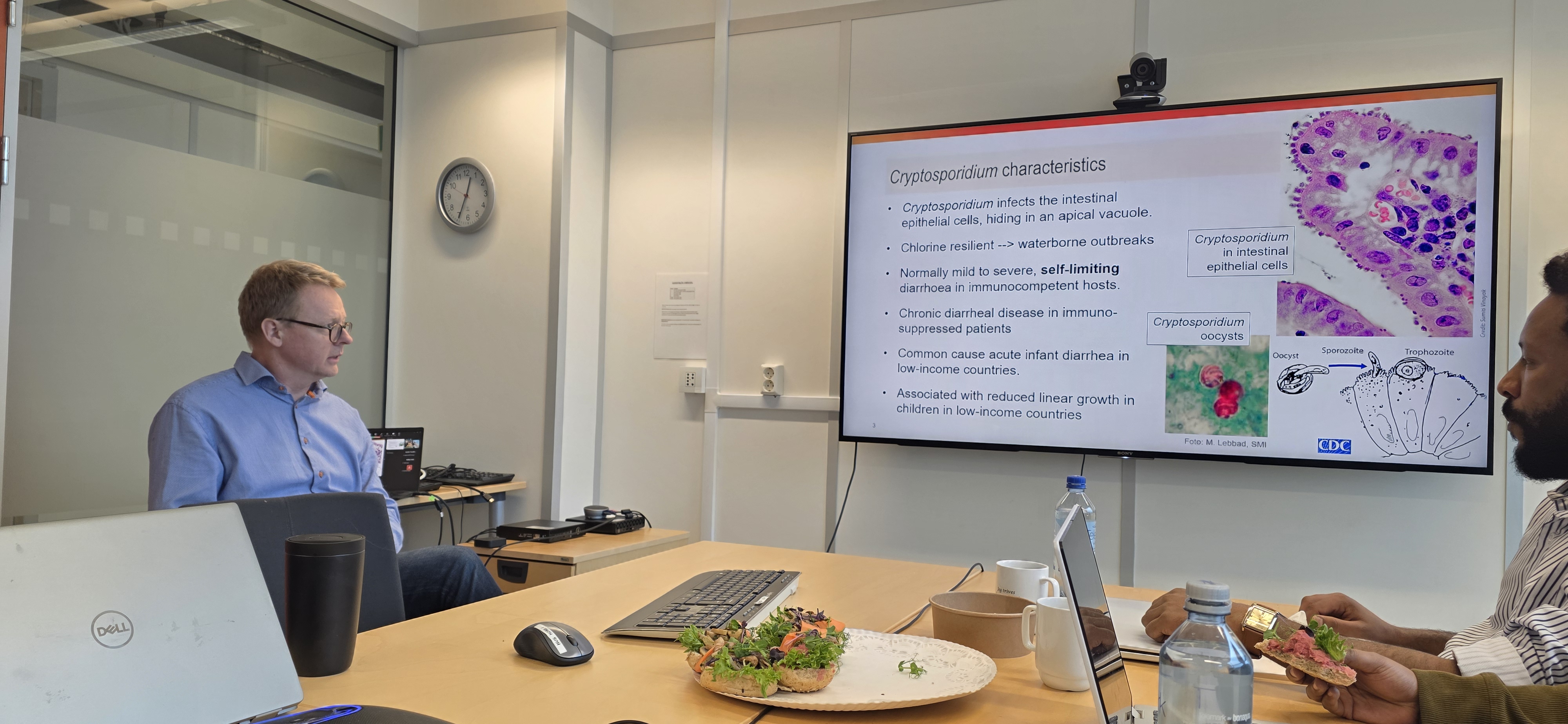
The project aims to collect the samples from 3500 children in an stepped-wedge clustered randomized trial (swCRT), whose design principles were aptly presented by Dagrun Slettebø Daltveit, statistician and Associate Professor at the Department of Global Public Health and Primary Care at UiB. This trial design underscores the statistical strength of collecting samples in clusters based on recruitment site in steps of 3 months. The total period of collecting initial samples, as well as follow-up samples, is foreseen to be 18 months using this trial design. The trial design, its strengths and weaknesses were discussed. Other discussed issues included seasonality of cryptosporidiosis, regional differences, limit on the number of children recruited per center in each period and possibly a dynamic timeline for each step in the swCRT.
The meeting was a great opportunity for young PhD candidates to present their forthcoming projects for the first time. Tewachew Awoke Dejenie (supervisors: Kurt Hanevik and Fregenet Tesfaye Tegegn (external link), AHRI) presented his PhD project within the study. His main objective will be diagnostic accuracy of rectal swab compared to stool samples. He will also investigate how acceptable rectal swab sampling will be for the different stakeholders, such as parents, clinicians and laboratory personnel in Ethiopia, as well as feasibility of the test-and-treat strategy, including test turnaround time. His final project concerns genotyping Cryptosporidium in Ethiopia and looking into its genetic diversity.

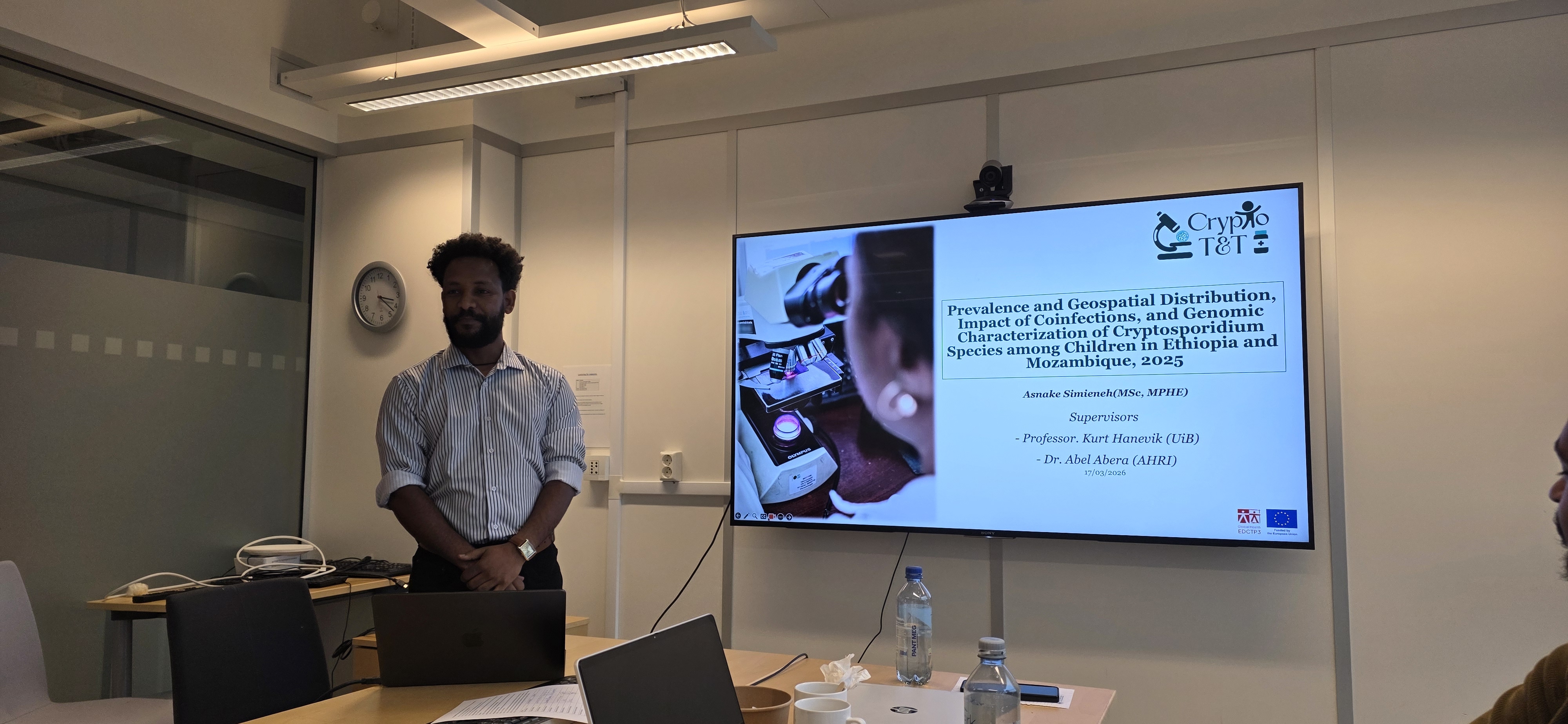
Asnake Simieneh Tamru (supervisors: Kurt Hanevik and Abel Abera Negash (external link)) presented his PhD project which will aim to investigate prevalence and risk factors for Cryptosporidium in Ethiopia. He will also analyze if coinfection of Cryptosporidium with other intestinal pathogens leads to increased disease severity and duration, as well as which risk factors might be involved in worse disease phenotype. He will collect and purify Cryptosporidium positive samples for deeper genotyping.
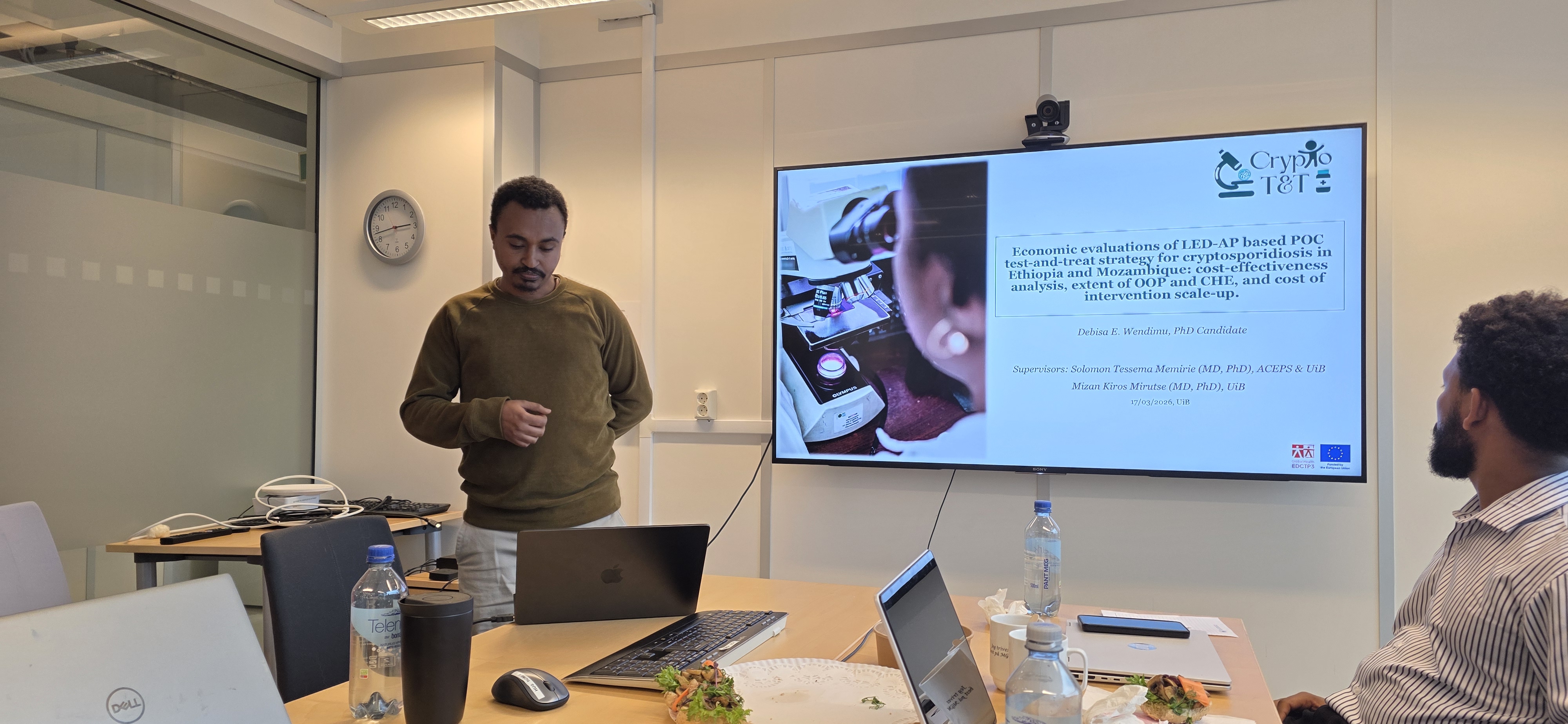
PhD student Debisa Eshatu Wendimu (supervisors: Solomon Tessema Memirie and Mizan Kiros Mirutse) will research economic aspects of implementing the test-and-treat principle in target countries. He will analyze its cost-effectiveness, the extent of out-of-pocket and catastrophic-health expenditures (OOP and CHE, respectively), as well as what would be the costs of scaling up the test-and-treat procedure to the level of an entire district or country.
Finally, Jahid Hasan Tipu has presented a part of his on-going PhD project relating to Cryptosporidium sequencing of European cohort. His experience in sequence analysis and genotyping will be helpful in the CryptoT&T project and for its PhD candidates.
In clonclusion, the half-day meeting was a good opportunity for both the presenters and the senior researchers at UiB to gather and get to know each other, as well as to participate in fruitful discussions on clinical trial design, qualitative studies and cost-effectiveness research in this project.