

EBV-MS Consortium at the European Charcot Foundation
At the 33rd Annual Meeting of the European Charcot Foundation on Emerging Therapies (November 13–15, 2025, Baveno), the EBV-MS team was present and vocal about the EBV-MS project.
By: Patricia Moghames
Published:
Anti-viral effects of approved MS drugs
Prof. Marco Salvetti, Professor and the Chair of Neurology at Sapienza University of Rome , delivered a thought-provoking presentation titled “Anti-viral effects of approved MS drugs (EBV)”. The session, Anti-viral strategies, focused on the pivotal role of the Epstein-Barr virus (EBV) in the development of multiple sclerosis (MS) and explored potential therapeutic approaches to target the virus.
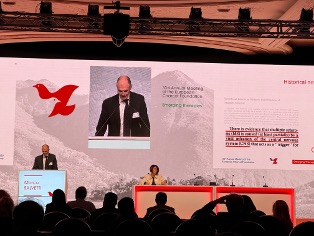
Prof. Salvetti explained that EBV plays a pervasive role in regulating the immune system, and therefore, many existing MS therapies, designed to modulate or suppress immune responses, also interfere with EBV’s lifecycle. His presentation highlighted how several currently approved MS drugs show notable anti-viral effects, offering new insights into their broader mechanisms of action.
These findings are highly relevant to the EBV-MS project, which aims to confirm EBV’s causal role in MS and develop innovative treatment and prevention strategies. By analyzing the antiviral properties of registered MS therapies, researchers can identify patterns that may inform the design of next-generation anti-EBV treatments.
Prof. Salvetti emphasised that collaborative research, such as that within the EBV-MS consortium, which combines antiviral therapy development with EBV genetics, will be essential to advancing more effective and personalized therapeutic approaches for people living with MS.
More aggressive B-cell depletion or a dual effect?
Prof. Fredrik Piehl, Professor of Neurology from the Karolinska Institute, summarized the existing and rapidly growing knowledge base of B-cell–targeted therapies in MS. His presentation highlights just how potent anti-CD20 treatments can be, and raises important questions about dosing, efficacy, and safety.
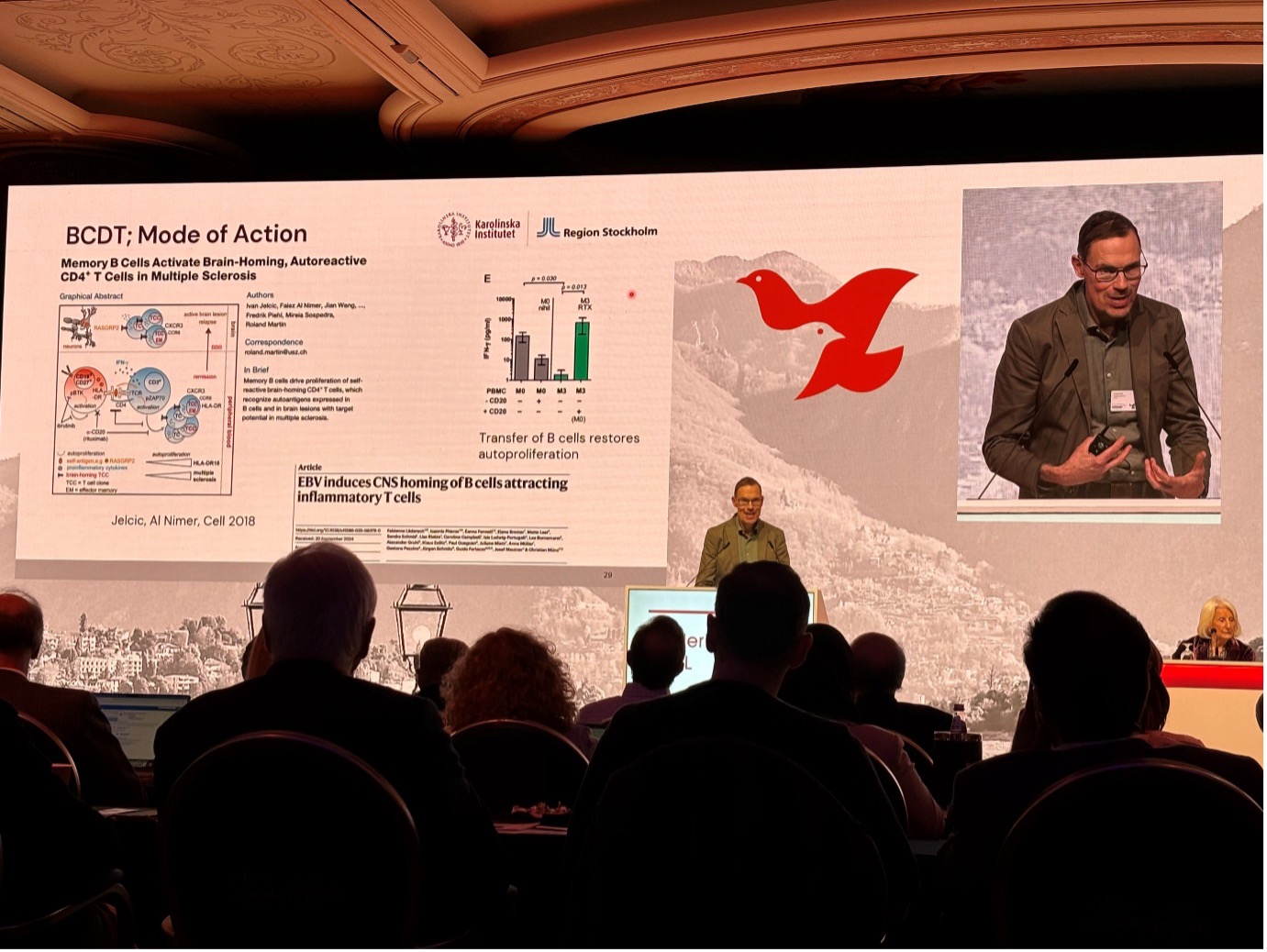
Across an impressively wide dosing range, from 2000 mg of ocrelizumab to just 30 mg of ofatumumab every three months, anti-CD20 therapies rapidly and profoundly suppress the appearance of new inflammatory MRI lesions. This finding suggests that even low-level peripheral B-cell depletion is sufficient to block acute MS activity.
Currently approved therapies, including ocrelizumab (600 mg), ofatumumab (20 mg), and ublituximab (450 mg), as well as rituximab (off-label; initially 1000 mg → 500 mg) - all significantly reduce relapse rates compared with active comparators. Notably, ocrelizumab and ofatumumab also reduce confirmed disability worsening, implying that interrupting B-cell mediated immune circuits may have downstream effects on neurodegeneration.
Of course, B-cell depletion comes with trade-offs. There is an increased risk of serious infections, though not cancer. Interestingly, extended-interval dosing (every 12-18 months) in patients with stable relapsing-remitting MS appears to be safe and may reduce infection risk. Still, we lack reliable predictors for which patients might experience disease reactivation with longer extension of dosing intervals.
These observations reinforce a critical idea: a key pathogenic B-cell population, likely EBV-infected cells, can be effectively suppressed with infrequent, moderate dosing. Yet the optimal dose, interval, and clinical impact, as well as predictive markers, requires further research.
Together, these insights underscore why the EBV-MS Consortium’s work is both timely and essential. By integrating cutting-edge virology, immunology, and therapeutic innovation, the project is paving the way toward more precise and effective prevention and treatment strategies. As research accelerates, the consortium continues to unite experts across disciplines to bring meaningful progress to people living with MS.