

EBV-MS highlighted at MENACTRIMS 2025
Professor Øivind Torkildsen from the University of Bergen and Haukeland University Hospital was invited to speak at the MENACTRIMS 2025 congress in Dubai, where he presented recent progress from the EBV-MS consortium. His presentation attracted considerable interest from clinicians and researchers across the Middle East and North Africa, reflecting the growing global attention around Epstein–Barr virus (EBV) as a key driver in the development of multiple sclerosis (MS).
By: Øivind Torkildsen
Published:
The EBV-MS project, coordinated in Bergen and funded through Horizon Europe, aims to unravel how EBV infection contributes to MS pathogenesis and why only a small fraction of those infected eventually develop the disease. By combining clinical cohorts, advanced molecular analyses and translational studies, the consortium seeks to identify mechanisms that could open the way for antiviral strategies, immunological interventions, or even preventive approaches such as vaccination. Understanding the EBV–MS connection is emerging as one of the most promising avenues for redefining MS treatment and prevention, and the project is now positioned at the forefront of this rapidly evolving field.
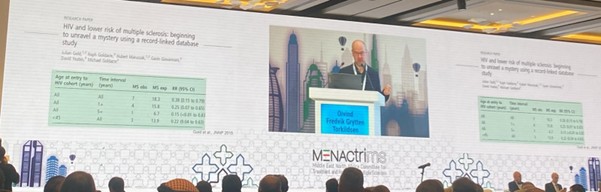
At MENACTRIMS, Professor Torkildsen presented new insights from the consortium’s work on EBV reactivation, immune signatures in MS patients, and potential therapeutic targets involving virus–B-cell interactions. The audience showed strong engagement, with extensive discussions following the session and clear recognition of the project’s potential impact. The invitation itself highlights the international relevance of the research, and the reception in Dubai demonstrated that the EBV-MS initiative resonates far beyond Europe.
The presentation also marked an important opportunity to raise awareness of the consortium’s objectives and ongoing studies. As the project progresses toward more in-depth mechanistic work and clinical translation, international collaboration and visibility will be essential. The enthusiastic response at MENACTRIMS 2025 underscores that the global MS community is watching closely and that the EBV-MS project may play a decisive role in shaping the next generation of MS therapies.