

Meeting with the Scientific Advisory Board of the EBV-MS Project
On 20 June 2026, the EBV-MS consortium met with its Scientific Advisory Board (SAB) to present progress and show how expert feedback is shaping our efforts to understand and target Epstein-Barr Virus in the context of multiple sclerosis (MS). From clinical trials and immunology to bioinformatics and predictive modelling, each work package shared exciting developments and next steps.
Published:

The EBV-MS consortium's meeting with its Scientific Advisory Board (SAB) was building on the valuable exchange that took place during the previous Annual Meeting in November 2024. This meeting served to update the SAB on the progress of the project’s various components, and most importantly, to demonstrate how the feedback shared in November has been integrated into the ongoing research activities.
The meeting was opened by Prof. Øivind Torkildsen (University of Bergen), who welcomed participants and reiterated the importance of maintaining active engagement with the Scientific Advisory Board to ensure the project remains grounded in scientific rigor and relevance. Each work package lead was given ten minutes to present updates and plans, followed by discussion and feedback from the SAB.
Work Package Updates
WP9 – Systems Bioinformatics (Hop-On)
Prof. George Spyrou (Cyprus Institute of Neurology and Genetics) introduced the newly added Work Package 9, established through a Hop-On proposal. WP9 focuses on systems bioinformatics and aims to integrate multi-source data - including genetic, omics, imaging, clinical, and lifestyle data - using network-based analytics. The ultimate goal is to perform both bulk and personalised data integration to support the development of AI-driven insights that can advance the project’s translational objectives.
WP2 – Clinical Trials
Prof. Øivind Torkildsen (University of Bergen) presented the progress of WP2, which is investigating whether antiviral treatment can reduce or prevent MS disease activity. He highlighted how the work package has been adapted in response to the SAB’s feedback, particularly in refining trial design and endpoints to strengthen the evidence base.
WP3 – Epidemiology
Dr. Jannicke Igland (University of Bergen) presented WP3 on behalf of Dr. Kjetil Bjornevik (Harvard T.H. Chan School of Public Health). This work package aims to characterise the interval between primary Epstein-Barr Virus (EBV) infection and the clinical onset of MS. The presentation focused on the variability of this interval and the influence of host-virus interactions, age, and sex on disease development.
WP4 – Immunology
Dr. Chiara Starvaggi (Karolinska Institutet) shared updates on WP4, which is focused on evaluating the impact of antiviral therapies and identifying cellular and molecular biomarkers. Dr. Starvaggi presented a detailed response to each of the SAB’s prior recommendations and outlined how each point has been addressed or incorporated into the work package’s ongoing activities.
WP5 – Genetics
Dr. Rachele Bigi (Sapienza University of Rome) and Sara Gordillo Sampedro (Hospital del Mar Research Institute) jointly presented WP5, which explores the role of EBV genetic variants in MS risk and their interaction with host genetic factors. The two teams shared their respective progress in sample collection, variant analysis, and integration of host-pathogen data.
WP6 – Prediction and Modelling
Prof. Pablo Villoslada (Pompeu Fabra University) presented WP6, which is focused on developing simplified mathematical models to better understand the dynamic interactions between the immune system and central nervous system cells. The team is currently testing various hypotheses to identify key parameters influencing disease progression and immune response.
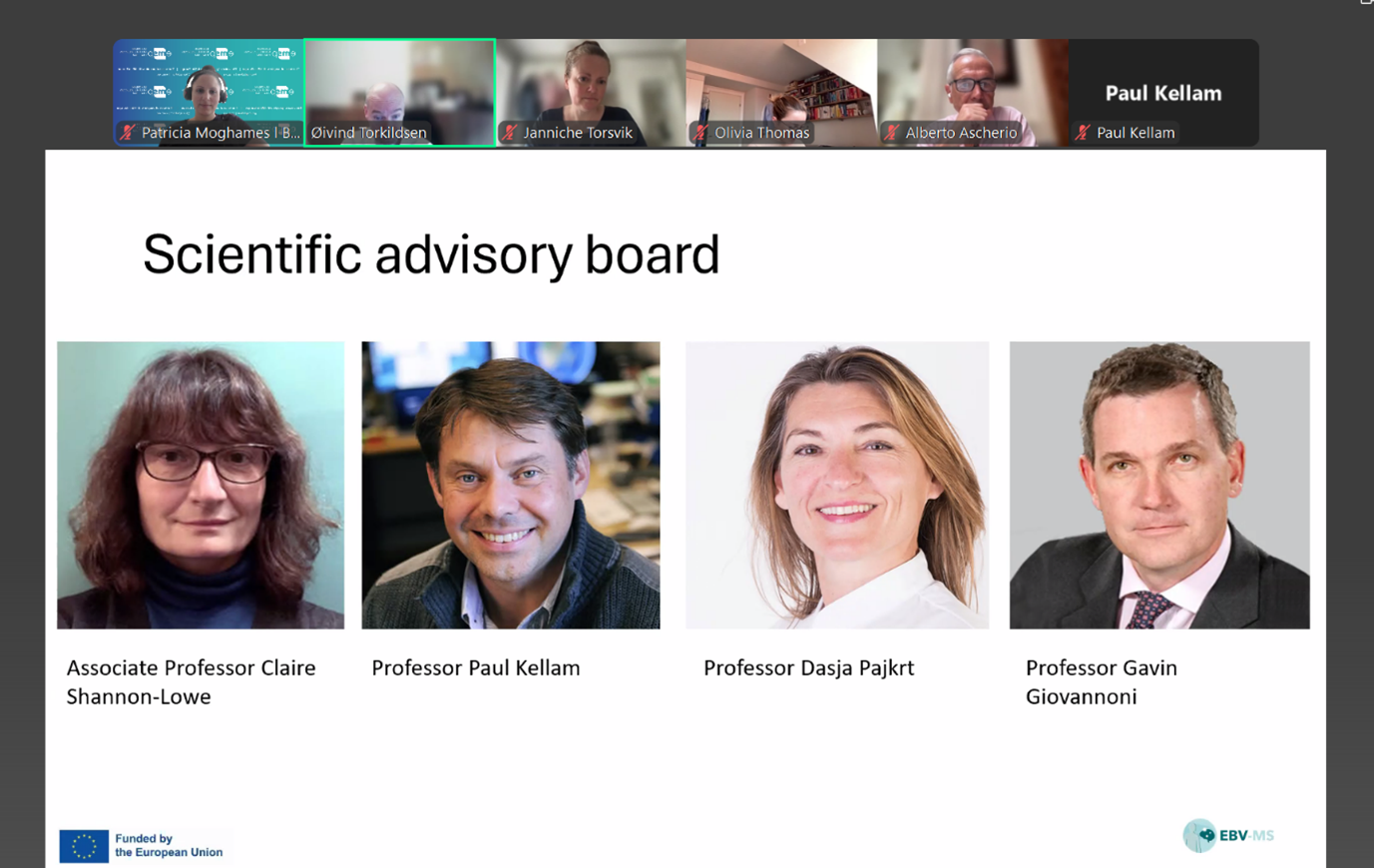
Scientific Advisory Board Discussion
Following the presentations from all work package leads, a dedicated discussion was held with the members of the Scientific Advisory Board who were present. The board shared thoughtful feedback on the methodological approaches, the integration of work across packages, and the alignment of the research with the project’s overarching objectives. Their input was particularly valuable in identifying areas for further refinement and opportunities to strengthen collaboration between clinical, epidemiological, and computational components of the project.
Looking Ahead
The meeting concluded with a recognition of the significant progress made across work packages and the vital role of the SAB in shaping the project’s scientific direction. The consortium remains committed to maintaining this two-way dialogue, ensuring that the expertise of the board continues to guide the project toward its goal of targeting EBV infection for the treatment and prevention of multiple sclerosis.
This project has received funding from the European Union’s Horizon Europe Research and Innovation Actions under grant no. 101136991 (EBV-MS). Funded by the European Union. Views and opinions expressed are, however, those of the author(s) only and do not necessarily reflect those of the European Union or the Health and Digital Executive Agency. Neither the European Union nor the granting authority can be held responsible for them.