

New doctoral fellow at EXPUN
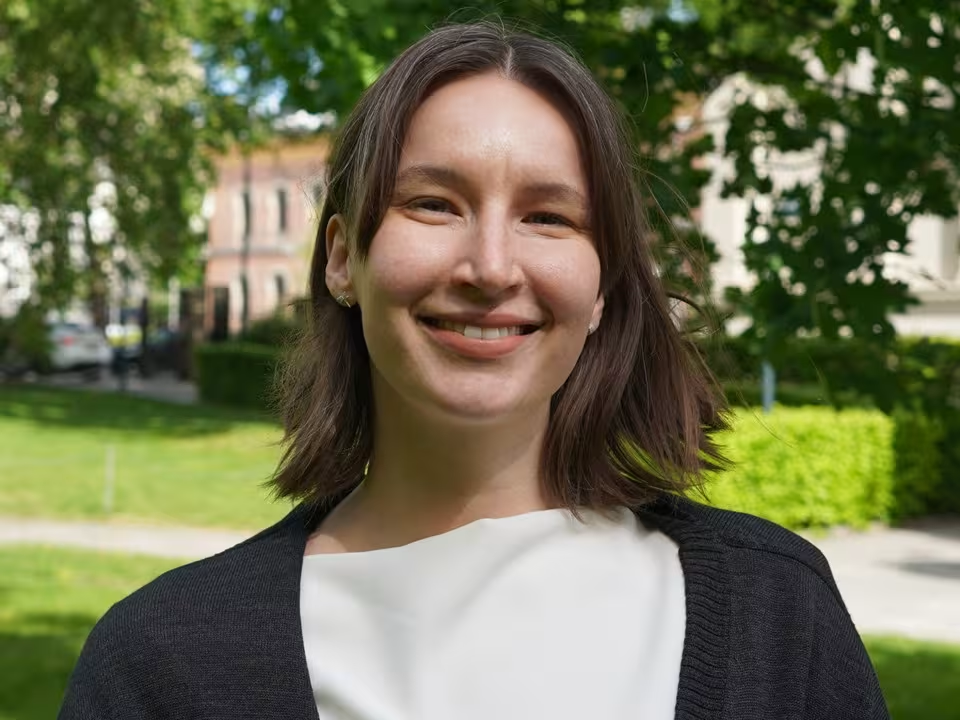
Kelly Solem-Young has recently started as a fellow at the Faculty of Law, where she is affiliated with the EXPUN research project. In her doctoral studies, she will research the relationship between sentencing and the enforcement of sentences.
Published:
– Can you describe what your doctoral project is about?
– The short answer is that my project is about community service and electronic monitoring.
– The longer answer is that I am researching various aspects of sentencing and the enforcement of sentences. I am analyzing the purposes of punishment and how these purposes are expressed in sentencing and the enforcement of sentences – and I will attempt to say something about what the purposes should be. I am also looking more closely at the legal framework for the roles of the courts and the Correctional Service in determining and enforcing punishment, including the division of roles between the courts and the Correctional Service.
– More specifically, I plan to examine how the courts and the Correctional Service perform their tasks, including through analyses of court decisions and rulings. I also want to interview people who have served community service and/or electronic monitoring sentences. Methodologically, I combine legal dogmatic methods with qualitative, quantitative, and philosophical approaches.
– And then, to be honest, I'm not entirely sure what my project is about yet. Fortunately, that makes me (mostly) curious and filled with hopeful anticipation.
– Why do you want to research this particular topic?
– I think the topic is important, interesting, and challenging. Sentencing and the enforcement of sentences involve various forms of intrusive exercise of power by the state, mainly against individuals. Although there is a close connection between sentencing and the enforcement of sentences, sentencing belongs to criminal law, while the enforcement of sentences is a form of administrative law.
– There is little legal research on the enforcement of sentences – especially research that examines the relationship between the courts and the correctional services and draws on other disciplines than primarily legal dogmatics. I appreciate that the project allows for an interdisciplinary approach, and I believe it will require a lot of effort on my part to do it well.
– How has the start of your fellowship been?
– I started as a fellow at the faculty in May. After several years in the workforce with many obligations (often visible as colorful boxes in my calendar), I envisioned a life with greater freedom. This quote from author Philip Roth, whom I was introduced to in my doctoral program, has provided a good description of my experience so far:
"It may look to outsiders like the life of freedom – not on a schedule, command of yourself, singled out for glory, the choice apparently to write about anything. But once one’s writing, it’s all limits. Bound to a subject. Bound to make a sense of it. (...) If you want to be reminded of your limitations virtually every minute, there’s no better occupation to choose..."
– Going forward, I will become more familiar with my new work environment and research topic. In the fall, I will also be teaching first-year students in the course Exfac – Introduction to Legal Method, which I am looking forward to!