INITIATE - The doctoral network for Climate - Tectonics interactions using Big Data and Numerical models
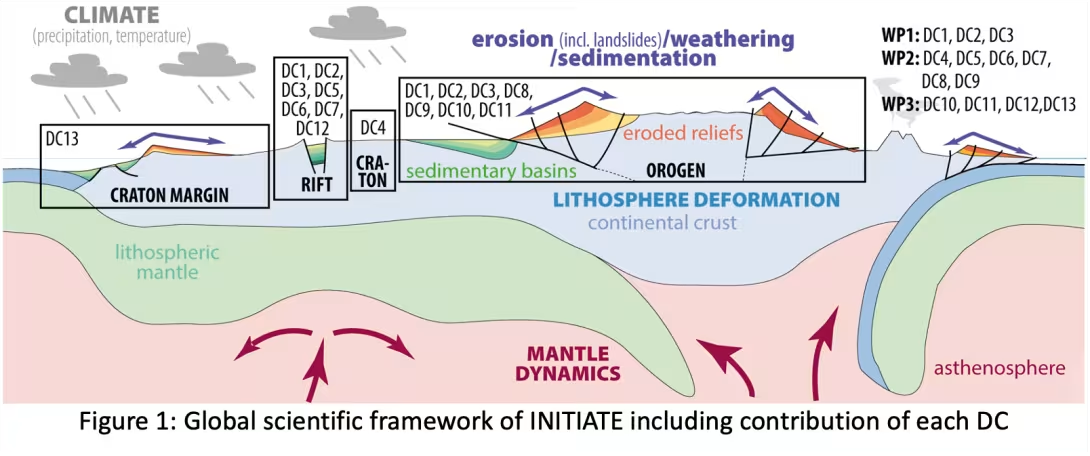
Earth topography and its subsurface are the result of complex interactions between tectonics and climate. Sediments in the shallow subsurface contain vital resources including water and energy that are crucial for mankind. They also provide temporary and long-term waste and energy storage. At the same time active deformation and rapid climate change interact posing significant risk for natural hazards such as debris flow, hillslope instabilities, and active faulting. To address these pressing challenges and seize the opportunities in the realm of Earth-climate interactions, it is imperative that we enhance our expertise in connecting extensive datasets with deterministic forward models.
About the research project
Objectives
INITIATE brings together 5 beneficiaries, 11 academic partners with complementary expertise, 12 non-academic partners, 11 media contacts and 13 doctoral researchers. Unravelling continental rifting requires substantial research efforts – so does the development of innovative solutions for the transition to green energies (geothermal and hydrogen), the subsurface storage of CO2, and the security of groundwater reservoirs. INITIATE will provide the basis to simultaneously develop both fields, with a perspective beyond the four-year duration of a network.
The main research and training objectives of INITIATE are:
1) Significantly advance our understanding of what triggers rift initiation, how continents break, and how rift structure and evolution link to rift-related societal benefits and challenges, through close coordination of the 13 research projects.
2) Train 13 Doctoral Candidates (DCs) in complex Earth Science systems, by offering an interdisciplinary and intersectoral career development programme. Our training will encompass: (a) Scientific training within a research project that will involve academia and industry and that will lead to a Ph.D. degree, (b) training by education in key scientific and business skills through short courses (e.g., interpretation of geophysical data, sustainable energy opportunities, geodynamic modelling, proposal writing, entrepreneurship), field courses, and E-seminars, which will enable doctoral researchers to implement changes in sustainability concepts, policies, and industry procedures. (c) participation in network workshops, and national and international conferences, (d) contributing to the organisation of network activities to develop organisational skills, and (e) training in societal engagement to communicate and discuss the research process, and its successes and challenges, to the general public.
3) Build a strong collaborative network between DCs, beneficiaries, partners and media contacts to ensure results, knowledge and skills are shared between academia, industry, and society, through workshops, publications and media outreach, and DC outreach and communication activities. Our research results, articles and data will be made available open access and, when possible, open source.
People
Project manager
Ritske Huismans Leader